• Skip to primary navigation
  • Skip to main content
  • Skip to footer

Bankwatch

  • About us
    • Our vision
    • Who we are
    • 30 years of Bankwatch
    • Donors & finances
    • Get involved
  • What we do
    • Campaign areas
      • Beyond fossil fuels
      • Rights, democracy and development
      • Finance and biodiversity
      • Funding the energy transformation
      • Cities for People
    • Institutions we monitor
      • European Bank for Reconstruction and Development
      • European Investment Bank
      • Asian Infrastructure Investment Bank
      • Asian Development Bank (ADB)
      • EU funds
    • Our projects
    • Success stories
  • Publications
  • News
    • Blog posts
    • Press releases
    • Stories
    • Podcast
    • Us in the media
    • Videos
  • Donate

Home > Archives for Blog entry

Blog entry

European banks: it’s time to quit coal in Ukraine


European commercial banks (such as Deutsche Bank, UniCredit Bank, ING Bank, Raiffeisen Zentral Bank, Erste Group Bank, RBS and Barclays) are major investors in the coal industry in Ukraine, most notably in the integrated coal and energy company DTEK (see its entry on coalbanks.org).

DTEK established itself as the strongest player in the energy sector of Ukrainein 2012 after a series of privatisations of state-owned utilities. It even obtained a monopoly on electricity exports. In 2013, DTEK controlled 46.1 per cent of coal production in Ukraine and 37.8 per cent of the distribution and sales of electricity. The company’s growth was also supported by European commercial banks which between 2005 and 2013 have invested more than 1.5 billion euros in DTEK, mostly in coal mines and thermal power plants.

A strategic approach to Ukraine’s energy policy is more urgent than ever before. Focusing on renewable energy sources and energy efficiency measures is the only way to increase the country’s independence from Russian fuel imports.

DTEK’s main assets are privatised mines and coal-fired power plants, all built in the Soviet era, when environmental concerns were not considered to be of significance.

Between 2010 and 2013, DTEK strategically increased its coal production and power generation. Among others DTEK acquired two coal-fired power plants in western Ukraine (Burstyn and Dobrotvir) and significantly increased their output and electricity exports to Ukraine’s neighbours in Hungary, Slovakia, Romania and Poland. In 2012, the company’s CEO Maksim Timchenko announced the construction of new coal-fired units and transmission lines in western Ukraine as part of a plan to ‘export coal through electric wires’.

Pollution financed by EU banks

Yet the cheap electricity from Burstyn and Dobrotvir that EU businesses and households enjoy result in increased greenhouse gas emissions and toxic air pollution in Ukraine.

Report


Why Ukraine must address inefficiency and pollution at its ageing coal-fired power plants

Download

Emission levels per kWh of electricity produced in Ukraine are much higher due to the low efficiency of plants and the inadequate equipment for pollution control. None of the coal-fired power plants have any pollution control for sulphur (SOx) or nitrogen oxide (NOx) and dust emissions are up to 45 times above the exceed limits of EU regulations. Basically, none of these plants would be allowed to operate in any EU country because of their emissions, or they would have a strict deadline for closure, like the Varna power plant in Bulgaria which was closed down on 1 January 2015 due to incompliance with EU environmental regulations.

Nonetheless, European commercial banks finance the export of coal-based electricity from Ukraine to the EU. In 2013 Deutsche Bank (together with Raiffeisen Bank, Erste Group, Uni Credit Austria and the Russian Gazprombank) granted a structured pre-export financing loan for DTEK, providing funds for export-oriented activities.

This stands in stark contrast to the often generous commitments to sustainability by these banks.

The times they are a changin’

The state of play around fossil fuels is rapidly changing. Public institutions such as international development banks and national export credit agencies are revising their energy strategies and some are already phasing out support for coal. Public multilateral development banks like the World Bank, the European Investment Bank and (to some extent) the European Bank for Reconstruction and Development have introduced energy lending policies that heavily restrict or rule out financing for new coal power plants.

On the other hand, Ukraine faces unprecedented threats associated with its dependence on imported fossil fuels. In addition to gas, Ukraine is now forced to import anthracite coal from Russia because it has lost a large part of its coal supplies that were mined in the now militarised Donbas region.

A strategic approach to Ukraine’s energy policy is more urgent than ever before. Focusing on renewable energy sources and energy efficiency measures is the only way to increase the country’s independence from Russian fuel imports.

Public and commercial investors must realise that real commitment to sustainability means financial support for innovation, energy efficiency measures and the transition to renewable energy sources. This is what is most needed in Ukraine and it is what concerned citizens in Kiev demonstrate today during a street action for the Global Divestment Day.

Guest post: Pljevlja shareholder A2A must resist pressure to build new lignite unit in Montenegro


A group of 16 leading NGOs from the Balkans and Italy dealing with energy and its impact on the environment yesterday sent a letter to Italian company A2A, a major shareholder in Montenegro’s electricity company EPCG, concerning ongoing negotiations about the construction of a second unit at the Pljevlja lignite-fired power station.

In spite of fierce pressure from the Montenegrin government, A2A has been reported by Montenegrin media to be sceptical about the construction of a new unit at Pljevlja due to concerns about the project’s economics, and our letter aims to encourage the company to stay firm in its position.

We believe that construction of a new unit would be harmful for the people and economy of Montenegro, as well as for its environment.

Read also


All we want for Christmas is to be able to breathe …
Blog post | December 23, 2014

Pljevlja II lignite power plant, Montenegro
Project background

The energy sector in Montenegro
Country profile

As an EU candidate country, Montenegro needs to bring its legislation and policies into line with those of the EU, including climate and decarbonisation policies, increasing the share of renewable energy and improving air quality, all of which would be made more difficult by building a new lignite-fired power unit.

The project would further burden the over-indebted public budget, as it is expected that the Montenegrin government would have to provide a state guarantee for the loan that would finance the majority of the project.

The economic feasibility analysis of the project and estimated electricity price from the unit presented by the government are not convincing and the government has never publicly proved this unit is needed to satisfy demand – except by inflating Montenegro’s future demand growth figures. Nor have alternatives ever been seriously discussed.

The air quality in Pljevlja is so poor that local people held a protest on 22 December 2014 to demand the implementation of the relevant laws and policies. However EPCG and the Montenegrin government have so far made no commitments to rehabilitate the existing power plant and bring it into line with the EU Industrial Emissions Directive and other environmental legislation, or to replace it with non-lignite generation capacity. The Montenegrin parliament has several times discussed the fact that the original plans for the existing plant stipulated the inclusion of an appropriate heating solution in Pljevlja, which would have reduced pollution from residential sources, however this has never been implemented, and we do not see any progress on this issue.

Online toolkit for coal campaigners in Turkey and the Balkans

A multilingual website that explains how to contact the investors behind a project, which policies guide their decisions and how best to influence them.

KINGSOFCOAL.ORG

The Energy Community has estimated that the rehabilitation of the existing unit at Pljevlja would cost around EUR 50.9 million, while a new unit would cost between EUR 277 and 356.7 million, not including the expansion of the mine, new ash dump or heating for Pljevlja. Nor does this cost include CO2 costs, or rehabilitation and recultivation of the existing ash dump and mine sites.

We therefore doubt that Montenegro can afford both rehabilitation of the existing unit and the construction of a new one and believe that rehabilitation of the existing unit, as well as rehabilitation and recultivation of the damaged areas should be an urgent priority. Therefore we call on A2A to take this into account as it considers its future engagement in Montenegro.

Natural gas left, right and centre at Energy Union conference in Riga


In his speech in the opening panel of the Energy Union conference in Riga on February 6, EU Commissioner for Climate Action and Energy, Mr Miguel Arias Cañete, summarised his priorities for the Energy Union. Evoking a competitiveness – security – sustainability triangle, he said the aim is to “craft an energy policy that will deliver a 40% CO2 reduction by 2030, but does so in a manner that becomes a motor for both competitiveness and energy security”.

Laying out how this could be achieved, his priorities include some positive aspects with regards to sustainability, in particular concerning energy efficiency and grid access for locally produced electricity, i.e. prosumers. Overall, however, I cannot help thinking that they will too easily be overshadowed by a focus on natural gas. In his speech Cañete mentioned among others an EU LNG Strategy, a Mediterranean Gas Hub, strategic alliance with key gas transit country Turkey, the European Projects of Common Interest (PCIs) (that include a large amount of gas infrastructure).

Moreover, Cañete implied that the massive Southern Gas Corridor, a chain of projects meant to bring natural gas to Europe from the Shah Deniz offshore gas field in Azerbaijan, is a done deal – he mentioned in passing that it will be delivering ten billion cubic metres of gas by the end of the decade. There can certainly be no doubt about the political backing that the project enjoys, but to be clear, the Corridor is facing numerous challenges and is far from shovel-ready in its entirety. The Trans-Adriatic Pipeline from Greece to Italy for example is (among others) still facing strong opposition (pdf, pg. 21) from regional and local administrative bodies.

Read more


Pipe Dreams: Why the Southern Gas Corridor will not reduce EU dependency on Russia (pdf)
Study | January 21, 2015

European Investment Bank confirms plans to finance Trans-Adriatic Pipeline
Blog post | February 4, 2015

In its recent study Pipe Dreams – why public subsidies for Lukoil in Azerbaijan will not reduce EU dependency on Russia, Bankwatch raised a number of other issues with the Southern Gas Corridor, most fundamentally the fact that the EU’s own projections suggest that the additional gas imports are not necessary. The project would also turn Azerbaijan into the new gas supplier for Europe, thus strengthening Aliyev’s authoritarian regime.

Still, the role of natural gas in achieving the EU’s Energy Roadmap 2050 seemed to be shared by a majority of participants at the conference in Riga. How reasonable it is to invest in gas infrastructure that will be ready in 10-15 years while the share of renewables should be two thirds by 2050 is still left without answer.

Bankwatch stops cutting of another 22 hectares of forest for coal mining in Romania

In a file launched by Bankwatch in 2014, a Romanian court annulled [ro] 27 deforestation permits last week, preventing 22 hectares of forest in the country’s south-west to be cut for the expansion of an open-pit coal mine.

All 27 decisions were issued in 2012 by a regional forestry agency for the Oltenia Energy Complex to extend lignite mining operations in Rosia quarry (located near Rovinari, Gorj County). This court decision comes six months after the Bucharest Court stopped the clearing of another 59 hectares of forest by cancelling the environmental permit for deforestation in the Tismana quarry area (also located near Rovinari).

Coal in the Balkans

Find out more

The Forest Code stipulates that the regional forestry agency can issue deforestation permits in the case of small areas, under one hectare, while a Government Decision is required for perimeters larger than 10 hectares. The Oltenia Energy Complex uses a practice of slicing the total area it needs to destroy into fragments of up to one hectare, enough for a few weeks of mining operations. Thus it avoids going through a procedure to identify the social and environmental impact of mining expansions and the measures to reduce it.

With this handy legislative loophole, the Oltenia Energy Complex can ask the forestry agency to issue deforestation permits for tiny areas compared to the scale of the work that it does. The 22 hectares of forest that have now been saved represent the approximate area of 44 football fields.

Bankwatch Romania initiated the court case in February 2014. Eight similar law suits are pending, concerning forests around nine lignite open pits. We estimate that the Oltenia Energy Complex obtained at least 49 deforestation decisions for at least 200 hectares near the Rosia quarry, in 2014 alone. As defendants, the forestry agency and the Oltenia Complex can appeal the court decision within fifteen days of its notification. So far, the court’s decision was not formally transmitted to the parties.

The attorney who represented Bankwatch Romania in court commented:

“The court’s decision in this case is not surprising. It comes after the European Commission initiated an infringement procedure in this case last month [ro] and after an illegally issued environmental permit for cutting of over 59 hectares of forest was cancelled in the first instance last summer [ro]. We believe that the Oltenia Energy Complex must begin to implement environmental legislation that is currently in force for lignite extraction and it has to understand that mining expansions must be done according to the principle of sustainable development.”

In the last 25 years, in addition to forests, expanding lignite pits wiped out at least three villages and many others suffer from the proximity to the pits. Mihai Stoica, a freelance photo journalist, traveled to the affected areas and made a video about the impact of the lignite quarries. The documentary “When mines expand…” captures people’s problems in three villages bordering lignite pits that are affected by their expansion.

New arrests should dampen Serbia’s appetite for coal


On January 27, Vladan Milošević, the general director of the public company Resavica which operates nine underground coal mines in Serbia has been arrested on the charge of corruption [sr]. In a statement, Serbia’s Minister of Internal Affairs said that Milošević was caught with a bribe of 14 000 euros of marked money. (The handover has been filmed by the police.)

The case adds to the impression that the dependence on coal creates a stack of vulnerabilities for Serbia’s energy sector, in particular in the aftermath of last year’s floods which turned Serbia’s largest coal pit at the EBRD-financed Kolubara mine into a lake and forced the country to start importing lignite.

Almost half of the planned new power capacity in the Western Balkans comes from coal.

Coal in the Balkans

Find out more

With 70 per cent of electricity coming from coal and alternatives developing by far too slowly, keeping Serbia’s coal power plants running is of such urgency that it opens the door for all kinds of negligence or even manipulation. Apart from the corruption case of Vladan Milošević or the choice of China’s CMEC as a contractor for the Kostolac power plant without any tender, irregularities have recently popped up also around the coal imports of Serbian state electricity company EPS.

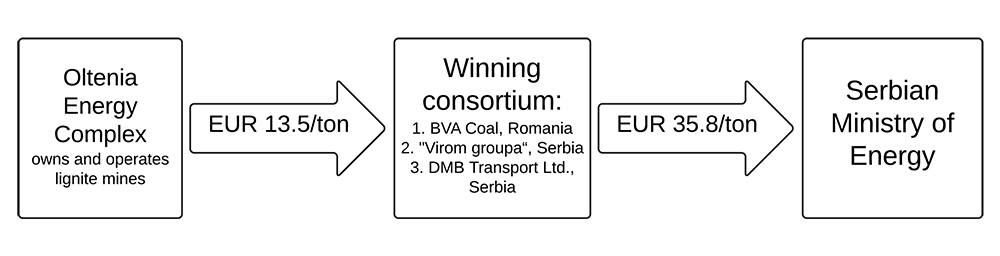
In November 2014 kurir.rs reported that a tender for the import of two million tons of coal from Romania was won by a consortium of three Serbian and Romanian firms. A look at the consortium members must raise eyebrows:

  • One of the two Serbian firms is „Virom groupa“ whose owner Dejan Oketić was convicted in 2008 as a member of the so called “oil mafia”.
  • According to the Romanian Trade Registry, the Romanian consortium member (Coal BVA) was registered on October 24, 2014, less than a month before the contract was signed (November 19). Coal BVA is registered in an apartment in Constanta, with a 20 shares capital worth 45 euros. The two only shareholders also own BVA Structure Trading, a company operating industrial waste and registered at the same address.
  • The names of both of Coal BVA’s shareholders have been associated with organised crime and bribes. One of them used to be the administrator of the company Steel Shining SRL, bought in 2007 from one of Romania’s most feared serial criminals [ro] (sentenced to life imprisonment in 2011 [ro]). The other one is being investigated for bribery in a case against the traffic police.
  • One of the sub-contractors is Dragan Ćurčić, a member of the so called “custom mafia” who served his time in prison and was released only recently.

Also suspicious is that the winning tender offered a price of 35.8 euros per ton which includes transport costs of 14 euros/ton. The remaining 24.5 euros/ton are still nearly twice as high as the 13.5 euros per ton from a recent contract with the Romanian state-owned Oltenia Energy Complex for importing 1.2 million tons of coal within the next six months.

Gearing up for more coal investments

And still, despite the costs of importing coal, Serbia keeps putting all its eggs in one huge basket – or rather coal cellar. Rather than trying to develop alternative electricity sources, it is gearing up for more coal investments, among others at least at two of the mines under the control of Resavica (Štavalj and Soko), the company of the arrested Vladan Milošević.


Running, financed and planned coal mine projects in Serbia. See an interactive map here.

In a letter from September last year, Milošević urged Serbian Vice Prime Minister Zorana Mihajlović to quickly open the tender for one of the project’s components, the Štavalj powerplant.

In December 2014 then, on the margins of the China-Balkan summit in Belgrade Serbia’s Minister of Energy and Mining Aleksandar Antić, after meeting the Czech Minister for Industry and Trade Jan Mládek, announced that an official decision to begin the Štavalj coal project should be adopted in the first half of March 2015. The approximately 800 million euro project – planned in cooperation with the Czech Republic – includes the construction of a new power plant around Sjenica and the development of the existing Štavalj mine to increase production from 50 000 to 2 million tons of coal per year.

Toolkit for coal campaigners in Turkey and the Balkans

KINGSOFCOAL.ORG

The two also discussed the modernisation of another Resavica venture, the Soko underground coal mine for which the Serbian budget foresees a 10 million euros investment this year and another 20 million euros projected for the next two years.

In the mentioned letter to the government, Vladan Milošević also pointed out that investors were interested in other coal projects as well, among them:

  • The Russian embassy is interested in a 45 million euros investment in the coal project Poljana.
  • The Russian controlled Serbian Oil Industry (NIS – Naftna industrija Srbije) is initiating investments to the new Kovin thermo power plant.
  • China is interested in the new TPP Despotovac and in opening new mines in the Despotovac region.

Risky business

Coal is not only there to stay in Serbia, but the push for more investments may well crowd out a renewable sector that is struggling to get its feet on the ground despite the promising potential of both wind and solar.

International financiers of these investments, among them the European Bank for Reconstruction and Development, the Chinese Export-Import Bank, and the German KfW should think twice about putting their money into Serbia’s obsession with coal.

European Investment Bank confirms plans to finance Trans-Adriatic Pipeline

On February 2, during the annual meeting between civil society and the European Investment Bank’s (EIB) Board of Directors, the EIB revealed that the Trans-Adriatic Pipeline (TAP) was among its priority projects for 2015 in the Balkans.[*]

The Trans-Adriatic Pipeline, planned to stretch from Greece via Albania and the Adriatic Sea to Italy, is part of the Southern Gas Corridor, a chain of projects meant to bring natural gas to Europe from the Shah Deniz offshore gas field in Azerbaijan.

The statement comes at a time when public criticism of the Southern Gas Corridor and its individual investment projects is increasingly showing the plans’ flaws. These range from creating an unnecessary and expensive surplus of gas import infrastructure, to propping up an undemocratic regime, to the irony of financing the Russian company Lukoil in order to reduce dependence on Russian gas. The Trans Adriatic Pipeline (TAP) itself is also facing heavy opposition in Italy.

In addition to the EIB’s support, the Southern Gas Corridor is set to be backed with public money via the Connecting Europe Facility, the Project Bonds Initiative, and indirectly via a loan by the European Bank for Reconstruction and Development (EBRD) to Lukoil for the second phase of developments at Shah Deniz, a loan set to be approved in early 2015. It is one of the most important projects on the EU list of Projects of Common Interest which are to receive political and financial backing in the following period.

–

* Other discussion points on the meeting’s agenda were the EIB’s climate and transparency policies.

« Previous Page
Next Page »

Footer

CEE Bankwatch Network gratefully acknowledges EU funding support.

The content of this website is the sole responsibility of CEE Bankwatch Network and can under no circumstances be regarded as reflecting the position of the European Union.

Unless otherwise noted, the content on this website is licensed under a Creative Commons BY-SA 4.0 License

Your personal data collected on the website is governed by the present Privacy Policy.

Get in touch with us

  • Bluesky
  • Email
  • Facebook
  • Instagram
  • LinkedIn
  • RSS
  • YouTube