• Skip to primary navigation
  • Skip to main content
  • Skip to footer

Bankwatch

  • About us
    • Our vision
    • Who we are
    • 30 years of Bankwatch
    • Donors & finances
    • Get involved
  • What we do
    • Campaign areas
      • Beyond fossil fuels
      • Rights, democracy and development
      • Finance and biodiversity
      • Funding the energy transformation
      • Cities for People
    • Institutions we monitor
      • European Bank for Reconstruction and Development
      • European Investment Bank
      • Asian Infrastructure Investment Bank
      • Asian Development Bank (ADB)
      • EU funds
    • Our projects
    • Success stories
  • Publications
  • News
    • Blog posts
    • Press releases
    • Stories
    • Podcast
    • Us in the media
    • Videos
  • Donate

Home > Archives for Blog entry

Blog entry

Is Egypt just stuck in transition or heading away from democracy? Considerations for the EBRD


Just before a constitutional referendum next week the situation in Egypt continues to be far from promising. A new analysis by the European Council on Foreign Relations assesses the prospects for the coming months and draws depressing conclusions:

“Egypt is not moving towards meaningful democracy or stability. Instead, the country remains under the control of an army leadership that has overseen a harsh crackdown on the Muslim Brotherhood and now appears to be trying to exclude them permanently from the country’s political life.

“A new controversial constitution has been drafted and will be put to a referendum next week. Parliamentary and presidential elections are scheduled to follow later this year – but the repression of alternative voices will not result in a political solution that can overcome the country’s deep political and societal divisions.

“While there are uncertainties about the path that Egypt will follow it is clear that the country’s powerful security forces will have decisive influence over the future of Egypt. Against a background of popular intolerance and public media that strongly back the state, there is little prospect of the clampdown being lifted in the short term.”

(More details on the desperate human and civil rights situation in Egypt can be found in earlier blog posts from December, November and June last year.)

Read also


Litmus test for EBRD rhetoric on democracy with Egyptian oil project
Blog post | December 19, 2013

How embarrassing: EBRD transparency ranked ‘poorest’ among multilaterals
Blog post | October 29, 2013

Advancing Egypt’s status at the EBRD?

This is the background for the EBRD’s decision (planned for the second half of 2014) whether or not to make Egypt a full country of operations. To prove that this decision is more than a formality the EBRD should come up with concrete, clear and publicly available criteria that define the conditions under which Egypt will and especially those under which it will not be given that status.

Unfortunately, statements from the EBRD so far rather suggest that the EBRD will not probe Egypt’s political situation too thoroughly. In response to a Bankwatch enquiry (pdf) following human rights violations in December, the EBRD affirmed its support for democracy in Egypt in principle. At the same time, the bank shies away from drawing concrete consequences should democracy fail:

„When we have significant concerns about conformity with these principles [of multiparty democracy and pluralism], we say so in our public political assessments as well as in private dialogue with the authorities in our countries of operations. However, it has always been the EBRD’s shareholders view that the Bank has to remain engaged, even in the most difficult environments to the extent it can to foster market-oriented transition. We believe that promoting the development of a dynamic private sector is the best way to enhance the sustainability of the transition process, which we recognise proceeds at different paces in different countries“. (Source: EBRD (pdf))

So the EBRD promises to voice its concerns, but it will go at great lengths to continue its lending, based on a flimsy hope that it could foster transition. The problem is that over the past six months, Egypt has moved away from democratic transition. Yet, in the middle of persistent human rights violations the EBRD did not even postpone the vote on its last loan in Egypt.

Under the current circumstances, continued lending in Egypt and advancing Egypt’s status to a full country of operations, violates Article 1 of the EBRD’s mandate.

Moving away from democracy or just ‘stuck in transition’?

Interestingly, the EBRD’s own Transition Report 2013 (pdf) – with the very telling title „Stuck in Transition?“ – draws a very different conclusion about the prospects for reform in Egypt:

“Economic policy-making and the undertaking of politically sensitive reforms have been undermined by domestic turmoil, lack of political consensus and the high turnover of governments.” (Source: EBRD)

And more generally, the study underlines the strong connection between political stability and functioning democratic institutions on the one hand and the success of economic reforms on the other hand (page 4, emphasis added):

“The evidence suggests that countries can promote and accelerate the return of reform, particularly if international integration, domestic leadership and broader social movements work hand in hand.”

only to add:

„Progress in transition has been closely correlated with political systems: countries which are more democratic have come further, in terms of reform, than their less democratic counterparts.”

„Political polarisation makes the success of reforms less predictable and reformers and civil servants more hesitant.“

„[D]emocratisation is less likely in the context of high inequality“.

Lending to private companies developing their new gas and oil fields will not help bridging the gap between rich and poor in Egypt, limit the polarisation of the Egyptian society or improve the democratic functioning of Egypt’s political system. Privatisation in a despotic country that is plagued by corruption and cronyism will not further the democratic reform, and neither will it support a sustainable economic transition.

Under the current circumstances, continued lending in Egypt (especially to environmentally and social controversial projects) and advancing Egypt’s status to a full country of operations, violates Article 1 of the EBRD’s mandate (page 4 (pdf), emphasis added):

„In contributing to economic progress and reconstruction, the purpose of the Bank shall be to foster the transition towards open market-oriented economies and to promote private and entrepreneurial initiative in […] countries committed to and applying the principles of multiparty democracy, pluralism and market economics.“

The commitment to democratic principles is a precondition for EBRD activities in a given country. The onus is on the EBRD to prove the democratic commitment of Egypt’s authorities. Until then and as long as the current outlook of a security state prevails, a continuation of the EBRD’s business-as-usual would be counter-productive.

Litmus test for EBRD rhetoric on democracy with Egyptian oil project


The last six months has seen the most intense repression since the Egyptian revolution began in January 2011 – the country has witnessed a military takeover, cancellation of the existing parliament and upper house, and the killing of another 1,300 protesters, the vast majority by state forces. The last month has seen a further crackdown on liberal and leftist journalists, bloggers and civil rights activists. In the last month:

  • High-profile activist Alaa Abdel Fattah, a critic of both Mubarak and Morsi, was snatched from his home during a violent raid;
  • 63 civil rights activists were arrested during a peaceful rally against military trials. 22 of them, all women were sexually harassed before being dumped in the desert outside Cairo;
  • A school boy was detained for 15 days for carrying a ruler with a pro-Morsi symbol.

What we are witnessing is not a transition to democracy. It is a transition away from democracy.

Read also


EBRD soldiering on in Egypt
Blog post | November 25, 2013

How embarrassing: EBRD transparency ranked ‘poorest’ among multilaterals
Blog post | October 29, 2013

The constitution that is being redrafted allows for military trials for civilians, a heavily abused practice in Egypt. A new anti-protest law was decreed by the military-installed President, severely restricting all demonstrations and any meetings of more than 10 people.

Indiscriminate killings by those in power have also been commonplace since July, with the following massacres witnessed:

  • July 8 – Republican Guard Club Headquarters – Nasr City
    Killed: 61 protesters – 2 members of security forces
  • July 27 – Nasr Street – Nasr City
    Killed: 95 protesters – 1 policeman
  • August 14 – Rabaa Square & Nahda Square
    Killed: Up to 1,000 people
  • August 16 – Ramsis Square
    Killed: 120 people
  • October 6 – Marches around Cairo
    Killed: 57 people

The Muslim Brotherhood and its allies were not peaceful, and its members used violence in recent protests. However, in all of these cases, the security forces dominated the situation and used excessive force. On August 14, there was a failure by senior-level officials to ensure safe exit for unarmed protesters, the injured, and children.

The government and the military

The recent killings, arrests and repression show that the military and the Ministry of Interior are reasserting their power. The current government has actively created a context of impunity. Ministers have either actively whipped up hatred targeting anyone opposing the military, as well as Palestinian and Syrian refugees, or failed to distance themselves from these statements or to acknowledge any wrongdoing by security forces.

The Ministry of Interior is widely seen as “getting so comfortable that not only can it not be bothered to cover up its undemocratic actions, but is proudly flexing its oppressive muscles to let everyone know that it’s back, and stronger than ever” (Heba Afify on Mada Masr).

While it is possible that there will be “multiparty elections” in the coming year, Egypt also witnessed repeated “multiparty elections” during Mubarak’s reign. However, few would claim that these applied the principles of multiparty democracy. It is not democracy when you first massacre your opponents, and then imprison those who remain alive.

The EBRD’s dilemma

This presents a particular challenge to the EBRD. According to the EBRD’s Establishing Agreement, the bank “promotes initiatives in countries committed to and applying the principles of multiparty democracy, pluralism and market economics”.

The EBRD claims that “supporting reforms that strengthen democracy is an important aspect of the EBRD’s mandate.” Many EBRD staff and Executive Directors at the EBRD AGM in Istanbul held major doubts about Egypt’s compliance with Article I, back in May 2013 before the military took power.

But they assured us that the Parliamentary and Presidential elections had been democratic, that the constitution had been passed with no repression of opponents and that therefore Egypt was on the road towards democracy. It was these institutions – that the EBRD itself held up as legitimate – which have since been removed by the military.

While Article I is seen as elastic, it surely cannot stretch as far as coups and massacres if it is to maintain any credibility.

It’s also worth remembering that large centralised loans to oil extraction projects have limited positive impact on the wider population, but can buttress and strengthen repressive regimes. A loan to an oil company has a different political impact than SME lending.

By the EBRD approving an oil project at this stage, it is sending a clear message:

  • We trust the Egyptian military’s use of power in Egypt.
  • We are comfortable with a crackdown on journalists, students and civil rights activists.
  • We believe that a constitution that allows for civilians to face military trials is part of a “transition to democracy”.
  • We are comfortable investing in a country with no elected President, Parliament or Upper House.

What we are witnessing is not a transition to democracy. It is a transition away from democracy.

Sounding out the EBRD’s energy strategy: little ambition besides scrapping coal


On Tuesday this week, the European Bank for Reconstruction and Development (EBRD) approved a new energy strategy (pdf) that will guide its energy sector investments for the next five years. The biggest news – and a big achievement for civil society – was the bank’s decision to turn away from coal.

I’ve taken the time to analyse the strategy in more detail. While the restrictions placed on coal lending are doubtlessly a great and appreciated step forward for the bank, the rest is a rather disappointing document. I’ll explain why below after offering a short review of what the “no coal” provisions exactly entail.

Less coal

The most important change that the EBRD’s new energy strategy brings is its shift away from coal. As the strategy document says, the bank will not finance any new (greenfield) coal-fired power plants “except in rare circumstances, where there are no economically feasible alternative energy sources.”

What a turnaround from the bank whose energy director said that opposition to coal was ‘ideological’ a few months ago.

This is a welcome improvement compared to the draft strategy, in which “[t]he Bank anticipate[d] that it will provide its financial support for greenfield coal power generation only on limited occasions.” The final wording is stricter. It also doesn’t ‘anticipate’, but simply says ‘no’.

Compared with the European Investment Bank’s (EIB) emissions performance standard for its energy investments of 550 g of CO2/ kWh, basically ruling out investments in any coal power plant, the EBRD’s coal policy is less ambitious. Instead, the EBRD uses three criteria to decide whether to support a coal project. (Positively, these criteria apply to investments at both new and existing coal power plants.)

  • it has to be the least carbon-intensive of realistically available options
  • it has to use best available techniques
  • it has to comply with EU requirements in relation to carbon capture and storage readiness

The most important criterion is obviously the first one, and the bank will look into energy efficiency, energy imports, renewable energy and other fossil fuel options as alternatives to the coal project proposed. In addition, the project’s host country will need to have in place a policy framework aimed at reducing greenhouse gas emissions.

The efficacy of this criterion remains to be tested. Given the reservations towards renewable energy in the EBRD’s countries of operation I wouldn’t be surprised if the analysis of realistically available options reaches the conclusion that the policy and investment environment makes it unlikely to have investors in new power capacity other than lignite- or gas-based.

In addition, the bank will use a shadow price for carbon and other emissions to assess whether investments are economically viable. The level of the shadow price remains to be set in 2014, but it is unlikely to be on a level below that used by the EIB. Hopefully, the inclusion of ‘other emissions’ means that the health impact of particulate matter, sulphur dioxide, nitrogen oxides, mercury emissions etc. will also be taken into account.

Despite its limitations, the new strategy means no more cases like the Sostanj lignite power plant in Slovenia and it should mean no investment in the Kosova e Re lignite power plant. What a turnaround from the bank whose energy director said that opposition to coal was ‘ideological’ a few months ago.

The devil in the detail

The executive summary of the EBRD’s new energy strategy very much focuses on energy efficiency and evokes a vision centered around secure, affordable and sustainable energy along well-intentioned pillars. Yet, looking into the details in the “operational approach” (what the bank sets out to do) these pillars turn out to be mostly focusing on fossil fuels:

  • ‘Energy efficiency and demand side measures’
    • ‘Energy efficiency’ includes hydrocarbons extraction, processing, transportation, distribution and supply.

  • ‘Building deep and liquid energy markets’
    • The details on this pillar read mainly as investments in the oil and gas sector. If you bear with me, the following (long) quote illustrates this vividly:

    “Recognising the key role of the energy sector in producer countries the Bank will work to strengthen the whole hydrocarbon value chain and maximise the role of energy projects in building more robust economies. The Bank’s involvement can be an important opportunity to promote backward and forward linkages, for example through support for service providers to an oil and gas project, construction of refining or petrochemical plants, downstream processing and marketing activities or economic use of by-products of hydrocarbon activities such as coal waste. In particular support to oil and gas service companies can be a catalyst to introduce international standards in the sector. Although oil and gas upstream and downstream sectors are often considered as a well-funded business dominated by large international companies, transition is, however, contingent on whether natural resources and the associated revenues are developed and managed responsibly over time. The Bank will also support the introduction of transparent, fair and stable legislative and regulatory frameworks for the award and monitoring of subsoil licenses.”

  • ‘Rethinking energy systems’
    • One might think this pillar refers to investments that help transforming the energy sector towards easier integration of renewables, for instance by reshaping electricity grids to adjust to the variability of renewables and making sure that interconnections are used for peak power rather than gas-fired units. Instead, the operational approach includes enhanced oil recovery (pumping water or CO2 into wells to get more oil out of them) and other ‘best practices in the hydrocarbon sector’.

  • ‘Cleaner energy production and supply’
    • With ‘gas flaring reduction, clean and efficient oil refineries, cleaner transport fuels, gas power plants’ lined up next to ‘resource efficiency’, a more accurate title for this pillar would have been ‘less dirty energy production and supply’.

  • ‘Setting standards and best practice’
    • In the more general outline, this pillar is centred around energy efficiency and transition to low carbon economies. In the operational details, however, the ‘responsible exploration’ and production of oil and gas takes centre stage.

    (Apart from these five pillars, the strategy includes also ‘low-carbon transition’ and ‘the wider role of the energy sector in building stronger economies’.)

What a contrast to the executive summary. And surely nothing that I would expect as actions to bring about sustainable production and consumption of energy and a low carbon transition.

Potential new risks with unconventional oil and gas

The good news on coal is further offset by the fact that the bank opens up to unconventional oil and gas. This is a bad policy signal to a few countries in Europe (Poland, Ukraine, Romania) that seem to be hypnotised by shale gas promises. Portraying these very controversial energy sources as a viable option for EBRD funding (read: subsidies) will likely reduce investment incentives in energy efficiency and renewables.

Still, the bank indicates that the technical and regulatory conditions in Europe determine very limited engagement in this sector in the new energy strategy’s period (2014-2018).

–

Overall, the new EBRD energy strategy is a comprehensive document, but it is as if someone sprinkled oil and gas everywhere. It requires a clean-up. It is not enough to acknowledge that there is a climate-change problem (as the EBRD’s energy director Riccardo Puliti did in an interview with Bloomberg). Ending subsidies for the fossil fuels industry is among the most crucial “actions to be undertaken in order to solve it” (Puliti).

Get your EU funds house in order – Hungarian group takes climate and jobs appeal direct to government’s doorstep

With only a few weeks to go now until final crucial decisions are taken that will determine Hungary’s EU spending plans for the next seven years, Bankwatch’s Hungarian member group MTVSZ decided last week that it was about time the Hungarian government got its house in order when it comes to beneficial EU allocations for cutting domestic energy bills, stimulating the Hungarian economy and fighting climate change.

Outside the Ministry of Economy in Budapest, MTVSZ and Bankwatch, represented by the network’s Executive director Mark Fodor, expressed the importance of more public investments via the EU funds in environmental protection and energy efficiency, as both an insulated house and a non-insulated house were erected – a fast construction process indeed (see the YouTube clip from the action below), but one that aimed to promote the delivery of long-lasting benefits for Hungarians and our environment.

As with other central and eastern European governments, the Hungarian government’s planning documents for EU spending in the 2014-2020 period do give prominence – in principle at least – to the need for a transition to a low carbon economy and environmental protection, in line with EU priorities.

However, in the Hungarian spending plans, as elsewhere in our region, the aspirations on paper are not being matched by real ambition in the actual spending figures across the so-called EU ‘operational programmes’.

Draft documentation seen by MTVSZ, under Hungary’s ‘Environmental Protection and Energy Efficiency Operational Programme’ (KEHOP), suggests that less than 15 percent of the total EU funding available, approximately EUR 3.7 billion out of total EUR 24.3 billion EU development money for Hungary) is set to be mobilised – a figure that is nowhere near enough to meet the set objectives.

The groups underlined in a petition – handed over at the action to a Ministry of Development representative, and sent in parallel to other relevant ministries – that the current EU spending proposals simply do not go far enough for the government to fulfil pledges made in recent years to introduce affordable energy efficiency measures in Hungarian homes, nor to implement the necessary environmental measures that are indispensable for the protection of natural resources and human health.

As a result of its close monitoring of the ongoing Hungarian EU programming process, MTVSZ believes that at least an extra EUR 0.3-1.7 billion should be added to KEHOP for energy efficiency and environmental protection in order to meet these challenges and governmental priorities.

And these funds could be shifted, for example, from currently over-generous draft EU allocations for Hungary’s road infrastructure, the kind of investment money that could instead, we believe, be covered by road tolls.

Grasping the EU funds potential to ramp up energy efficiency in Hungarian homes is something the Orbán government cannot afford to pass up – the benefits are clear for the public both in terms of reduced bills and the increase in jobs that will come as the work is carried out. Hungary’s energy security and independence, equally, will be enhanced.

We set up our stall – and our houses – outside the Ministry of Economy, and it is now time for the necessary planning permission, in the shape of EU budget adjustments, to be granted.

The Hungarian government must now significantly increase the financial resources devoted to the Environmental Protection and Energy Efficiency Operational Programme, focusing on residential energy efficiency, energy awareness, conservation and support for awareness-raising programmes.

Ukrainian nuclear sector in defiance and in financial trouble

On November 28, the state nuclear regulator of Ukraine (SNRIU) allowed the continued operation of unit 1 of the South Ukrainian nuclear power plant (SUNPP-1) until December 2, 2023 – 10 years beyond its technically designed lifetime. The decision not only constitutes a breach of national regulation, but also disregards an unresolved case of non-compliance with the UN Espoo Convention. All this while Energoatom is in an increasingly tight financial situation.

Breach of national regulation

In December 2012 the nuclear regulator SNRIU had identified 43 obligatory measures required for prolonged operations. However, the latest periodic safety review report of the plant (from October 10) shows that [1]:

  • 38 out of 43 measures have not been completed and for 13 of these neither the status of implementation nor the expected implementation timing has been specified.
  • Most importantly, the number of allowed cycles of “planned cooldowns” at SUNPP-1 has already been exceeded (91 cooldowns vs 90 allowed). Each cooldown results in the wearing off of crucial reactor parts, increasing the risk of cracks in the core reactor, one of few irreplaceable parts.

During the SNRIU board meeting on November 28, Energoatom claimed to have finished all measures in the two months since October, but that the necessary paperwork is simply not yet finalised. Yet, verbal promises by the company cannot be the basis for SNRIU’s decision on the lifetime extension. Without being based on the results of the periodic safety review a positive decision is highly questionable.

Violation of UN rules

Even if all safety measures would be implemented, there is another unresolved problem. Consultations concerning the transboundary impacts of SUNPP-1, a requirement under the UN Espoo Convention, were still not held with Ukraine’s neighbouring countries. Consequently, during the SRNIU board meeting, a representative of the Espoo Implementation Committee pointed out that SRNIU’s decision could create problems for Ukraine.

It wouldn’t be the first time Ukraine’s nuclear sector is in violation of the Espoo convention. In March this year, the Espoo Implementation Committee ruled (pdf) that Ukraine’s decision to extend the licenses of units 1 and 2 at the nuclear power plant in Rivne violated the UN rules since it had been done without an environmental impact assessment and without informing neighbouring countries about the plans, as Espoo procedures would require.

Financial difficulties for Energoatom

A direct financial impact from these unresolved cases on Energoatom’s operations comes via a proposed EUR 300 million loan by EURATOM for the Ukrainian Nuclear Safety Upgrade Programme. The programme includes safety measures at several Ukrainian nuclear power plants, among them also those at the South Ukraine and Rivne power plants.

In a letter to Members of the European Parliament the EU Commissioners Stefan Fule (Enlargement and EU neighbourhood policy) and Guenther Oettinger (Energy) stated that the EURATOM loan will not be disbursed until Ukraine is in compliance with the Espoo and Aarhus conventions. Therefore, until the pending case on Rivne 1 and 2 will not be successfully resolved, the loan will not happen. (An agreement for a loan of the same size by the European Bank for Reconstruction and Development has been approved in March this year but not yet disbursed.)

Losing the EURATOM loan would be a hard blow for Energoatom and Ukraine’s nuclear ambitions generally. After 9 months of 2013 Energoatom had net losses of UAH 4.7 billion (EUR 0.42 billion), UAH 2 billion more than in 2012. Energoatom struggles to find sufficient financing for the Nuclear Safety Upgrade Programme: the needs for 2013 are UAH 3 billion while Energotom only made UAH 517 million from the electricity tariff.

Under such circumstances any financial support is crucial for Energoatom in order to finish the safety measures at SUNPP-1 and to start preparations for the still outstanding upgrades at other plants, starting with ZNPP-1 by the end of 2014.

Notes


1. These and more details can be found in a technical analysis (pdf) commissioned by NECU (National Ecological Centre of Ukraine) to assess whether the technical state of SUNPP-1 is sufficient for safe operations for ten additional years and whether the necessary safety upgrades have been fully implemented. A recent briefing (pdf) summarises the results of the analysis.

UPDATED: Six months and counting… EBRD silent on investigations into its own operations


Update (4.12.2013): In an email, staff of the EBRD’s Project Complaint Mechanism has informed us that internal discussions on the cases described here are ongoing in the EBRD. An indication for when the reports will be published could not be provided.

Today it’s exactly six months since I received a draft of the EBRD Project Complaint Mechanism’s (PCM) findings from its investigation into the Boskov Most hydropower plant in the Mavrovo National Park in Macedonia. Although the report had only to be acknowledged by the EBRD’s board before publication, it has so far been delayed countless times. Two more draft reports on PCM findings on hydropower plant projects were also completed around the same time: one for the 87 MW Paravani derivative hydropower plant in Georgia, approved by the EBRD in July 2011, and one for the 68 MW Ombla underground hydropower plant in Croatia, approved in November 2011.

These three hydro project cases are among the few to be concluded by the PCM in the four years of its existence, and the delay begs the question whether the EBRD takes seriously its commitment to transparency and accountability of its operations? This question is especially relevant as the PCM Rules of Procedure are under revision – an exercise that is hard to conduct without the ability to discuss actual outcomes from PCM investigations.

How sustainable are the EBRD’s hydropower projects?

Hydropower is the renewables favourite that attracts the greatest volume of investments from the EBRD’s Sustainable Energy Initiative outside of the European Union. The three Bankwatch complaints, however, expose the failure of the EBRD to ensure protection of endangered and endemic species, and the need to better balance carbon emission reduction and biodiversity protection objectives.

For example the Boskov Most investigation was the result of a complaint submitted by our organisation, Eko-Svest, in November 2011, when the EBRD approved a loan for the 70 MW Boskov Most hydropower plant, Macedonia. The dam is to be located on the Bistra mountain, the core reproduction area of the critically endangered Balkan lynx, and is one of several hydropower projects threatening the Park. We pointed out that the Bank failed to undertake adequate research before project approval and that it failed to recognise the site as a critical habitat.

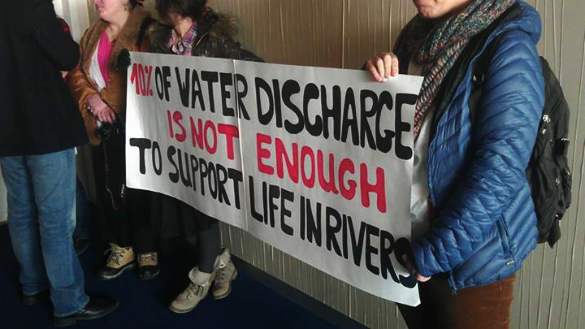
The Paravani hydropower plant includes a 14 km derivation tunnel to divert water from the Paravani river to the Mtkvari river upstream of the village of Khertvisi. Our colleagues in Georgia, Green Alternative, submitted a complaint in December 2011 pointing out that in some periods this would leave only 10 percent of water in the Paravani river – inadequate to ensure the survival of downstream flora and fauna – while at the same time, the project creates a significant risk of flooding Khertvisi and the associated transmission lines threaten migratory birds. The bank, it was alleged, had not undertaken sufficient measures to ensure sufficient water levels in the river, and other Georgian hydropower promoters had started to notice and claim that their projects complied with EBRD standards.

The 68 MW Ombla underground hydropower plant near Dubrovnik in Croatia was approved by the EBRD in 2011, on condition that an additional nature impact assessment was carried out. The plant was planned to be built in a future Natura 2000 area that had not been fully researched but was known to contain endemic species. Zelena akcija/Friends of the Earth Croatia submitted a complaint pointing out that the EBRD had failed to ensure adequate environmental assessment prior to project approval and that the project would damage critical habitat without due justification.

Luckily for our colleagues and undeground fauna in Croatia, the Ombla project did not survive long enough to see the outcome from the PCM investigation, but in Macedonia and Georgia, the outcomes of the investigation will have very real impacts. For Boskov Most we are still discussing with the bank the outcomes from biomonitoring that has taken place but come to rather bizarre conclusions, while in Georgia the bank has already thumbed its nose at critics by showing interest in financing the Adjaristsqali hydropower plant, whose environmental impacts are likely to be similar to Paravani, but worse (more to come in the following weeks from our colleagues in Georgia…).

If dealt with in a more timely manner, lessons from these three PCM cases would have served to inform the revision of the Energy Sector Strategy of the Bank that is to be concluded next week. In this process Bankwatch proposed sustainability criteria for hydropower, in order to ensure that the transition to low-carbon economies that the EBRD claims to promote through its investment does not clash with its sustainability mandate and its environmental and social policy.

Is the EBRD delivering on its accountability commitments?

As a multilateral financial institution EBRD is in many ways above the law. Although its clients’ operations are subject to national, EU and international law, the implementation of the bank’s own environmental and social safeguards can only be challenged through the independent reviews of the PCM. If there are barriers to making PCM findings public and thus enabling an open dialogue about the projects’ adherence to the bank’s highly regarded environmental and social standards, then there is a serious problem of accountability.

This is especially problematic as the PCM Rules of Procedure, the bank’s Environmental and Social Policy and Public Information Policy are being revised at the moment, and there is a threat of watering them down instead of strengthening them. So no wonder we are concerned. What exactly delays the disclosure of the PCM findings? In whose interest is it to make the PCM process slow and ineffective? Will the PCM be given the chance to perform its functions and ensure that the EBRD is accountable and can handle independent assessment on how well it complies withs its policies?

It is high time for the Boskov Most, Paravani and Ombla reviews to be made public and for the EBRD to affirm its commitments to transparency and accountability.

« Previous Page
Next Page »

Footer

CEE Bankwatch Network gratefully acknowledges EU funding support.

The content of this website is the sole responsibility of CEE Bankwatch Network and can under no circumstances be regarded as reflecting the position of the European Union.

Unless otherwise noted, the content on this website is licensed under a Creative Commons BY-SA 4.0 License

Your personal data collected on the website is governed by the present Privacy Policy.

Get in touch with us

  • Bluesky
  • Email
  • Facebook
  • Instagram
  • LinkedIn
  • RSS
  • YouTube