• Skip to primary navigation
  • Skip to main content
  • Skip to footer

Bankwatch

  • About us
    • Our vision
    • Who we are
    • 30 years of Bankwatch
    • Donors & finances
    • Get involved
  • What we do
    • Campaign areas
      • Beyond fossil fuels
      • Rights, democracy and development
      • Finance and biodiversity
      • Funding the energy transformation
      • Cities for People
    • Institutions we monitor
      • European Bank for Reconstruction and Development
      • European Investment Bank
      • Asian Infrastructure Investment Bank
      • Asian Development Bank (ADB)
      • EU funds
    • Our projects
    • Success stories
  • Publications
  • News
    • Blog posts
    • Press releases
    • Stories
    • Podcast
    • Us in the media
    • Videos
  • Donate

Home > Archives for Blog entry

Blog entry

The EBRD should listen (better) to civil society in Arab Spring countries


One of the announcements during the EBRD’s annual meeting last week was its shareholders’ approval of a special one billion euro fund for investments in Arab Sping countries in the southern and eastern Mediterranean (SEMED) region. While this will only be an interim measure, the bank is pressing on with preparations for expanding its operations in the region.

As part of these preparations, the EBRD is currently inviting local civil society organisations to give their feedback on the bank’s plans for the SEMED region, that is on the draft concept notes for the countries involved – Egypt, Jordan, Morocco and Tunisia. Meetings are mostly being held this week, starting today with Amman, Jordan.

Since scepticism is growing (from different directions) towards the bank’s general approach to supporting democracy and inclusive development – which in short terms is economic liberalisation (something Bankwatch has been criticising in the past) – the EBRD seems to have the right idea when at least asking for opinions from the local civil society.

But one must question the seriousness of these consultations, considering how hastily they are being conducted. The EBRD writes:

    The purpose of these meetings is to solicit the feedback from local CSOs [civil society organisations] on a draft Concept Note that will serve as a basis for the preparation of Country Assessments and Operational Priorities documents. (Source: EBRD “have your say” webpage)

In case of Jordan, CSO representatives received the concept note (the basis of today’s discussion), on the afternoon of Friday, May 18, leaving factually one working day to prepare for the meeting, which itself lasted merely two hours.

The EBRD can’t possibly expect sufficiently informed inputs with such a schedule, thereby taking into account that its plans might bypass the needs and interests of the people in the region.

By pushing through the consultations at high speed, the EBRD will more quickly be able to start lending to the region, but this illustrates one of the fundamental shortcomings in how it measures success: showing lending volumes seems more important than for example counting the jobs that were created (or destroyed) as a result of the EBRD’s activities.

This is all the more worrying since the consultations also intend to help assessing the political situation in the Arab Spring countries. It is well known that it is far from stable, but the EBRD has already shown that it doesn’t always have a fine-tuned understanding of what’s happening on the ground.

I urge the EBRD to take these consultations more seriously, provide ample time for preparations and also revisit the suggestions for the consultation model (pdf) that have already been sent in the beginning of April by local NGOs.

The writings on the European Parliament’s wall: Make the EIB choose a brighter future


Europe’s political leaders are beginning to clutch at straws in the ongoing eurozone crisis. Facing an unreal choice between growth and austerity, a capital increase for the EIB has been put forward as an alternative to budget cuts and fiscal orthodoxy.

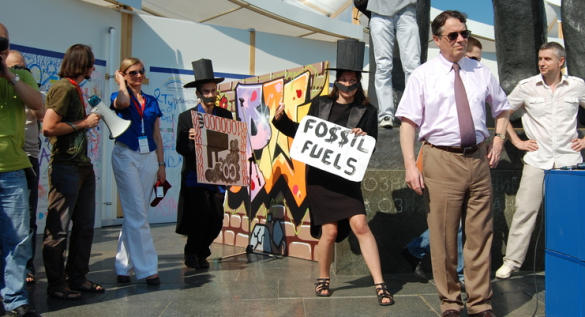
Since this suggestion is expected to be high on the agenda of the bank’s annual meeting today, Counter Balance and Bankwatch chose a public action to remind the EIB governors (mostly the Ministers of Finance of the member states) and other EU policy makers of the need to discuss first the quality of the EIB’s lending before increasing its quantity.

More concrete claims regarding the capital increase said that an additional EUR 10 billion for the EIB could trigger additional investments to the tune of EUR 180 billion – all for the sake of European economic growth.

Leaving aside the adventurous maths that was challenged also by the EIB’s president Werner Hoyer himself, the real question not only remains unanswered, but isn’t being asked resolutely enough: Is the EIB with its current performance actually able to lead the EU out of the current crisis and into an (economically, socially and environmentally) sustainable future?

Having monitored the bank for many years now, we have our doubts in Counter Balance and Bankwatch. Be it for example the EIB’s continued support for fossil fuel projects or it’s questionable lending through financial intermediaries, it’s a matter of quality, not quantity, to make the bank’s lending work for a sustainable Europe.

For more information, read the press release and a recent article in our quarterly newsletter Bankwatch Mail.

The medium-sized EIB bazooka – Europe’s people and environment must benefit this time around


(This post is an article from the upcoming Issue 52 of our quarterly newsletter Bankwatch Mail.

To receive Bankwatch Mail via email, subscribe to our mailing list here.


A EUR 10 billion capital boost for the EIB, that could see resulting investments of five times that sum, is the current clamour across Europe, though at the time of going to press little detail has emerged as to how to make this cash injection work in practice.

Big numbers and not enough details is something of an EIB hallmark. Josef Stalin, whose mantra was that “Quantity has a quality all of its own”, may well have been an admirer of the EU’s bank if he’d been around to witness its operations and reporting on such – thankfully quality versus quantity concerns related to the EIB’s investments and performance are beginning to register at the European parliament. But if EU finance ministers are intent on signing off on this capital increase for the EIB at the bank’s annual meeting in Brussels on May 15 (and perhaps Stalinist measures will be required to persuade austerity-philes such as the UK’s George Osborne to sign up to increased EIB capital), the ‘quality of EIB investment’ issue has to be addressed, rather urgently. The European Commission’s chief Jose Manuel Barroso may now be talking about ‘targeted investments’ via the EIB to ensure growth, but we have been here before.

Following the outbreak of the current crisis of capitalism in autumn 2008, the EIB was quickly given a ramped up investment role by EU decision-makers. An additional EUR 3.5 billion in both 2009 and 2010 for EIB investments to support European SMEs and “mid-cap” companies was mandated, with the lending to take place via on-lending from private banks. A “Clean transport facility”, aimed primarily at the European automotive industry, also included an extra EUR 6 billion worth of support in both 2009 and 2010 via the EIB. An extra EUR 2.5 billion in both 2009 and 2010 was also mandated via the EIB to benefit central and eastern European countries.

How this additional EIB crisis lending has worked out is open to question, although without it – its proponents argue rather tendentiously – things may be a lot worse than they are now. On vital SME lending provided by private banks via initial EIB funding, very little is known about how the EIB financing has benefitted the European economy generally. With next to no information on specific beneficiaries – and what they have done – available, the EIB nonetheless notes that 105,000 SMEs received its support in 2009 and another 115,000 in 2010. It also provided some EUR 13 billion of finance to 120,000 SMEs in 2011.

Bankwatch’s research (pdf) has shown meanwhile that EIB crisis loans to SMEs were more helpful to the commercial banks disbursing them than to the cash-strapped SMEs they were supposed to help. Bankwatch found that the EIB’s ‘global loans’, designed to benefit SMEs via lending from commercial banks, had a very poor penetration rate of 0.001 percent of all SMEs in the central and eastern European countries that were surveyed.

Any increased EIB investment potential, therefore, should not be directed willy-nilly at the SME sector given the problematic ‘intermediated finance’ model that the bank continues to insist on for this sector. The European private banking sector has just recently had a massive, temporary bailout known as LTRO (the long term refinancing operation), and it has had limited results despite its scale. EUR 489 billion flooded out of the European Central Bank in December 2011, yet bank lending to the real economy is still in negative territory.

These underlying issues have been acknowledged by a European Parliament report on the EIB’s own Annual Report for 2010. The rapporteur for this report, Bulgarian MEP Ilana Ivanova, told Bankwatch Mail: “We need clear performance indicators such as penetration rate but also target values for these indicators which could be used for assessment of the activities. I would like to stress that the SME support programs should be based upon explicit intervention logic and should be linked to expected results and impacts. It is clear that the final result could not be assessed when we do not have any explicit targets.”

As a further indication of how serious the gaps in the EIB’s support for SMEs are being viewed, Ivanova also revealed that: “The European Court of Auditors prepared a Special report on the SME guarantee facility which is managed by the EIB group. Within this report there have been identified weaknesses which are valid not only for this concrete program but for most of the Bank’s support programs for SMEs. I believe that we should continue our efforts and push the EIB to improve further on these points.”

In terms of the transparency of such investments, Ivanova was also clear: “A lot has been done by the EIB these last years for improving transparency in the intermediated loans for SMEs. However, in my view, there are still points to be improved in order to achieve better accountability to the European citizens.”

Accountability generally to European citizens, and awareness of environmental considerations, needs to be paramount if major infrastructure projects are to be part of any EIB sponsored growth package. A new ‘EIB rush’ may be upon us, but it is essential that new finance projects are based on needs assessments, especially in those countries and regions of Europe where the needs are greatest.

A thorough assessment of needs that considers not only climate and environmental limits but also the optimal options for satisfying these needs has to take place. Mere energy and transport growth should not be regarded as unlimited in the current scenario – needs should be assessed locally, country by country (with emphasis on the most needy countries) in order to identify the best way for the EIB to help fight the crisis and create jobs.

Following her study of all things EIB, Ilana Ivanova maintains: “I believe that in these times of austerity measures we need to reallocate and to concentrate money where its added value is the highest. In this regard the EIB should establish a clear link between inputs and outputs. We need clear objectives not only in terms of quantity but also in terms of quality in order to assess the efficiency and the effectiveness of the different programs. Therefore, I believe the bank needs to be lending better taking into account specific and measurable objectives.”

Read more

A factsheet on the EIB and the economic crisis is available at the Counter Balance website.

Chernobyl at 26: nuclear dynamite is growing in Ukraine


On today’s 26th anniversary of the most disastrous nuclear accident in history, Europe and the rest of the world will doubtlessly see numerous manifestations of peoples’ opposition to nuclear energy and the risks it entails.

The risks of nuclear energy are manifold: There’s the obvious danger of a meltdown that can never be ruled out and that was again tragically illustrated by the 2011 accident in Fukushima. Apart from this, though, there are also radioactive waste and the costs of the safe closure and decommissioning old power plants.

Interestingly, although energy producers and governments can to some extent prepare for the long-term risks and future costs, it is sometimes not happening, and it has not happened in my country, Ukraine.

Ukraine has not put aside sufficient money for closing down its soon to be outdated nuclear reactors. It is not even considering the closure and decommissioning of Ukraine’s Soviet-type reactors from the seventies, but plans to extend their lifetimes, stubbornly arguing that they are necessary to cover the country’s growing energy demand. Stubbornly, because this kind of argumentation ignores the potential and inhibits any serious efforts to decrease the economy’s enormous energy-intensity, which is two to three times higher than in EU countries.

Apparently, it’s for that kind of plan and not the safe closure of outdated nuclear plants, that money might just be available: Both Euratom and the European Bank for Reconstruction and Development are considering loans (of up to 500 and 300 million euros respectively) for Ukraine’s Nuclear power plant safety upgrade programme. (The decision on the Euratom loan is expected around June this year.)

As a report from March shows, however, part of the “safety upgrades” are in fact upgrades that are only necessary if the reactors run much longer than their designed lifetime. European institutions would therefore become complicit in a plan that puts Ukraine and Europe in considerable danger, namely:

  • increased risk of accidents,
  • the growing amount of nuclear waste and spent fuel,
  • enormous costs for decommissioning the plants which will likely burden Ukraine’s taxpayers in the future.

There are countries in Europe that are likely to be little disturbed by this, but then there are countries like Germany, Austria and Italy, that are working to avoid the risk of nuclear. I’m wondering whether they shouldn’t be more aware of what European institutions (in which they are members and shareholders) are about to engage in the EU’s direct neighbourhood.

And there is the fact that the public in Ukraine has hardly any access to information concerning the lifetime extensions, making it impossible to properly assess and influence a decision that has affects on the entire country and the country’s neighbours.

One can find many more shady aspects connected to the nuclear power plant safety upgrade programme. It is high time these become well known at a European level before it’s too late.

Read more on the project on our website.

Europe’s energy games are not child’s play


When it comes to EU energy policies, particularly those that guide the relationships with neighbouring countries, Europe at times displays characteristics similar to the self-absorbed stubbornness of a child who doesn’t play nicely with his schoolmates.

Stealing things from others, taking candy from strangers against his better judgement and using his wild imagination to conjure up fantastic stories.

In our latest cartoon, we’ve once again teamed up with the good folks at Gordo (the creators of ‘One big pig goes to market,’ or the European Investment Bank explained) to animate our main concerns with EU energy policy outside Europe.

For a more in-depth analysis, read the new policy briefing Beyond our Borders. A critique of the external dimension of the EU energy policy and its financing mechanisms (pdf) and a recent blog post at EurActiv.

Poland’s anti-climate gamble continued


Poland, who has just recently blocked more ambitious emission reduction goals for Europe, is trying to place further road blocks in the way of Europe’s plans to decarbonise its energy sector.

The country where approximately 90% of electricity production comes from coal, has requested over 405 million free CO2 emission allowances under the EU Emissions Trading System (ETS) legislation. A considerable portion of these allowances however is disputable. As European Parliament member Bas Eickhout has highlighted in a written question to the European Commission, Poland’s request is highly questionable and fundamentally contradicts the purpose of Article 10c of the ETS directive.

Free transitional emission allowances – the idea

By exempting new EU member states from the obligation to buy all the CO2 emission allowances for their power sector Article 10c allows these countries more time to diversify their energy mix and lower their dependence on fossil fuels in the period 2013-2020. If granted, these free allowances can be allocated to functioning installations and such for which the investment process was physically initiated by the end of 2008.

In exchange for the free allowances, the applying member states are obliged to invest an equivalent amount of money (as the emission allowances’ market value) into energy efficiency measures and other technologies that reduce their energy system’s carbon emissions and lead to the diversification of their energy supply.

A national plan listing these investments had to be submitted along with the application for a derogation from the ETS.

Is Poland’s application impudent or just uninspired?

There are two related issues with Poland’s national investment plan, that Bas Eickhout’s written question emphasises:

Firstly, “[m]ore than half of the Polish investments in the national plan […] would lead to a continued dependence on coal.”

Concretely, Poland’s national plan includes 16 coal-fired power plant units that are still to be built. This would factually mean that the free emission allowances will neatly fit into Poland’s plans to construct a capacity of 11 300 megawatts of coal power by 2020 (dwarfing the currently installed renewable energy sources).

If built, the new coal power plants will emit more than 47 million tones of CO2 per year or 1 504 million tonnes from now until 2050, while the EU roadmap 2050 puts their profitability at risk due to the rising costs of emitting CO2. So instead of using the opportunity to prepare for an inevitable future and to diversify its energy sector by investing in renewable energy sources, Poland stubbornly pursues the short-sighted coal option.

Bas Eickhout therefore rightly asks: “Is the Commission of the opinion that more coal power plants in Poland will lead to the modernisation and diversification of its energy mix?” (By the way, a similar question can be asked with reference to the Romanian application.)

Secondly, “[t]he Polish application contains 14 ineligible coal-fired power plants that were not physically initiated by the end of 2008.”

… and even worse, in nine of those power plants physical construction still hasn’t started, including the one planned in Rybnik, in southern Poland, pictured below. (The image shows the “construction site” for the new unit on November 25, 2010.)

Not enough that Poland ignores the obligation to invest into a diversification away from fossil fuels, it even defies the eligibility criteria defined in Art. 10c of the ETS by including what could be called “phantom power plants”.

How will the European Commission react?

In July, the European Commission will decide on the free emission allowances to be granted. It has the power to reject parts of the application and turn down projects that don’t fulfil the necessary criteria.

Rumour has it that Poland’s veto on higher EU emission reduction targets in March was part of a gamble to have its free allowances granted. The veto would therefore indicate a good chance that the Commission will reject at least part of Poland’s application.

Rumours aside, a sober look at the facts can only lead to one conclusion: not to support Poland’s free-ride on EU legislation, and not to put EU climate policy at risk by playing in the hands of a Polish coal lobby.

The European Commission’s answers (to Bas Eickhout’s question and to Poland’s application) will show how determined the EU is in pushing for a European energy sector that responds to the climate and energy crisis and that avoids harmful business-as-usual solutions.

« Previous Page
Next Page »

Footer

CEE Bankwatch Network gratefully acknowledges EU funding support.

The content of this website is the sole responsibility of CEE Bankwatch Network and can under no circumstances be regarded as reflecting the position of the European Union.

Unless otherwise noted, the content on this website is licensed under a Creative Commons BY-SA 4.0 License

Your personal data collected on the website is governed by the present Privacy Policy.

Get in touch with us

  • Bluesky
  • Email
  • Facebook
  • Instagram
  • LinkedIn
  • RSS
  • YouTube