• Skip to primary navigation
  • Skip to main content
  • Skip to footer

Bankwatch

  • About us
    • Our vision
    • Who we are
    • 30 years of Bankwatch
    • Donors & finances
    • Get involved
  • What we do
    • Campaign areas
      • Beyond fossil fuels
      • Rights, democracy and development
      • Finance and biodiversity
      • Funding the energy transformation
      • Cities for People
    • Institutions we monitor
      • European Bank for Reconstruction and Development
      • European Investment Bank
      • Asian Infrastructure Investment Bank
      • Asian Development Bank (ADB)
      • EU funds
    • Our projects
    • Success stories
  • Publications
  • News
    • Blog posts
    • Press releases
    • Stories
    • Podcast
    • Us in the media
    • Videos
  • Donate

Home > Archives for Blog entry

Blog entry

Tackling gender inequality at the EU’s flagship energy project

It is fitting that we use today to reflect on the European Investment Bank’s new Strategy on Gender Equality and Women’s Economic Empowerment: 8 March is International Women’s Day. Adopted at the beginning of this year, the strategy complements the bank’s existing social policy and reflects the equality principle of the EU Charter of Fundamental Rights. The document sets three objectives for the bank: “to ensure that gender specific impacts are considered and addressed across the bank’s activities, to ensure equal access to the assets, services, benefits and opportunities generated by EIB Group investments and to increase women’s participation, on equal terms, in the economy and labour market.”

A good place to start with applying the new gender strategy is the Trans Adriatic Pipeline (TAP), which the EIB is currently appraising to the tune of EUR 2 billion. The construction of this gas pipeline through Greece, Albania and Italy has already led to a number of social and environmental impacts. Depriving women a fair compensation for the loss of their livelihood in Albania is another serious risk that should be subject to due diligence.

In Albania, TAP runs through rural areas and has caused temporary and permanent disturbances to the farming that serves as the main source of income for many of the families. Although TAP has paid compensation for the loss of land and assets, neither TAP’s social and human rights assessments nor its compensation management plans acknowledge the broader problem of gender inequalities in access to property registration.

According to customary law (Kanuni), women have no right to inherit property of any kind. They cannot inherit it from their parents, but should take part of their husband´s family property. Women are also not able to control the property and so must rely on their husbands’ will. This situation often worsens in cases where a husband leaves the country for work, dies or divorces his spouse.

During the privatisation that followed the end of communist rule in Albania, land and other properties were redistributed to families and registered with the head of the family. Traditionally, the head of the family was its oldest man, who was sometimes not even a spouse but a father-in-law. In this way, women were effectively eliminated from owning property and subsequently running a business or participating in local decision-making.

Since then Albania has adopted several laws to address these inequalities. Civil servants are now obliged to register a property’s co-owner, including spouses. While the situation is improving, barriers to these inequalities are strong and difficult to tackle: a lack of awareness among local authorities and women especially in the countryside and the strong roots of tradition are just two such impediments. More broadly, the United Nations Food and Agriculture Organisation found that still land tends to be registered in the name of men and estimated that women account for only 6.47 per cent of total farm managers in Albania.

That TAP has not noticed this problem is alarming, as it shows an ignorance of the challenges to land compensation, because it has not adopted any measures to ensure equal access by men and women alike to compensation. This oversight may not go unnoticed by the public financiers. The EIB’s new gender strategy is intended to tackle exactly these types of situations, so hopefully the bank undertakes a thorough due diligence of the gendered impacts of this project and develops a corrective action plan if the equality principle has been breached.

[Campaign update] Ukrainian nuclear power consultations could be Potemkin villages

On Sunday, March 5, nuclear reactor number 3 at the Zaporizhia power plant in Ukraine, Europe’s largest nuclear power station, will reach the end of its 30 year lifespan. Kiev wants to keep this Soviet-era nuclear unit going for at least ten more years, just like six other nuclear units which have already been granted lifetime extensions. But, for the first time and following a lot of international pressure, the Ukrainian government is planning to ask its neighbours whether they are OK with this. Or at least that’s what it says.

In December, the inter-service governmental coordination group on the implementation of the Espoo Convention in Ukraine
decided to start a series of transboundary consultations as part of the environmental impact assessments (EIAs) for the South Ukraine and Zaporizhia nuclear power plants as well as for the Rivne 1 and Rivne 2 reactors.

This decision is a major development, as Bankwatch and its member groups in Ukraine, Romania, Slovakia and Hungary have long been calling on the Ukrainian government to condition the re-licensing of nuclear units on transboundary EIAs, as mandated by the Espoo Convention.

So far, the Ukrainian government has even ignored such requests from its neighbours and conducted only partial EIAs for the power plants with no consultations, thus disregarding the decision and recommendations of the Espoo Convention Implementation Committee (ECIC), issued in 2014. These violations have also led the ECIC to open new cases on five Ukrainian reactors. Now, the announced consultations should cover the three power plants power plants, where six reactors already operate beyond their original expiry date after their licences had been renewed.

Even though plans to start the transboundary consultations were set for January 2017, there are serious doubts that the results of the transboundary consultations will have any impact on the decision-making on lifetime extensions. Ukraine’s current nuclear regulations do not contain any such provisions, and given that the planned EIAs will be conducted for the power plants as a whole (South Ukraine 1 and Zaporizhia), rather than for individual units, there is a risk that the assessments and the transboundary consultations will not be bound to existing and upcoming lifetime extension decisions. Lifetime extension decisions are taken for individual reactors while the EIAs and the planned consultations are intended for entire power plants and therefore, the upcoming consultations might be incomplete and disconnected from the lifetime extension decision-making.

In addition, neither current Ukrainian legislation on EIAs, nor draft amendments that have been circulated in past few years, consider nuclear lifetime extensions an activity that requires transboundary EIA.

As part of Ukraine’s EU Association Agreement, as well as membership in the Energy Community, Ukraine should have already aligned its EIA legislation with the relevant EU directive, but it appears that Kiev is in no rush. As a result, in January the Energy Community Secretariat announced it is opening an infringement procedure against Ukraine over the country’s failure to introduce the relevant transboundary EIA provisions.

The Ukrainian government is currently working on a new energy strategy and the publicly available draft shows a continued focus on the prolongation of nuclear units’ operations for 20 years beyond their projected lifetime. In light of its plans to continue with lifetime extensions, it is imperative that the consultations the government is planning in neighboring countries assess the feasibility of lifetime extension for each unit separately and that their conclusions are binding for the decisions on lifetime extensions. Even though for 6 of the 11 reactors licenses have already been renewed, some important safety upgrade measures in these reactors are yet to be completed, and the consultations are an opportunity for Ukraine’s neighbors to raise the issue. Not least, neighboring countries, including Austria, Romania, Slovakia, Hungary and Poland, are ought to be vigilant when invited for consultations and explicitly request that their outcomes have an impact on future lifetime extension decisions.

Updated: March 7, 2016, 12:40 CET

Small is (not always) beautiful: small hydro development in the Western Balkans

This blog first appeared on Balkan Green Energy News

It has long been recognised that the human and environmental costs of large dams are extremely high — just recently recent failure of the overflow channels at the Oroville dam, California, almost triggered a tragedy. Across the Balkans, however, instead of coming up with genuinely new ideas, doing the same but on a smaller scale is being repackaged as something innovative and sustainable. Small is beautiful, after all. And given the looming climate crisis, it must be a win-win: producing renewable electricity from small hydropower plants (SHPPs) goes hand in hand with saving the environment at the same time, so the logic goes.

Four myths about small hydropower plants

Proponents of small hydropower plants put forward four recurring arguments: that they cut CO2 emissions; ensure electricity supply; secure jobs and stimulate investment.

It is true that small hydropower plants have minimal impacts on climate. However they are often built in areas of high biodiversity value. A study by Austrian NGO Riverwatch showed that 817 or 49% of all projected hydropower plants in the wider Balkan region, most of them small, fall in protected areas. Research from Norway and China indicates that damage per MW is similar to those of bigger dams. The small output means that carbon savings are minimal. For instance just three wind turbines with a capacity of 2.2 MW (about the European average) would be sufficient to surpass the planned output of the 4.9 MW Medna Sana hydropower plant in Bosnia-Herzegovina.

Most of the Western Balkans have yet to see whether the planned small hydropower plants produce as much electricity as expected. Albania has gone furthest in terms of construction: In early 2015, according to its National Renewable Energy Action Plan (NREAP), it had around 90 operational SHPPs compared to 18 in early 2006. Their total installed capacity was 294.32 MW and in 2014 they produced 919 GWh out of total electricity generation of 7793 GWh – just over 10 percent.

This appears to be a reasonable contribution to the energy supply, but it comes at a high environmental cost: Making serious changes to watercourses at 90 sites is not something to be undertaken lightly, especially in a climate change-vulnerable country. And this is far from the end: According to the NREAP in the first nine months of 2015, the Albanian Government awarded 110 more concessions for hydropower plants of various sizes.

Promises of economic prosperity are unfortunately ill-founded. Project promoters promise jobs, but due to automation this means just a few engineers, unlikely to be hired locally. Even some proponents of small hydropower acknowledge this: the EBRD in its Environmental and Social Guidance Note for Hydropower Projects says that “Hydropower projects typically…require a very limited number of staff for their operation.”

Finally, although small hydropower indeed attracts investments (the international development banks alone approved at least 819 million EUR worth of loans for hydropower in the wider Balkans between 2005-2015), it is questionable who benefits. In Montenegro, a company called Hidroenergija Montenegro d.o.o has won concessions for no less than 15 projects, either on its own or in a consortium, and is represented by controversial businessman Oleg Obradović, who is known to be close to the ruling party. Two projects, Slatina and Vrelo, are carried out by BB Energy, owned by Blažo Đukanović, the former Prime Minister’s son.

Is there such a thing as sustainable hydropower?

Very small hydropower may be a good solution for remote areas that are not able to get access to the grid or when the alternatives (e.g. kerosene lamps) are indeed more dangerous. For instance, the UK organisation Practical Action has implemented the Tungu-Kabiri Micro Hydro Power Scheme in rural Kenya. The scheme, built by local community, generates 18 kW that will cover a radius of 3 km. The power generated is owned by the local community.

But this is far removed from the realities in the Balkans. Unlike the Kenyan project, concessions in the Balkans are mostly awarded to private investors. Communities often oppose rather than supporting such schemes and are seldom involved in the decision-making, building or operation. And in most cases there is no real reason why the answer has to be hydropower — the region has largely untapped potential for wind and solar energy.

Alternatives: wind and solar

Looking at the National Renewable Energy Action Plans of the Western Balkan countries, hydropower predominates. For example, if the Bosnia-Herzegovina plan is implemented, in 2020, BIH’s renewable electricity generation would be 89.37 percent hydropower, 9 percent wind, 1.36 percent biomass and 0.27 percent solar. Albania has until recently prioritised small hydropower to such an extent that no feed-in tariffs were provided for other forms of renewable energy. However with a new law recently approved, this situation may finally change. Other Balkan countries have also prioritised hydropower above other renewables to a greater or lesser extent.


Source: National Renewable Energy Action Plans, Energy Community

At the same time, Serbia only has two wind farms in operation – Kula (9.9 MW) and Zagajica (La Piccolina) (6.6 MW); Macedonia has one — Bogdanci 1 (36.8 MW) and Bosnia and Herzegovina, Montenegro and Albania have none, although the 72 MW Krnovo plant in Montenegro should be starting operation this year. Kosovo’s AEC Kosova-Golesh (1.35 MW) wasn’t operating for years due to a dispute over feed in tariffs. Solar electricity generation is even scarcer than wind.

There is significant investor interest in tapping the region’s wind potential, but they face regulatory hurdles. Governments have capped the amount of wind power capacity that can be connected to the grid and receive feed-in tariffs at 500 MW until 2020 in Serbia and 350 MW until 2019 in BiH – thus delaying numerous projects.

Poorly-sited hydropower projects across the Balkans are facing growing resistance. If the destruction of rivers for hydropower continues, the backlash is likely to set back all forms of renewable energy. This is the last thing the region needs as it finally gets its decarbonisation process underway. It is therefore imperative on all of us to act promptly and put the transformation back on track.

[Campaign update] Protestors take to Kyiv to demand action from agribusiness giant encroaching on their lands

On 22 February, more than 70 activists and residents from the Chyhyryn region south of Kyiv protested outside the headquarters of Myronivsky Hliboproduct (MHP), the Ukrainian agribusiness conglomerate owned by one of the country’s richest billionaires. The protesters were airing their grievances against MHP’s plans to greatly expand its poultry operations in Chyhyryn, which locals believe will have a devastating effect on the small and medium sized farmers and the tourist potential of the area.

The expansion in question involves the construction of nine poultry brigades, which would provide rearing for more than a million chickens at a time. MHP is received financing for its operations from from a number of international financiers, including the European Investment Bank, the International Finance Corporation and the European Bank for Reconstruction and Development.

Nina Martynovska, the deputy village council of Ratseve, a village in Chyhyryn region, joined the protest because she believes that their concerns are falling on deaf ears. “We’ve complained to decision-makers at all levels of the government, including the president of Ukraine, so many times that we’ve lost count.” For her opposition to the project, Martynovska was beaten and hospitalised in June 2016. This is not the first instance of harassment related to resistance against agribusiness developments across the region.

Nina Martynovska during Wednesday's action
Nina Martynovska during Wednesday’s action

Discussion about the construction of the MHP’ facilities near Chyhyryn began in 2015, with several announcements and advertisements in local newspapers and a visit of company representatives to Ratseve. “We went to other parts of the region to see for ourselves the consequences of such developments: the stench, less water in wells, manure stored in the open and in our fields and woodland, and damage to our roads,” said Myhaylo Pohorishniy, a resident of Ratseve who was also at Wednesday’s march. In spite of the villagers’ ongoing complaints, MHP subsidiary Peremoha Nova published in November 2016 an official statement of intent to construct the rearing facilities within the boundaries of Ratseve.

MHP officials met with the protesters during the action, but the activists know the that fight for the survival of their community will continue.

Question marks abound over EU-Azerbaijan gas tango

Ministers, ambassadors and envoys from at least 15 countries, including Maroš Šefčovič, the European Commission’s Vice President for the Energy Union, are gathered today in the Azerbaijani capital to discuss the progress on the Southern Gas Corridor, the largest energy project the EU is currently pursuing.

But over the past couple of months, it seems the European Commission’s justifications for this controversial undertaking have been crumbling by the day.

Little left of human rights

A growing number of civil society organisations, including Human Rights Watch, have been warning about the EU locking arms with the Azerbaijan’s authoritarian ruler Ilham Aliyev, despite Europe’s commitment to human rights.

In a recent response to a question from MEP Xabier Benito (Podemos) regarding the SGC project, the EU’s energy and climate action commissioner Miguel Arias Cañete stated that the EU’s High Commissioner for Foreign Affairs and Security Policy Federica Mogherini had brought up the issue in a recent meeting with the Azerbaijani president and foreign minister. “Cooperation with Azerbaijan on energy issues including the SGC is a further means for engagement and in full respect of fundamental values and principles.” For now, it seems EU leaders are mostly willing to turn a blind eye to the Azerbaijani government’s ongoing crackdown on civil society and journalists in the country.

In fact, it looks like Brussels is even willing to embrace Azerbaijan’s lack of transparency. The Commission made sure to stifle any advance information about the date of the Azerbaijani president’s visit to Brussels earlier this month.

Yet, in an open letter published last month, jailed Azerbaijani dissident Ilgar Mammadov delivered the latest warning to European leaders about engaging with the Azerbaijani regime. “Recently, Aliyev has been trying to present the SGC as his generous gift to the west so that governments will not talk about human rights and democracy in Azerbaijan,” he wrote from his prison cell.

In two weeks Azerbaijan will need to show what it has done over the past four months to improve its so far horrid human rights record. The board of the Extractive Industries Transparency Initiative (EITI) has already decided to suspend Azerbaijan’s membership over its failure to comply with the international body’s standards. At its meeting on March 8-9, the board, which has already given Baku a second chance, will decide whether it can now restore its status. So far, there is little to indicate that the Azerbaijani leadership has any understanding of what human rights even means.

The European Bank for Reconstruction and Development (EBRD) has already said that the funding it is considering for the Trans Anatolian Pipeline, the SGC’s Turkish section, is dependent on Azerbaijan’s EITI status.

In the meantime, EU leaders’ feeble response to concerns around Europe’s commitment to human rights when dealing with Azerbaijan leaves no doubt about their shared commitment to dirty fossil fuels.

In his answer to MEP Benito’s question, Commissioner Cañete also confirmed that no climate assessment has been done for the EU’s largest fossil fuels project. Rather, he tried to rationalize this by claiming that “gaining access to gas from new sources under competitive market conditions should enable countries in South East Europe to replace some of the most polluting lignite power stations with efficient gas turbines.” But the environment commissioner did not bother explaining how this could be in line with the EU’s renewables goals and the Commission’s ‘energy efficiency first’ principle.

Greetings from Moscow

Not least worrying is that even the Commission’s narrative on the SGC as a way to diversify the EU’s energy suppliers is becoming increasingly questionable. The massive pipeline, carrying Azerbaijani gas, EU policymakers have repeatedly said, would help the EU lessen its dependence on Russian gas imports. But now it seems that the Trans Adriatic Pipeline (TAP), the western leg of the SGC, could in fact be used to deliver Russian gas into Europe.

In late January, Gazprom’s deputy head told attendees to the European Gas Conference that his company is interested in using TAP, likely by connecting the Turkish Stream pipeline to it, for shipping Russian gas to Europe.
And turns out that a number of the members of the TAP consortium, including Azerbaijan’s energy firm SOCAR, would actually be in favour of this scenario.

In fact, even Šefčovič said said, after presenting the annual “State of the Energy Union report” earlier this month, that the EU “should be less worried [about Gazprom] than in the past.”

But the news about Moscow’s interest in the Southern Gas Corridor really should not come as a surprise. TAP’s country manager for Italy already told Italian investigative journalists that the pipeline could carry Russian gas.

What’s more, another Russian energy giant, Lukoil, is already one of the companies developing Shah Deniz II, the Azerbaijani gas field intended as the source for the SGC. The EBRD has even arranged a half billion dollar loan for Lukoil’s share in the Shah Deniz II project, which was then matched by another loan from the Asian Development Bank.

What, then, could be the EU’s motivations to advance a project as massive as the Southern Gas Corridor? Hopefully the European Commission and governments can offer more convincing answers, because it surely isn’t about promoting human rights, tackling climate change, or even mitigating the EU’s dependence on Russia.

Under heavy skies: dire results from first independent pollution monitoring in Montenegro

It was ten in the evening on 17 December when my colleague and I arrived in Pljevlja, Montenegro. Although we could feel the smell of burnt coal already while driving there, the minute we set foot out of the car, the air was stifling. “This place reminds me of childhood, it smells like in your grandparents’ house when the chimney was stuffed and all the smoke came inside. Only this is outside”, he said, with a scarf pulled over his nose.

We travelled to Pljevlja to install our environmental dust monitor, which will independently record the particulate matter (PM 10 and 2.5) levels for at least the next month. We were apprehensive that this month would be some of the worst pollution we’ve seen.

Air pollution in Pljevlja has led to protests in many forms: residents lining up to form the letters SOS, visible from high above, and oversized electricity bills featuring the heavy health costs of coal displayed in the town square.

A person being interviewed in front of a group protesting with a placard.
Image by Green Home, Montenegro

Now we are able to report on just how bad the pollution is in this little town in northern Montenegro, home to the country’s only lignite power plant.

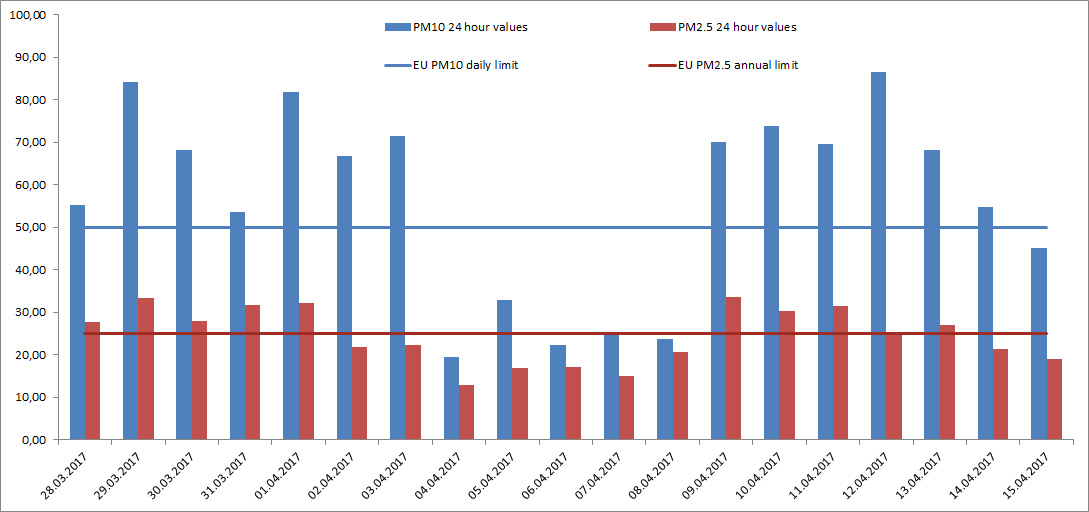
This graph shows the average PM 10 and 2.5 levels over a 24-hour period. The EU limit on PM 2.5 was exceeded on 29 of the 35 days observed, or 83 per cent of the time. The EU’s directive on air quality, which has been transposed in Montenegrin legislation, does not allow for any exceedance of the PM 2.5 limits.

The PM10 daily average was breached on 21 of the 35 days observed. Over the course of one year, the PM10 limit may be exceeded no more than 35 times. With half of winter still to come, and locals’ observation that air quality doesn’t improve much during the rest of the year, it is inevitable that more than 14 days will exceed PM10 limits.

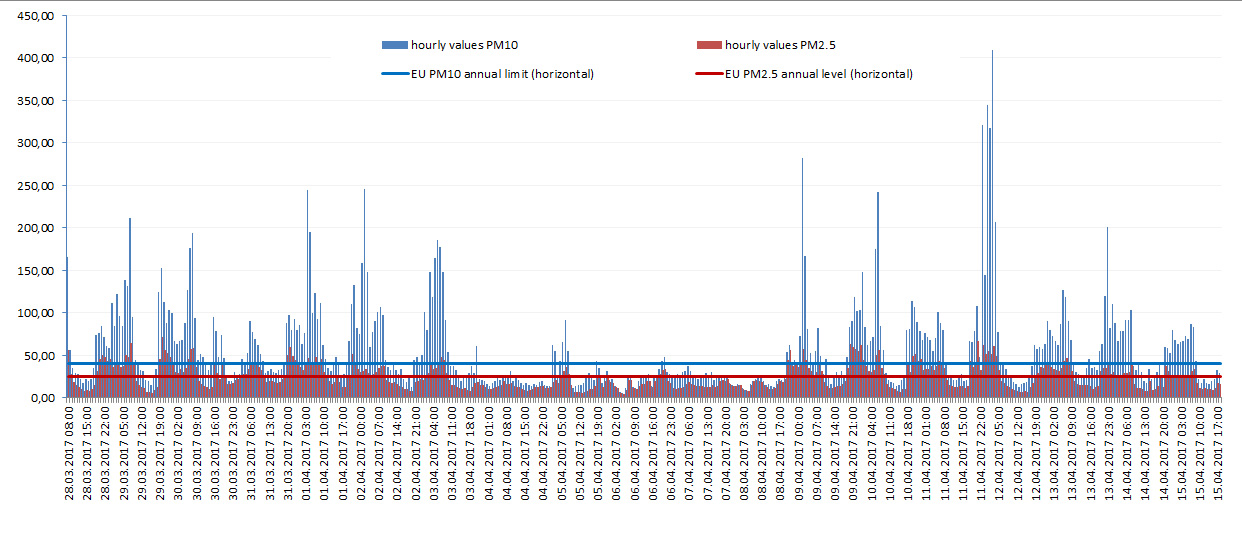
This graph of hourly measurements shows high PM10 peaks, with the highest recorded on Christmas day eight in the morning, at 294.15 micrograms per cubic metre. Similarly PM 2.5 levels spiked on a number of occasions and are on average above the EU annual limit more often than not. The highest levels of PM2.5 recorded came on 13 January between midnight and one in the morning, standing at 238.85 and 206.16 μg/m3 , respectively.

The high PM2.5 levels are particularly worrying, because these particles are lighter and so penetrate deeper into the lungs, causing greater respiratory damage in long-term. PM2.5 also stays in the air longer and can travel farther: while PM10 particles remain in the air for minutes or hours, PM2.5 particles can stay in the air for days or weeks. Whereas PM10 particles can travel from as little as a hundred metres up to 30 kilometres, PM2.5 particles can travel up to many hundreds of kilometres. PM2.5 levels are not however monitored by government monitoring stations in Montenegro, so even though the locals can feel that the air is bad, there is no way to tell exactly how dire the situation is.

Air pollution in Pljevlja is caused by the nearby lignite power plant and the domestic use of coal and wood for household heating. There are no plans in the immediate future to tackle the pollution, and the long-term solution offered by the government is to construct yet another unit at the lignite power plant. It claims that this unit would produce heat, and the town would be connected to a district heating system. However, there is no separate project to back this claim, so no reason to believe this would ever materialise. The same promise was made 35 years ago when the first unit was put into operation.

A new air quality action plan is desperately needed for Pljevlja, one that provides heating options that do not rely on burning fuel. It is also high time that local authorities start planning for a transition away from coal, including in electricity generation. Technology is advancing at a fast pace, surely plans for the energy sector can keep up.

« Previous Page
Next Page »

Footer

CEE Bankwatch Network gratefully acknowledges EU funding support.

The content of this website is the sole responsibility of CEE Bankwatch Network and can under no circumstances be regarded as reflecting the position of the European Union.

Unless otherwise noted, the content on this website is licensed under a Creative Commons BY-SA 4.0 License

Your personal data collected on the website is governed by the present Privacy Policy.

Get in touch with us

  • Bluesky
  • Email
  • Facebook
  • Instagram
  • LinkedIn
  • RSS
  • YouTube