• Skip to primary navigation
  • Skip to main content
  • Skip to footer

Bankwatch

  • About us
    • Our vision
    • Who we are
    • 30 years of Bankwatch
    • Donors & finances
    • Get involved
  • What we do
    • Campaign areas
      • Beyond fossil fuels
      • Rights, democracy and development
      • Finance and biodiversity
      • Funding the energy transformation
      • Cities for People
    • Institutions we monitor
      • European Bank for Reconstruction and Development
      • European Investment Bank
      • Asian Infrastructure Investment Bank
      • Asian Development Bank (ADB)
      • EU funds
    • Our projects
    • Success stories
  • Publications
  • News
    • Blog posts
    • Press releases
    • Stories
    • Podcast
    • Us in the media
    • Videos

Home > Archives for Press release

Press release

NEW REPORT: EU push for metals mining is a raw deal for people and environment

The full report can be found here: http://bankwatch.org/raw-deal

Despite long-term objectives of achieving a circular economy and reducing resource use, the European Green Deal plans to increase mining raw materials to meet demand for clean energy, renewables, and other hi-tech solutions at the forefront of the EU’s green development agenda. 

The European Commission has outlined extensive plans for securing access to ICT-related raw materials but mentions little about effectively dealing with risks associated with their extraction. For instance the EU estimates that for electric vehicle batteries and energy storage, it would need up to 18 times more lithium and five times more cobalt in 2030, and almost 60 times more lithium and 15 times more cobalt in 2050.

The Bankwatch report describes cases of environmental destruction, poor working conditions and a lack of sufficient public participation during the planning and implementation of metal mining and smelting operations, often backed by funds from the European Bank for Reconstruction and Development and the European Investment Bank. 

In one instance, gold mined in Bulgaria that contains levels of arsenic not permitted in the EU is shipped instead to Namibia for smelting, at the expense of workers’ health.

The report calls on the Commission to provide a clear vision and dedicate funds to overcome the problems related to raw materials mining. The EU should take the following actions to ensure that its new development model is sustainable:

  • the reduction of resource use as the underlying principle for any new publicly financed project;
  • the use of less-exploitative and toxic-safe technologies;
  • the restoration of old mining sites;
  • strict and efficient environmental, social and human rights due diligence for mining projects; and
  • the right for communities affected by the mines and surrounding facilities to have a say.

Anelia Stefanova, programme director at CEE Bankwatch Network and co-author of the report, said: ‘We welcome the increasing confidence about the feasibility of Europe’s decarbonisation, but we are concerned about the lack of safeguards in place to make it sustainable. The EU, with its financial institutions, cannot attempt to overcome the climate crisis at the expense of local communities, workers’ rights and biodiversity. ”

Daniel Popov, mining expert at Za Zemiata, CEE Bankwatch Network member and co-author of the report, said: “The EU needs to boost its scientific potential and deploy innovative technologies that are not associated with rights abuses and environmental destruction. Europe can move forward from technologies dependent on expensive, impactful and difficult to supply raw materials.”

For additional information please contact:

Anelia Stefanova
Programme director, CEE Bankwatch Network
E-mail: anelias@bankwatch.org
Mobile: +39 3338092492

Aleksandra Antonowicz-Cyglicka
Researcher, CEE Bankwatch Network
E-mail: ola@bankwatch.org
Mobile: +48 601325242

Daniel Popov
National Campaigner, Bulgaria, CEE Bankwatch Network, Za Zemiata
E-mail: dpopov@bankwatch.org
Mobile: +359 886818794

EIB needs fundamental reforms to back its sustainable finance plans

Not yet a ‘climate bank’

By the end of the year the EIB will be ending its support for fossil fuels. It’s a crucial milestone in the global effort to tackle the climate crisis – not least for the EIB as the world’s largest multilateral lender – but there’s much to be done before the EIB can bill itself ‘the EU’s Climate Bank.’

Anna Roggenbuck, Bankwatch’s Policy Officer, said:

“The EIB’s Climate Bank Roadmap, approved by the bank’s board of directors in November 2020, finally excludes financing for projects, especially in the energy sector, that would aggravate the climate crisis. But funds for some carbon intensive infrastructure projects would still be available.

In the transport sector, for instance, the EIB could still support motorways and expressways at a time when private vehicles with internal-combustion engines urgently need to be restricted, not encouraged.

The Roadmap also lacks guidance on the selection of trustworthy clients and financial intermediaries who would genuinely facilitate the EIB’s climate goals.

As an earlier Bankwatch analysis showed [1], between 2013 and 2019, the EIB provided EUR 4.7 billion in European public money to a number of companies with a high share of coal in their power and heat generation portfolios, or companies that still have plans to develop new coal power capacities.

“This policy loophole needs to be closed to ensure the EIB is no longer bankrolling the climate crisis, even if indirectly. Requiring Paris-aligned decarbonisation plans from corporate  borrowers and financial intermediaries is the least the EIB can do to ensure it is part of the solution, not the problem. In fact, the commercial financial sector is already doing that, so it is disappointing the  EU’s financial arm is still dawdling.”

Raise the bar on transparency and human rights

As the EIB’s Climate Bank Roadmap also seeks coherence with the environmental and social policies, building a sustainable Europe and contributing to development globally will not happen without strengthening of the EIB’s environmental, social, human rights and transparency standards.

Aleksandra Antonowicz-Cyglicka, Researcher at CEE Bankwatch Network, said:

“The EIB still lags behind the transparency and disclosure practices of other multilateral financial institutions. The European Parliament has repeatedly called on the EIB to raise the bar on transparency and ensure the highest level of integrity of its financial intermediaries.

“Moreover, the environmental and social sustainability due diligence for projects the Bank has been financing in recent years leaves much to be desired. For instance, Bankwatch revealed how the EIB had enabled, through the financial intermediaries, massive and poorly planned hydropower development in Western Balkans [2], and showed that the Bank does not screen its projects for their impact on human rights [3], including in countries ranked very low on Freedom House’s Freedom in the World index [4].

“It is time for the EIB to take seriously the transparency, human rights, environmental and social dimensions of its operations. If the Bank is to live up to its very mandate, it needs to develop a proper human rights due diligence, on both the policy and project levels.”

For additional information please contact

Anna Roggenbuck
Policy Officer, CEE Bankwatch Network
annar@bankwatch.org
Tel. +48 509 970 424

Aleksandra Antonowicz-Cyglicka
Researcher, CEE Bankwatch Network
ola@bankwatch.org
Tel. +48 601 325 242

Notes to editors

[1]  The Road Less Travelled: How the European Investment Bank’s Climate Roadmap 2021-2025 can lead it to become the climate bank https://bankwatch.org/publication/the-road-less-travelled-how-the-european-investment-bank-s-climate-roadmap-2021-2025-can-lead-it-to-become-the-climate-bank

[2]  Broken rivers: The impacts of European-financed small hydropower plants on pristine Balkan landscapes https://bankwatch.org/publication/broken-rivers-impacts-european-financed-small-hydropower-plants-pristine-balkan-landscapes

[3] Can the EIB Become the “EU Development Bank”? A critical view on EIB operations outside Europe https://bankwatch.org/wp-content/uploads/2020/11/2020-Can-the-EIB-become-the-EU-Development-Bank_Online.pdf

[4] Freedom in the World 2020, A Leaderless struggle for Democracy https://freedomhouse.org/sites/default/files/2020-02/FIW_2020_REPORT_BOOKLET_Final.pdf


EU Ombudsman launches investigation into financing of Europe’s largest fossil fuels project

The complaint can be found here: https://bankwatch.org/publication/a-complaint-to-the-european-ombudsman

Despite the EU’s commitment to tackle the climate crisis, its financial arm, the EIB, signed in 2018 loans totalling EUR 935 million to the Trans Adriatic Pipeline (TAP) and the Trans Anatolian Pipeline (TANAP) that make up the western and central sections, respectively, of the 3500 kilometer long Southern Gas Corridor [1].

Filed by environmental NGOs CEE Bankwatch Network, Counter Balance, Re:Common and Friends of the Earth Europe, the complaint to the European Ombudsman reveals that the EIB greenlighted loans for both pipelines without proper assessments of their climate impact.

The EIB’s carbon footprint assessment of TAP projected 2.5 times less greenhouse gas emissions than the figure in the environmental and social impact assessment that had been submitted by the consortium building the pipeline. In the case of TANAP, the EIB’s estimate was 3.5 times lower than that in the project’s environmental and social impact assessment.

Yet, the emissions projections that do appear in the environmental and social impact assessments for the two pipelines also understate the mega-project’s climate footprint. These projections only take into account emissions in the two pipelines’ transit countries, without accounting for all emissions throughout the Southern Gas Corridor.

The EIB’s estimation of the climate impact was also based on science that was already out of date at the time of the assessment.

A more truthful estimation, the four environmental groups argue, should factor in emissions resulting from both the extraction of the gas at the Shah Deniz field in Azerbaijan, its entire transportation, and its eventual use in power plants in Europe.

Infrastructure projects of this kind and scale are typically planned to operate for several decades into the future – in reality, well beyond the EU’s 2050 carbon neutrality deadline. And yet, the EIB’s carbon footprint assessment neither considered the projects’ full lifetime, nor accounted for emissions resulting from the planned increase in volume of gas pumped through the Southern Gas Corridor.

Both TAP and TANAP are listed as Project of Common Interest (PCI), a priority status that grants privileged access to European public money, mainly via the EIB.

On November 17, the European Ombudsman found that the European Commission has so far not properly assessed the sustainability and climate impacts of gas projects included on PCI lists [2].

Civil society groups have long argued [3] that the EIB should not have supported the Southern Gas Corridor as the climate crisis is fast unfolding. And as the complaint now shows, the EIB has also failed to uphold its own standards on projects’ climate impact.

The TAP consortium, as well as 18 executives from both the company itself and some of its contractors are currently under trial in Italy for environmental damages. The prosecutor considers the environmental impact assessment of the project invalid because it didn’t take into account the cumulative impacts of one this massive climate-wracking energy project.

Anna Roggenbuck, Policy Officer at CEE Bankwatch Network, said: “In the complaint we showed that the EIB had downsized the real climate impact of the Southern Gas Corridor in order to portray the project as more climate friendly than it is in reality. The two hefty loans that the bank provided to TAP and TANAP will inevitably impact the EU’s ability to fight climate change. Also our earlier analysis showed a high risk that the gas from the Southern Gas Corridor would be as climate damaging as coal.” 

Elena Gerebizza, senior researcher and campaigner at Re:Common, said: “The EIB inadequate due diligence on the environmental, social and climate impacts of TAP is blatantly under our eyes. The climate impact of this pipeline project – and the entire Southern Gas Corridor – was completely underestimated by the EIB, who didn’t even count the emissions for the Italian section of TAP. This is not acceptable and the European Ombudsman should look into it.”

Xavier Sol, Director at Counter Balance, said: “It is outrageous that the EU’s financial arm is downplaying the climate impacts of fossil fuels projects. As the EIB plans to transform itself into the ‘EU Climate Bank’, we urge the bank to apply much more stringent and science-based assessments in the future, so that it can effectively end its support to gas projects.”

Colin Roche, climate justice and energy programme coordinator at Friends of the Earth Europe, says: “The abject failure by the EIB to adequately assess the climate impact of one of Europe’s largest ever fossil fuel projects shows the cavalier attitude which the bank has had towards its environmental responsibility. Without addressing the fundamental flaws in its assessment and complaints mechanisms it’s doomed to fail the climate challenge.”

For further information please contact:

Anna Roggenbuck
Policy Officer, CEE Bankwatch Network
annar@bankwatch.org
+48-509970424

Elena Gerebizza
Re:Common
egerebizza@recommon.org
+39 3406705319

Xavier Sol
Director at Counter Balance
xavier.sol@counter-balance.org
+32 473 223 893

Colin Roche
Friends of the Earth Europe
colin.roche@foeeurope.org
+32 489 598 984

Notes to editors:

[1] Background on the Southern Gas Corridor: https://bankwatch.org/project/southern-gas-corridor-euro-caspian-mega-pipeline

[2] The European Ombudsman’s decision: https://www.ombudsman.europa.eu/en/decision/en/135095

[3] NGO open letter to EIB president: don’t finance the Southern Gas Corridor: https://bankwatch.org/publication/ngo-open-letter-to-eib-president-dont-finance-the-southern-gas-corridor

18 NGOs call on the Coal Platform for the Western Balkans and Ukraine to commit to public participation and climate action

Based on their experience in coal regions in the Western Balkans and Ukraine, and with the EU’s Coal Regions in Transition Platform, the NGOs urge the platform to internalise early on the four principles outlined below to ensure the success of this initiative: 

  1. The Platform must have clearly defined, consistent and measurable goals, set up within a clear time frame.
  2. The Platform must ensure that all relevant groups – local communities, NGOs, trade unions, educational institutions, local businesses, etc. – are involved, from participation in the Platform’s meetings, to the selection of pilot regions, to project selection and implementation. This principle must apply on all levels downstream of the Platform, so planning processes in the countries must take a bottom-up approach starting from the local level and engage communities in coal regions.
  3. Any funding channeled by this initiative must be conditioned on local and participatory plans, exclude any kind of support for fossil fuels and incentivise reasonably fast coal phaseout dates. 
  4. The initiative should incentivise the adoption of territorial just transition plans, which should be consistent at least with National Energy and Climate Plans. If needed, to ensure consistency with achieving climate neutrality in the region by 2050, the just transition plans should go beyond the NECPs. 

“This Initiative is starting in countries whose progress towards climate neutrality is uneven and where political reluctance to act on ending fossil fuel burning is still a reality. If it is to be successful, the new Platform must clearly incentivise early coal phaseout dates and planning for the transition, while educating decision-makers about the enormous opportunities brought about by engaging in these processes,” said Elena Nikolovska from Eko-svest, North Macedonia.

“What we have learned by being active in the Coal Regions in Transition Platform in EU countries is that this only works if the local communities are involved. Wherever truly participatory processes happened, they brought about not only very useful ideas for the transformation, but also – crucially – buy-in for just transition from the targeted communities themselves,” Alexandru Mustață, Bankwatch just transition coordinator, added. 

Notes for the editors:

Read a briefing prepared by the 18 NGOs for the kickoff of the Coal Platform for the Western Balkans and Ukraine: Four principles for a participatory just transition in the Western Balkans and Ukraine – Bankwatch.

For more information, contact: 

Alexandru Mustață, Just Transition Coordinator at Bankwatch
Email:
alexandru.mustata AT bankwatch.org 
+40726770808

Czech Coal Commission likely to approve 2038 as coal phaseout date in key vote tomorrow

The official coal phaseout advisory body to the Czech government is only considering scenarios with 2033, 2038, or 2043 exit years, all of which would leave the country clinging to uneconomic coal plants for too long, threatening both its economy and reputation. Any coal exit later than 2030 would inevitably have to be accelerated anyway to secure a robust EU climate target that Czech Prime Minister Andrej Babiš recently committed to.

“I consider 2033 to be the only responsible choice from the options presented – not only in terms of addressing the climate crisis, but also in terms of energy security and social impacts. Coal has a very poor economic outlook and we cannot plan that energy companies will burn coal for more than another ten years,” Jiří Koželouh, Head of Climate and Energy at Friends of the Earth Czech Republic and member of the Coal Commission, said.

“We need to phase out coal in the Czech Republic in the next decade to tackle the climate crisis. And the Coal Commission could be an instrumental tool in this effort. But so far this is a wasted opportunity. We know that the 2038 coal phaseout scenario is now a favourite choice for some members of the Commission and they are trying to sell this as a compromise. But you cannot make compromises with reality. It would be really bad to plan a coal phaseout which lasts 18 long years because the economic collapse of the coal industry will likely happen much sooner,” Lukáš Hrábek, press officer at Greenpeace Czech Republic, added.

In response to the fact that the majority of the official Coal Commission is made up of politicians and representatives of coal lobby groups, Czech citizens and environmentalists have now established a Shadow Coal Commission, which they argue better represents the interests of society at large. According to the shadow body, the official Commission underestimates the potential of renewable energy sources in the country and is wrong to insist – without grounds – that coal is key to the country’s energy security. 

“When deciding on the date of the end of coal, the coal commission does not take into account the potential of renewable energy sources that we have in the Czech Republic. We recommend that the government commissions a study with more ambitious RES goals, to reduce greenhouse gas emissions by 2030,” Alexander Ač, a climatologist and member of the Shadow Coal Commission, commented.

Photo credit: Limity jsme my

Activists and youth organisation members have been occupying the Czech Ministry of the Environment since November 16 and demand coal phaseout by 2030 the latest. 

EMBER, BloombergNEF, Energynautics and McKinsey all recently published studies presenting different possible phaseout scenarios for the Czech Republic, demonstrating an earlier phaseout date is feasible. The Czech Republic needs to be coal free by 2030 to be in line with the Paris Agreement, and according to a new report by think tank Ember, it can achieve this by investing into renewable energy at a rate similar to other EU countries.

Contact:

Nicole Princlova, Communications coordinator, Centre for Transport and Energy
E-mail: nicole.princlova@cde-org.cz


Shadowy spending of pandemic funds could dash EU hopes for a green recovery

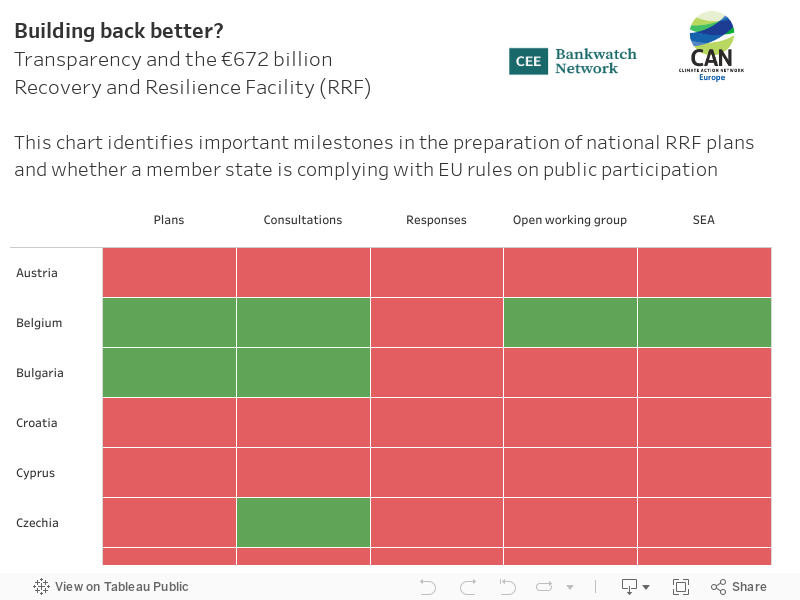
A survey of eight countries – Bulgaria, Czechia, Estonia, Hungary, Latvia, Poland, Romania and Slovakia [1] – shows that citizens and stakeholders have not been involved in the drafting of these spending plans, against the EU’s ‘partnership principle’ which obliges states to consult the public when formulating such strategies. With governments refusing to open these plans for consultation, most inputs reflect only those of a limited set of state actors.

The study also finds that nothing in the plans suggests the necessary ambition to reach the EU’s 2030 climate and energy targets, a key milestone that guides the European Green Deal. No explicit ban on funding for fossil fuels projects is in place, and the majority of plans do not set higher targets than are found in the countries’ national energy and climate plans, which the Commission already had said in October [2] will not be up to the task of delivering on the 2030 goals. 

Raphael Hanoteaux, EU funds policy officer with CEE Bankwatch Network, said, “Governments must do everything to ensure citizen ownership and improve the ambition in this major stimulus package. But we see no guarantee that these plans will help seal the European Green Deal. There is still time to improve them so they answer the climate emergency and help build back better.”

For more information contact

Raphael Hanoteaux
EU funds policy officer
Email: raphaelh@bankwatch.org
Mobile: +32496205903

Notes

[1] The summary assessment of the findings is in the table below:

[2] See https://bankwatch.org/press_release/eastern-europe-climate-plans-struggle-to-keep-pace-with-eus-greenambitions 

« Previous Page
Next Page »

Footer

CEE Bankwatch Network gratefully acknowledges EU funding support.

The content of this website is the sole responsibility of CEE Bankwatch Network and can under no circumstances be regarded as reflecting the position of the European Union.

Unless otherwise noted, the content on this website is licensed under a Creative Commons BY-SA 4.0 License

Your personal data collected on the website is governed by the present Privacy Policy.

Get in touch with us

  • Bluesky
  • Email
  • Facebook
  • Instagram
  • LinkedIn
  • RSS
  • YouTube