ARCHIVED: Shuakhevi hydropower plant, Georgia
Georgia’s biggest and one of the most controversial hydropower plants is mostly famous for its failures. Two months after becoming operational in 2017 its tunnels collapsed. And after two years of repairs water is leaking from the dam. Shuakhevi hydropower plant (HPP) once promised to bring energy independence to Georgia. Instead it managed to collect an impressive ‘portfolio’ of problems in a wide range of areas: from biodiversity, to gender impacts, to community relations.
Stay informed
We closely follow international public finance and bring critical updates from the ground.
Key facts
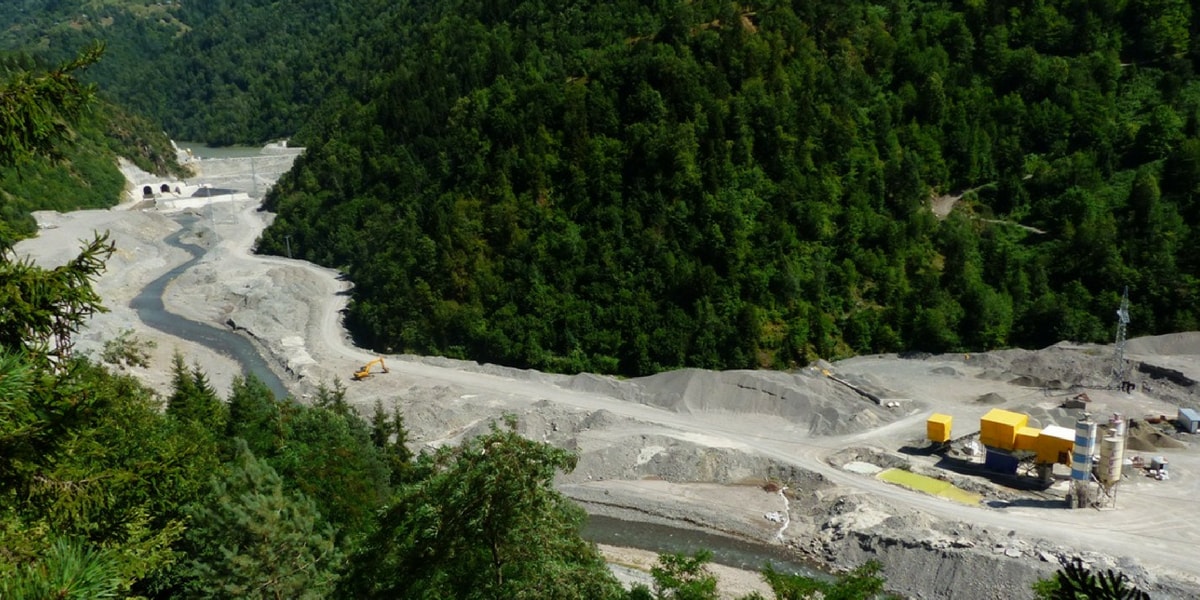
Location: Location: Adjaristsqali river in south-western Georgia Two dams, 39 metres and 22 metres high, with an installed capacity of 187 MW with expected electricity output of 452 Gwh, and three diversion tunnels of 5.8, 9.1 and 17.8 kilometers. Total project cost: more than USD 420 million.
Total project cost: USD 417 million
- the EBRD: USD 86.5 million
- the IFC: USD 90 million, 20% equity in the project
- the ADB: USD 90 million (source)
Client: Adjaristsqali Georgia LLC (AGL), a special purpose vehicle established in Georgia for the sole purpose of constructing a cascade of three hydroelectric power plants on the Adjaristsqali river, the first of which will be Shuakhevi HPP. Adjaristsqali Georgia LLC is owned by Norway’s Clean Energy Invest AS (50%), India’s Tata Power (50%).
Key issues
- extensive damage to the local ecosystems following the construction of the hydropower plant. The adequacy of the mitigation and biodiversity offsetting measures in ensuring conservation of valuable habitats and species is questionable.
- Lack of detailed assessment of geological risks threatens both hydropower investments as well as communities living in the shadow of the 2 big dams, 1 wier and 32.7 kilometers of tunnels.
- A failure to safeguard local women residents by conducting proper gender impact assessment and ensuring meaningful participation of women in consultations and decision-making
Background
A press release from the Ministry of Energy of Georgia from 24 June 2017 announced that project construction was completed, claiming that by adding its 187 MW to the total installed capacity of the country “the Shuakhevi HPP project will significantly contribute to Georgia’s path toward energy independence”.
Long after that, the project is still not operational. On-going problems with the tunnels of the project raise questions about the robustness of the project design, impact assessment and implementation, as well as about financiers’ prudence in conducting due diligence before decisions were made on public money spending, and in monitoring of the project implementation.
One of the villages heavily impacted by the construction, submitted a request for problem-solving to the EBRD’s, the IFC’s and the ADB’s respective accountability mechanisms. The complainants have brought up concerns of unmitigated negative impacts on community safety and access to water, as well as of inadequate handling of their grievances by the lenders and the client Adjaristsqali Georgia LLC (AGL).
In view of the continued ambition of the Georgian government to build risky dams and of the lenders like the EBRD to provide public money investments for these projects, Bankwatch and Green Alternative call for a transparent process of compliance review to ensure accountability and lessons learned for the institutions involved.
Environmental impact
A 2017 report commissioned by Green Alternative and cited in the complaint documented extensive damage to the local ecosystems following the construction of the hydropower plant, which destroyed 93 ha of natural habitats – the area 10 times higher than the 9,2 ha estimated in the project’s impact assessment.
Some of the report’s key findings:
River and riparian habitats
Biodiversity offsetting or compensation were proposed only for forest habitats. The loss of key river and riparian habitats was not offset at all and grassland habitats were not restored. Worse still, some additional areas were destroyed during afforestation activities.
Tree planting
Despite the clear requirements in EU Directives, tree planting was only done after the habitats had been destroyed and it will never be able to recreate habitats with similar ecological functions to the destroyed habitats.
Local fish populations
By the end of the project’s construction local fish populations were found to be almost completely extinct throughout several kilometers below the two dams and the weir, and the remaining fish populations above the dams/weir were in a bad state.
Red list species
The Adjaristsqali basin is considered a critical habitat for the Eurasian otter (Lutra lutra), a red list species in Georgia. If the minimum ecological flow in the river is indeed limited to 10% and there are daily changes in the water release from the Shuakhevi powerhouse, the viability of the local otter population would be further threatened.
Bird and bat conservation
The introduction of bird and bat conservation measures have been totally inadequate as they cannot offset the loss of natural, especially riparian, habitats. Two other impacts on bird species are not addressed properly – the migration barrier effect of new powerlines and the impact on the Chorokhi delta because of changed hydrological and sedimentation regime;
Biodiveristy hotspots
The river banks, where traces of wolves, golden jackals, and brown bears have been documented, should be considered a biodiversity hotspot where no effective offsetting is possible.
Gender impact
It is unclear whether the bank and AGL ensured gender equality and proper safeguarding of women as a vulnerable group, and whether or not local women participated in decision-making and were consulted in a culturally appropriate manner.
The project’s impact assessment included no information on gender impact or special provisions for protection of women from local communities, for example in view of influx of workers, no mention of women-headed households or opportunities for women entrepreneurs.
It didn’t present any consideration for the cultural barriers to women’s participation in consultations, in view of the traditional and religious background.
The Land Acquisition and Livelihood Restoration Plan makes a reference to the number of female-headed households, however, it does not analyse the land ownership and land use patterns or the impact on women’s livelihoods if compensation is given to male property owners.
Green Alternative’s 2016 report Gender Impact of Shuakhevi HPP Project And Its Compliance With EBRD Requirements concludes that:
“The Shuakhevi HPP construction has revealed a lot of gender-sensitive problems, on which the project developer failed to respond adequately, as comprehensive social and environmental assessment including gender analysis and assessments has not been conducted at the stage of the project development. […] In addition, there are no evidence that can verify the fact that the project brought sustainable benefits to the affected population and simultaneously strengthened women in Adjara.”
The report recommended that the lenders, in close coordination with the Georgian government, demand from the project developer to draft gender assessment and action plan, and then strictly monitor its implementation – a recommendation that was never followed.
Latest news
The damage from Slovenia’s Mokrice dam won’t stop at the Croatian border
Story | 27 May, 2026Slovenia’s state-owned Hidroelektrarne na Spodnji Savi (HESS) has for two decades been trying to build the controversial Mokrice hydropower plant on the river Sava. But poor quality environmental studies have been repeatedly quashed in court by the Slovenian Native Fish Society, and a recent transboundary assessment’s claims that the impacts will stop at the Croatian border are far from convincing.
Read moreObstacles pile up for the Dabar hydropower plant in Bosnia and Herzegovina: Time to rethink the whole Upper Horizons complex
Story | 14 May, 2026When the Republika Srpska authorities signed contracts with the China Eximbank to finance the Dabar hydropower plant at the end of 2021, it seemed like the first and largest part of the Upper Horizons complex was a done deal. Today, more than four years later, obstacles are piling up for this controversial project, providing a much-needed opportunity to rethink the whole idea.
Read moreDon’t look, don’t find: Buk Bijela’s ‘environmental impact assessment’
Story | 2 March, 2026Bosnia and Herzegovina’s Upper Drina hydropower scheme would turn 30 kilometres of this iconic river into stagnant reservoirs and cut a key Danube Salmon habitat into pieces. Its largest dam would be the 118-megawatt Buk Bijela, first proposed in the 1970s but repeatedly scuppered due to its impact on Montenegro’s Tara Canyon. Now a new environmental assessment is out for public consultation, but it’s being more than economical with the truth.
Read moreRelated publications
Update to the Bern Convention on the Complaint No. 2016/09 – Possible threat by hydropower to “Svaneti 1” Candidate Emerald Site
Official document | 22 February, 2022 | Download PDFThe Svaneti 1 Candidate Emerald site in Georgia is threatened by the decision of the Georgian government to reduce its size for construction of the 280 MW Nenskra Hydro Power Plant (HPP) project. This is an update by the complainants on the Complaint No. 2016/9 – Possible threat to “Svaneti 1” Candidate Emerald Site who request an on-the-spot appraisal mission by the Bern Convention to Georgia, in order to investigate the threats to rivers that were recorded by Bankwatch during its fact-finding mission in July 2021.
Public money vs. pristine rivers
Study | 21 October, 2021 | Download PDFAs the EIB revises its Environmental and Social Standards, this report presents eight hydropower schemes in central and eastern Europe either financed or under consideration by the Bank. The projects – some financed directly and others via intermediari
A case study on the Beli Kamen and Komalj hydropower plants on the Crni Rzav and Ribnica Rivers in Serbia
Study | 22 April, 2021 | Download PDFThe small hydropower plants Beli Kamen and Komalj are built on the Crni Rzav and Ribnica Rivers of the Drina basin in western Serbia. Both plants are interconnected, as they use water from the same intakes and were financed by the European Investment B

