EU-backed fossil fuels binge needs to end in ‘neighbourhood’ countries
Publication | 17 December, 2015Bankwatch has been taking a look at EU financing for the energy sector in 16 European Neighbourhood countries between 2007 and 2014. Alarmingly, our research has uncovered that out of at least EUR 9 billion provided by the EU to energy projects in the ENP region during the period under assessment, more than EUR 4.2 billion in financing went to hydrocarbons in contrast to the EUR 1.5 billion awarded to low carbon sources of energy and energy efficiency projects.
Read more
Exporting toxic pollution from Europe to Namibia
Publication | 17 December, 2015The case of the Tsumeb smelter in Namibia demonstrates how European pollution is being exported to the Global South with the indirect help of public development money.
Read more
Foul play: development banks condone top Ukrainian poultry producer’s abuses
Publication | 17 December, 2015A closer look at Europe’s recent investments in Ukraine’s agriculture sector shows that the failure to apply high transparency standards and social safeguards poses not only business risks but also undermines Ukraine’s democratisation process.
Read moreBankwatch Mail 63
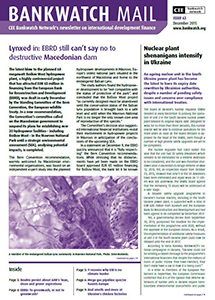
Publication | 17 December, 2015Published after the conclusion of the UN climate negotiations in Paris, Issue 63 of Bankwatch Mail presents ample evidence of how the EBRD and the EIB continue to be firmly tied to fossil fuel financing, in spite of increasing pressure to do more to end support for carbon-intensive sources of energy. And even when multilateral development banks say they’re doing ‘clean energy’ some of the effects are proving to be catastrophic – as the impacts of IFI-backed hydropower projects across the Balkans show. We also take a look at the new kid on the IFI block, the Asian Infrastructure Investment Bank, and consider among other things how its ambition to be ‘lean, clean, and green’ sits with apparent plans for the new bank to help fire up a lot of coal power plants across Asia.
Read moreImprovements needed in transparency and environmental soundness of EBRD-financed hydropower facilities
Publication | 15 December, 2015In light of the worrying findings of a study on hydropower projects in southeast Europe – most notably the high number of projects in protected areas – this letter asks the European Bank for Reconstruction and Development to better implement its environmental and social policy and hydropower sustainability criteria, establish no-go zones in protected areas and rivers of outstanding quality, and disclose project information about projects with a clear environmental impact which are financed through financial intermediaries.
Read moreInfographics: Pristine Balkan rivers threatened by European “green energy” funding for hydropower
Publication | 14 December, 2015A wave of hydropower development fuelled by European public funding and EU companies is endangering pristine river environments in the Balkans.
Read moreBriefing: Centerra gold and the Kumtor gold mine, Kyrgyzstan
Publication | 14 December, 2015An update on the contentious EBRD project and its client, following a field visit by Bankwatch and partners to the mining site in October 2015
Read more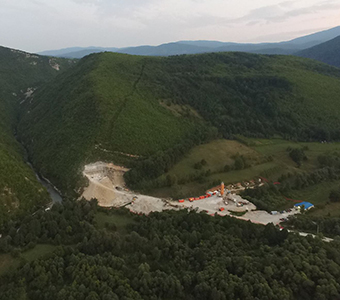
New Bankwatch study: European “green energy” funding for hydropower threatens pristine Balkan rivers
Press release | 11 December, 2015Radolfzell, Vienna, Prague – A wave of hydropower development fuelled by European public funding and EU companies is endangering pristine river environments in the Balkans, finds a new study by CEE Bankwatch Network released today.
Read more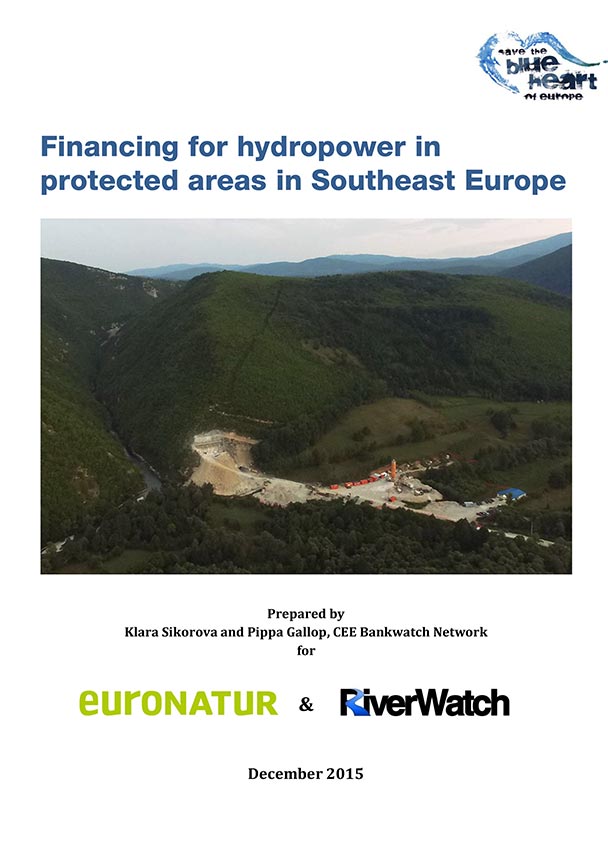
Financing for hydropower in protected areas in southeast Europe
Publication | 11 December, 2015Southeast Europe is experiencing a wave of hydropower projects. In a region with a deadly combination of Europe’s last wild rivers, rampant corruption and inadequate nature protection, the potential for damage is immense. In order to address this issue, we need to know who is making it happen. This research aims – to the extent possible given the secrecy around the financial sector – to find out who are the main actors involved in financing hydropower projects in the region, both overall and inside of protected areas. Update January 2017 The EBRD has said that financing has been cancelled for four small hydropower plants in Macedonia: Zrnovska reka 1, Zrnovska reka 2, Estericka reka, Kadina reka. In addition, financing has been cancelled for the 68 MW Boskov Most plant in the Mavrovo National Park, also in Macedonia. Regarding the Ternove SHPP in Albania, the EBRD has said that it had conducted an on-site investigation into the concerns received in a letter from an affected citizen. The bank found nothing to substantiate the allegations. Bankwatch will continue to monitor the issue.
Read more
Ukraine snubs safety concerns and European donors, extends lifetime of fourth Soviet-era nuclear reactor
Press release | 8 December, 2015Kiev, Prague – An ageing nuclear unit in the South Ukraine power plant is the latest to have its expiry date rewritten by overzealous Ukrainian authorities, despite a number of pending safety issues and concerns over compliance with international treaties.
Read more
