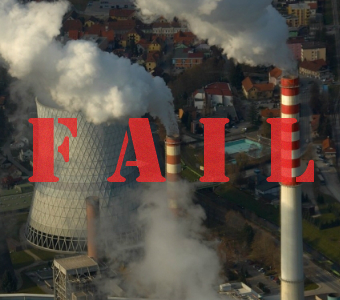
Guest post: A Balkan lesson for coal investors
Blog entry | 28 January, 2014When Dr. Kim, President of the World Bank, and leaders of other international financial institutions ponder funding new coal power projects this year – like the one in Kosovo – there’s one word that should be seared into their memories: Sostanj.
Read moreCivil society letter: EBRD’s political mandate and value added in Egypt doubtful
Publication | 27 January, 2014With this letter 14 organisations from the MENA region and Europe bemoan the lack of clear purpose and effectiveness of the EBRD’s democratic principles that are being undermined by the bank’s moves towards making Egypt a full country of operations despite having significant concerns about the state’s conformity with these principles.
Read moreLeaked document: Doubling of electricity tariffs in Ukraine, condition for EBRD nuclear safety loan
Press release | 27 January, 2014The project through which the life time of old Ukrainian nuclear reactors is being prolonged with EBRD financing would not be economically feasible without a doubling of electricity tariffs, shows a document leaked to EurActiv last week.
Read moreUPDATED: Slovenia continues to fall into the economic abyss of the lignite plant at Sostanj
Press release | 24 January, 2014Ljubljana – The scandal-marred lignite plant TES 6 at Sostanj in Slovenia will likely cost 1.44 billion euros (2 billion US), more than double than what was initially predicted, and is due to produce annual losses of 50 million euros, show calculations recently revealed by Slovenian media. These cost escalations, predicted by NGOs critical of the project, should constitute a word of caution for other countries in South-Eastern Europe that are considering building new coal capacities.
Read moreEBRD set to backtrack on environmental and social safeguards
Press release | 22 January, 2014A draft released yesterday of the Environmental and Social Policy of the European Bank for Reconstruction and Development shows that, instead of strengthening the policy to provide for better implementation, the bank opens several loopholes which ensure that approval of financing is achievable for problematic projects.
Read moreEBRD environmental policy breaches on hydro plants confirmed by internal investigation
Press release | 13 January, 2014The EBRD has failed to properly assess 3 hydro projects it has approved for financing in Macedonia, Croatia and Georgia, according to bank internal investigations initiated after formal complaints by Bankwatch member groups. NGOs caution that, more than mere slips, these improper assessments are a symptom of what could be called bankers’ overconfidence – that is, a tendency to assume that all environmental damage can be ‘managed’, which from a business point of view is much more convenient than admitting that some projects simply should not go ahead.
Read more
Is Egypt just stuck in transition or heading away from democracy? Considerations for the EBRD
Blog entry | 10 January, 2014Six months after the Egyptian army deposed Egypt’s first freely elected president, the weak democratic signals by the authorities are overshadowed by widespread repression. How can the European Bank for Reconstruction and Development possibly help under these circumstances? Or put differently: Will the limited benefits to the country’s private sector from EBRD engagement really be enough to outweigh the harm done by the bank’s support for an undemocratic regime?
Read moreLetter regarding EBRD operations in Egypt despite continued human rights violations
Publication | 23 December, 2013Prompted by gross human rights violations in Egypt this letter asks for clarification how the EBRD can continue to operate in Egypt even though the EBRD’s mandate states that the bank operates in “countries committed to and applying the principles of multiparty democracy, pluralism and market economics” and its continued operations in Egypt therefore amount to a blatant violation of its commitments as a public institution.
Read moreMissing sustainability: The EBRD’s controversial energy lending in Ukraine (2006-2013)
Publication | 20 December, 2013While the EBRD’s founding document require it to “promote in the full range of its activities environmentally sound and sustainable development” more than half of the bank’s energy investments in Ukraine for the period 2006-2013 hardly served the purpose of sustainable development promotion. In this period the EBRD has supported nuclear energy production and new output capacities for nuclear power plants, export-oriented infrastructure, as well as controversial initiatives in the renewable energy sector.
Read more
Litmus test for EBRD rhetoric on democracy with Egyptian oil project
Blog entry | 19 December, 2013On December 18 the EBRD board of directors approved a loan of USD 50 million to finance a project aimed at the expansion of oil operations and reducing gas flaring in Egypt. Yet the tenuous political situation in the country continues to raise concerns about the bank’s ability to make a positive contribution towards the democratic process, and whether it should be investing there at all.
Read more
