• Skip to primary navigation
  • Skip to main content
  • Skip to footer

Bankwatch

  • About us
    • Our vision
    • Who we are
    • 30 years of Bankwatch
    • Donors & finances
    • Get involved
  • What we do
    • Campaign areas
      • Beyond fossil fuels
      • Rights, democracy and development
      • Finance and biodiversity
      • Funding the energy transformation
      • Cities for People
    • Institutions we monitor
      • European Bank for Reconstruction and Development
      • European Investment Bank
      • Asian Infrastructure Investment Bank
      • Asian Development Bank (ADB)
      • EU funds
    • Our projects
    • Success stories
  • Publications
  • News
    • Blog posts
    • Press releases
    • Stories
    • Podcast
    • Us in the media
    • Videos
  • Donate

Home > Archives for Blog entry

Blog entry

That’s what they call sustainable. The EBRD’s 10 billion for sustainable energy


The EBRD announced yesterday that since 2006 it has invested no less than EUR 10 billion in sustainable energy under its Sustainable Energy Initiative (SEI).

Part of me wants to say “Well done, chaps!”, knowing that the bank – even according to Bankwatch’s figures, which use more stringent criteria than the bank’s – has ramped up its lending for new renewables (= renewables excluding large hydro) and power sector energy efficiency significantly since 2006.

  • New renewables lending has been increased from only EUR 6.8 million in 2006 to 271.9 million in 2011 and
  • power sector energy efficiency from EUR 73.9 million to EUR 394 million over the same period.

However shockingly low the bank’s starting point, and however much more investment is needed, the improvements must be recognised. Yet how a new lignite unit can constitute sustainable energy in the 21st century is beyond me.

Another positive trend is that the bank has started to support new renewables outside of the EU in countries like Ukraine which have so far been a difficult environment for such projects.

At the same time, the devil, as always, is in the detail. And the detail that most shocked me so far about the Sustainable Energy Initiative is that the 2011 list of SEI projects includes no other than the new block 6 at the Sostanj lignite power plant in Slovenia. How a new lignite unit can constitute sustainable energy in the 21st century is beyond me.

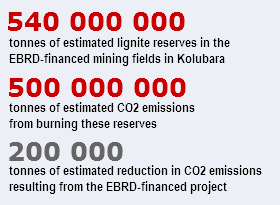
Sostanj is not the only project raising eyebrows about the EBRD’s Sustainable Energy criteria. There’s the so-called Kolubara environmental improvement project too, which will (maybe) save 200 thousand tonnes of CO2 per year but will allow the mine to expand, thus opening the way for about 500 million tonnes of CO2 emissions from burning the lignite from the EBRD-financed fields.

These are just two recent examples, but when reviewing the SEI our calculations showed that around 1/3 of the total SEI investments are questionable (pdf, see page two).

It’s not only fossil fuels causing problems, either. The bank has pumped up its Sustainable Energy figures by throwing in some large hydropower plants too.

After years of not financing new large hydropower plants, in 2011 the EBRD suddenly financed three, and decided they were all Sustainable Energy. We disagree:

  • the Ombla plant in Croatia would affect a future Natura 2000 area;
  • the Boskov Most plant in Macedonia looks set to flood the habitat of the Balkan Lynx, and
  • the Paravani plant in Georgia threatens to dry out one river while transferring flood risks to another.

So, with its EUR 10 billion for Sustainable Energy, the EBRD has proved it can do quantity. For the next EUR 10 billion, let’s hope it pays more attention to quality.

Crunch time at Sostanj


Last Friday, in the latest exciting episode, Alstom, the French company contracted to provide the main equipment for the plant, stopped works on the site, fed up with constant delays on due payments from the TES management (154 million euros were supposed to be paid to Alstom by October 30). They’ll get back to work, they say, if they’re paid the due amounts. However, if they leave and stay away for just 2 months, additional 30 million euros could be added up to an already exploding bill for the new plant, which has reached over 1.3 billion euros by now.

The Slovenians, of course, didn’t have the money for this plant in the first place. That’s why around half of the costs are to be covered by two European public banks, the European Investment Bank and the European Bank for Reconstruction and Development. And here’s where it gets interesting. The European Investment Bank wants a state guarantee for its loan (not only is the EU’s house bank financing a dirty coal plant that should not be built in the first place, but it’s asking the Slovenian tax payer to commit to covering the eventual losses).

Slovenian decision-makers are not able to offer this state guarantee just yet: even though earlier this year the Slovenian parliament passed the state guarantee law (with an awesome 29 out of 90 votes!), the government still needs to assess if the new investment plan for TES 6 is in line with national legislation and with the conditions authorities set out for the guarantee.

As a matter of fact, the foot dragging is happening because it is really doubtful whether the investment plan meets these conditions. An internal rate of return of 9% is required, but is totally unrealistic, as is guaranteeing lignite costs at EUR 2.25/GJ. It has been quite clearly proven that the TES management has overestimated the profitability of the plant and with all these delays the profitability of the plant can only be going down, not up. The project promoters also hasn’t assessed the CCS-readiness of the plant, as national legislation demands.

On top of that, all eyes are on the Slovenian government not to mess up this decision: earlier this year, a state commission for the prevention of corruption claimed that conditions of corruption existed (pdf) at the time of awarding the contract to Alstom and that national public procurement legislation may have been breached. Investigations are ongoing both in Slovenia, as well as at European level (the European Anti-Fraud Office is looking into the corruption allegations and so are internal investigators at the EIB and EBRD).

Last week, the Slovenian finance minister told national media that there are still unresolved issues around the state guarantee. We don’t know precisely which issues he meant, but certainly there’s no lack of problematic points, we mentioned only a few.

So now we’re waiting. We’re waiting to see how the Slovenian government is able to pull this one off. Under public scrutiny, how to figure out a way to pay 1.3 billion euros for this plant, much of it to a company that is under suspicion of having conducted corrupted acts to get the contract?

We’re also waiting (since spring) for the results of the internal investigations at the EIB and the EBRD. The banks are now saying that they won’t pay their half of total costs unless the Slovenians pass the state guarantee. As if that were the only criterion. The banks have promised to thoroughly look into the corruption allegations themselves as well as co-operating with the OLAF investigation. Let’s hope they don’t suddenly forget about this when under pressure to come up with the money.

If they all manage to pull it through by the end of November, we’ll have a proper state guarantee, some money paid to Alstom, a resumption of works, and the EIB and EBRD getting ready to pay their due. In that case, our thriller will have turned into a predictable romantic comedy: the sides kiss and make up, putting on fake smiles to persuade us all that there was no dirty dealing in the awarding of the contract, that this coal plant is really necessary for the Slovenians, and that European public banks are safeguarding the interests of European citizens.

Meanwhile, while waiting to see how the plot develops, we’ve nominated Alstom for the Public Eye Awards, a competition of the world’s least ethical companies. Because, as you may remember, allegations of corruption around Alstom are not appearing for the first time: we’ve heard about them across continents, types of business, and despite fines and investigations. Keep an eye on this blog to see whether Alstom wins, despite tough competition from other corporations around the world.

‘Comments noted’, business as usual continues. The marginal public influence on the EBRD’s new mining policy


Those who have followed our work on the EBRD’s mining activities are aware of our discontent about the bank’s performance in the mining sector – with problems ranging from deepened commodity export dependence and the exacerbation of environmental problems to negative impacts for local communities.

Read more:

Our commentary on the policy

The EBRD’s draft Mining Strategy (pdf)

The final EBRD’s Mining Operations Policy (pdf)

The EBRD’s report on the invitation to the public to comment on the Mining Operations Policy (pdf)

Now with the mining policy approved we remain similarly unhappy: Compared to the draft version from April (pdf) (subtitled “Supporting Responsible Mining”), the final policy (pdf) did not change much (the subtitle disappeared, though). Most notably, the policy fails to incorporate the obvious links between its support for coal mining activities and the climate impacts of burning coal.

A host of other important issues, including the protection of important natural areas (like glaciers), the diversification of export oriented economies, and the strengthening of transparency, participation and revenue sharing in mining activities have been postponed to the revision of other policies and strategies. (Read more details in our commentary on the new mining policy.)

Despite the bank’s bold claims of an exhaustive consultation process the outcome does not sufficiently “incorporate differing views”. Bankwatch’s extensive and sound comments on the draft policy have hardly found their way into the final document – without so much as an explanation.

This mining policy is decidedly failing to lay the groundwork for less harmful EBRD mining operations. It hardly describes anything else than an expanded business as usual. Neither does it offer a vision to align the interest of local people and the environment with the commercial benefits for mining corporations.

EU budget update: Are Europe’s leaders serious about taking the green shirt off all of our backs?


These are negotiations, if you recall, that got underway in summer 2011 when the European Commission proposed that 20 percent of future EU budget spending should go to ‘climate mainstreaming’ measures – that is, for the approximately 1 trillion euro EU budget over seven years to comprise a good chunk of projects and initiatives, from across the budget’s entire range, aimed at tackling climate change.

Scandalously, we are now staring down the barrel with only one month – seemingly – of frantic shuttle-diplomacy to go in order to decide on whether to make the future EU budget environmentally progressive. Or instead to add it to the EU’s growing list of botched compromises – compromises that let EU leaders smile for the cameras, but that do nothing for people living in Europe, or for the environment.

If the budget negotiations are grinding remorselessly on (though look out for some ‘real’ budget figures to be announced, it is rumoured, by the Cypriot EU presidency on Friday this week), a gathering storm is being played out in the media – and for EU budget bloodlust, you can always rely on Twitter. The current, short-term focus is on the extraordinary summit called by Herman van Rompuy, president of the European Council, for November 22-23, aimed at thrashing out agreement on the shape, and size, of the EU budget for 2014-2020.

Van Rompuy is pinning a lot of hope on the November summit. Not only is he scheduled to do a tour of 27 EU countries in five days in early November, he recently tweeted that the summit could be the first ‘three shirter’ under his presidency (‘three shirter’, in Brussels parlance, means that the scheduled two day summit could easily become a three day job, requiring a third shirt to be pulled from diplomatic baggage in order to secure a deal). This kind of wardrobe flexibility should not, however, be regarded as heroic: let’s bear in mind what is at stake, the length of time taken to reach where we are now, and a certain English language idiom.

‘Taking the shirt off someone’s back’ means to take payment from a certain other, as a payment or a punishment. The shirt in question could well end up being Europe’s collective ‘green shirt’, namely the environmental impetus put forward by the Commission last year. How the environment is deserving of this punishment from European decision-makers remains a mystery.

Yet, with all to play for, green spending within the EU budget is not getting a look in – in spite of Bankwatch and our partners, Friends of the Earth Europe and WWF, last week launching our map and video of ‘Well Spent’ EU Cohesion fund spending.

Also last week, Bankwatch’s EU Funds coordinator in Slovakia, Miro Mojžiš, set out in the European Voice how Europe’s member states could – credibly and urgently – come together on the future EU budget with a collective championing of increased green spending for the 2014-2020 spending. Not only shared EU 2020 commitments on climate change can be realised. There are further additional ‘green’ dividends to be unlocked via targeted EU spending, including massive job creation in times of economic precariousness, as well as greatly reduced fuel bills for European households via EU funding support for obvious energy efficiency measures.

As Miro warns, “We are now at a dangerous moment, and bellicose posturing has to be replaced by constructive negotiations focused on areas of mutual concern and benefit. It is time for both advocates of better spending and cohesion to abandon haggling over cuts and actually discuss the quality of spending and cohesion.”

To achieve this ‘win-win-win’ scenario via green EU spending, we believe that any EU budget deal should involve not just 20 percent climate mainstreaming but, given the climate and economic challenges facing the member states (especially in eastern Europe), 25 percent going to green spending.

More shirtiness

Not only is the green shirt being removed from our backs, if the latest reporting from the Financial Times is to be believed, we are now entering a new period of ‘shirtiness’ (read it as you will, but the English language equates ‘being shirty’ or ‘shirtiness’ with ‘being difficult’ – who are we to argue, but Brussels press corps, you got the November summit headline here first) as regards the EU budget.

Chancellor Angela Merkel is apparently intent on squaring up to UK threats of vetoing the EU budget in November, threatening from Germany’s end to cancel the November summit completely if David Cameron’s government doesn’t soften its stance. This kind of FT headline needs to be taken with a certain amount of sel – ‘Merkel to warn UK on EU budget veto’ has certainly attracted more online comments (mostly from what appear to be a UK Daily Mail readership) than I can previously recall for an FT article. But, unmistakenly, it does illustrate the bankrupt contours of opinion regarding the EU budget that are emanating from Europe’s key capitals.

Unmistakable, too, in the latest brouhaha is the lack of talk about green spending, even with one month to go.

Get ready to find yourself without a shirt, green or otherwise, in the upcoming Budget negotiations – even though our leaders appear to be measuring up for EU budget hairshirts.

How Ukraine can survive without nuclear – renewable energy potentials reviewed


On Sunday a week ago, Lithuanians voiced a clear “No” to nuclear energy. Ukrainians may give the same verdict – were they informed and asked about it. But the only information about nuclear energy that state officials usually communicate to the Ukrainian people is that it is our country’s only option. (This is our government’s rationale for keeping nuclear reactors running beyond their lifetime.)

Alternatives however do exist even here. They just aren’t being studied properly. This is why we set out to examine, by way of example, how Ukraine can reduce its dependency on nuclear energy, without sacrificing its ability to meet demands. (The results are available in a briefing (pdf). We took the data for the renewable energy potentials from scenarios (pdf) prepared by the European Bank for Reconstruction and Development’s Ukraine Sustainable Energy Lending Facility (USELF).).

The results (pdf) show that Ukraine could very well satisfy its electricity needs even when it shuts down expired nuclear power plants, does not built new ones, and neither increases the use of coal in thermal power plants. (At a first glance, our results are also supported in a brand new publication by the International Energy Agency which must have felt a similar need for an alternative assessment.)

Here is our estimation for the potential production capacity in 2030:

According to our estimation, Ukraine could cover up to 27 per cent of its electricity demand in 2030 with renewable energy.

Unfortunately, these are not the priority areas in the currently revised Energy Strategy of Ukraine:

Official forecast is based on flawed calculations

How do these differences come about?

The fundamental bias in Ukraine’s Energy Strategy is that its estimates are based on exaggerated assumptions of economic growth (five per cent annually), an only marginal increase in energy efficiency (1.2 per cent annually), and a low target for decreasing the economy’s electricity intensity (which at the moment is more than twice as high as the EU average). (This is explained in more detail in our briefing paper (pdf).)

In a letter to Ukraine’s Minister for the Energy and Coal Industry Yuriy Boiko, the delegations from both the European Union and the United States have highlighted the same problems and have asked Ukraine to further revise the strategy.

An alternative scenario

In order to realize the potential we laid out in our study (pdf), the Ukrainian government has to focus on decreasing our economy’s energy intensity and utilising Ukraine’s nearly untapped renewable energy potential

This task – moving from the extension of centralised capacities towards an efficient use of energy and decentralisation of production the long-run – is not easy. European institutions, including the European Bank for Reconstruction and Development have an exceptionally important role to play in helping Ukraine along this way.

It needs first and foremost a strategic focus of all technical and financial support on renewables and energy efficiency – areas that Ukraine desperately needs to develop if it doesn’t want to fall further behind the trends in Europe. Current support for renewables projects is not enough. Potentially laudable initiatives are hopeless if you continue to invest in nuclear power.

There are no grounds for European institutions to support the further development of Ukraine’s coal or nuclear sectors, which are already subsidised heavily. Such practices have made the rest of the energy sector stagnate during the last two decades, making Ukraine’s economy the second most energy intensive in the world.


Update: The comparison between the EBRD’s support for nuclear and renewables in Ukraine has been adjusted to reflect that the EBRD finances renewables in Ukraine not only through USELF.

When loyalty blocks climate action – Polish parliament pledges allegiance


Last Friday, in an unanimous vote, the Polish parliament adopted a resolution which criticises the European Commission’s long term objectives for reducing greenhouse gas emissions and creating a low-carbon economy in Europe.

The resolution states that:

These proposals, contained in documents such as the Energy Roadmap 2050, do not consider the specific economic conditions of individual member states […] (Propozycje te, zawarte w takich dokumentach jak Energy Roadmap 2050, nie uwzględniają specyficznych uwarunkowań gospodarczych poszczególnych krajów członkowskich […])

… instead it calls for

[…] a comprehensive analysis of the costs and benefits associated with the implementation of climate policy. ([…] wzywa Radę Ministrów do przygotowania wszechstronnej analizy kosztów i korzyści związanych z realizacją polityki klimatycznej.)

This vote (and the fact that even the more progressive members of parliament voted in favour) is just another sign of how much Poland is detached from the rest of Europe – and from reality.

While countries such as Finland work on plans to phase-out coal generation by 2025 and Germany foresees a full decarbonisation of its electricity in 2050, Poland is still fighting wars with its perceived enemies, embodied now also by the European Commission. (And never mind that 26 countries have supported the Commission proposal.)

At the same time, Poland’s decision makers have not come up with a document that outlines their vision of an effective climate policy (a need that Friday’s Parliament resolution “recognises”). Instead they repeat a mantra that mingles the fear of economic stagnation with an imagined or at least grossly exaggerated threat to Poland’s energy security by external powers.

Many open questions, no answers

I think it is legitimate to ask my country’s representatives: What would a Polish “Roadmap 2050” look like? What is the place of renewables in Poland after 2020? How is Poland willing to address its growing dependence on oil coming predominantly from Russia? And what about the increased coal imports?

Poland’s Energy Policy 2030 (pdf) envisages over 65% of primary energy demand in 2030 coming from coal, lignite and oil. It does not include much development in renewable energy after 2020 – the renewable ratio of the final gross energy demand would increase by only one percent between 2020 and 2030.

What about energy efficiency, then? Will Poland exploit its still massive potential and thus reduce our energy and heating bills and our CO2 emissions?

Instead of answering these questions or consulting them with its citizens, Polish authorities are grumbling at the European Commission and are buying time to continue business as usual. (We have also heard Prime Minister Tusk on Friday, announcing more roads, more coal power plants and shale gas [PL].)

Poland’s long-term thinking seems to cover only considerations over how to get us through the next two difficult years when EU money will only come as a trickle.

More than one possible future

The sad thing is that understanding climate policy simply as a “burden” (as the Parliament’s resolution does) neglects the benefits that lie in green investments.

A study by the Central European University estimates that large-scale deep retrofitting of buildings would bring energy savings worth EUR 203 billion by 2080 and create 224 000 additional jobs.

In numerous places around Europe, Poland included, money from the EU Budget has been used fruitfully to implement projects that benefit both the environment and the economy. The next EU Budget (2014-2020) worth one trillion euros, a third of which will go to Cohesion Policy funds, could bring many more such investments, especially if – as planned by the Commission – at least 20 percent of this money is earmarked for low carbon spending.

Clearly, for Poland, low carbon comes with EU financial support and with economic benefits added to the environmental ones. It has been stated over and over again by the EU and by independent researches.

Alas, Polish decision makers are not willing to listen to civil society’s suggestions or proof. The state prefers to support research that is decidedly pro-fossil fuels, because the government has always known that there is only one possible future and that any discussion with the remaining 26 EU countries – or its own citizens – is useless. And now the Polish Parliament has backed this approach unanimously.

But questions over how to build a more sustainable energy sector must not just be ignored any longer.

The next time you see a Polish official criticising the European Commission’s Roadmap 2050 please do raise these issues with them. Ask them how their Roadmap looks like. Call the bluff.

« Previous Page
Next Page »

Footer

CEE Bankwatch Network gratefully acknowledges EU funding support.

The content of this website is the sole responsibility of CEE Bankwatch Network and can under no circumstances be regarded as reflecting the position of the European Union.

Unless otherwise noted, the content on this website is licensed under a Creative Commons BY-SA 4.0 License

Your personal data collected on the website is governed by the present Privacy Policy.

Get in touch with us

  • Bluesky
  • Email
  • Facebook
  • Instagram
  • LinkedIn
  • RSS
  • YouTube