Environmentalists, get your keyboards ready: The European Investment Bank asks for inputs on its energy policy


The long awaited revision of the European Investment Bank’s energy policy has been kicked off yesterday with a consultation paper (pdf) calling for public inputs on its energy lending.

Find out more

How to submit comments (EIB website)

Contact us

If you care about greening Europe’s energy sector in the coming years, then this is crunch time:

  • While the EIB has already increased its lending to renewable energy sources, it is not envisaging a phase out of its support for fossil fuels and even coal. (The Sostanj lignite power plant in Slovenia is so big that its C02 emissions would swallow the country’s entire carbon budget by 2050.)
  • At the same time the bank could do much more to downsize our energy use by investing more into energy efficiency measures. This is especially so in central and eastern Europe: In 2011, only 176,4 million euros went to projects in CEE that would reduce the still enormous energy intensity.
  • The EIB’s climate friendly energy lending in general shows a strong bias towards old EU Member States and thus offers CEE countries only little incentive to reduce their dependency on coal or other fossil fuels.

By improving what kind of energy the European Union’s long-term financing institution supports, Europe could make an important step towards reducing its greenhouse gas emissions – and create jobs along the way.

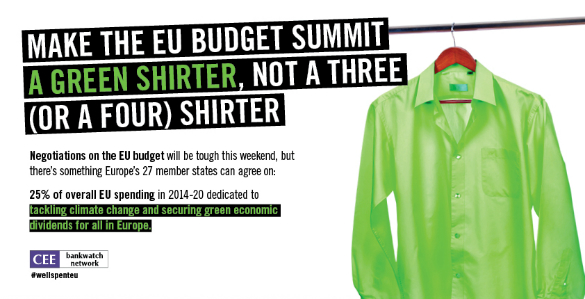
EU budget negotiations: a zero-sum game?


This article was originally published on Public Service Europe.


Engaging in the debate currently approaching boiling point over the European Union budget for 2014-20, the so-called Multiannual Financial Framework, is not for the faint-hearted. Yet the MFF is of huge importance for European citizens situated outside the Brussels bubble. Heavy on acronyms and featuring a blizzard of arcane, overlapping policy minutiae and formulae – the famous United Kingdom budget rebate is remembered for Margaret Thatcher’s wielding of her handbag in Fontainebleau in 1984, which is just as well because allegedly only four people alive understand how to calculate said rebate – the budget ultimately comes down to money. It is roughly €1trillion over seven years, as proposed by the European commission last year, to be distributed in varying sums across member states and economic sectors.

But it also comes down to how to spend the money. The commission has proposed that …

Read the full article on the Public Service Europe website

Trust us, we’re euphoric – Private equity and a tax haven part of the EBRD’s first post-Arab Spring swoop


This post is an article from the upcoming Issue 53 of our quarterly newsletter Bankwatch Mail.

Subscribe now


Public investment millions provided to a private equity fund based in a tax haven – these days, with the buccaneer activities of private equity firms and the use and abuse of tax havens very much in the public spotlight, this kind of thing could validly be expected to provoke a public outcry.

Yet when such investments are made under the cloak of international ‘development finance’, as the European Bank for Reconstruction and Development did last week, there is not only cursory media reporting but, by the sounds of it, some hearty back-slapping within the EBRD itself.

The deal in question, a EUR 20 million equity investment in Maghreb Private Equity Fund III, is part of the EBRD’s first raft of signed-off investments for the Middle East and North Africa (MENA) region.

Private equity may set some alarm bells ringing (just ask the Obama presidential campaign) but the Maghreb Private Equity Fund III is also based in Mauritius, a renowned tax haven, a fact not alluded to in the EBRD’s press materials. It is, however, cited in the bank’s project summary document that was published unusually late: not months in advance of the EBRD’s board meeting to discuss it, as is the norm, but on the same day as the board approved it.

Accompanying the press announcement of this private equity deal, and two others involving ‘intermediated finance’ (see below) in the EBRD’s new region of operations, was a Tweet from the bank’s recently appointed president, Suma Chakrabarti:

Clearly much excitement, then, as the EBRD’s lengthily trailed and controversial entry into the MENA region became a reality. Given the nature of these investments, though, and their highly uncertain ability to deliver developmental value in these acutely needy economies, what exactly is there to shout about?

Black hole development finance

Last week’s private equity deal and the two other accompanying investments in Jordan and Morocco see the EBRD relying on intermediary institutions to select and pass on loans to thousands of final beneficiaries, usually in the small- and medium-sized enterprises (SME) sector.

While the intention of these investments is to spur economic development by lending to SMEs, the investment model (so called ‘intermediated finance’) raises more questions than answers.

For one thing, based on the EBRD’s track record in eastern Europe over more than a decade, accountability for this type of lending is nowhere to be seen due to commercial confidentiality. The EBRD is not compelled to (and very rarely does) reveal publicly who the final beneficiaries are, or what they have been doing with the funding; nor do the intermediary institutions, be they commercial banks, private equity firms or hedge funds.

And yes, the World Bank’s private lending arm, the IFC, has invested in a hedge fund under the ‘development’ banner. As Nick Hildyard of The Corner House has recently pointed out, though:

    ‘An IFC review of its private equity portfolio has concluded that any correlation between high profits and wider positive development outcomes was relatively weak, and that the most pronounced impact of private equity investments was in “improvements in private sector development”, such as encouraging changes in the law favourable to the private sector. In effect, what is good for private equity is good for private equity – but not necessarily for the wider public.’

What’s more, a May 2011 report of the World Bank Independent Evaluation Group, Assessing IFC’s Poverty Focus and Results (pdf), found that less than half of the projects reviewed (the IFC invests only in the private sector) were designed to deliver development outcomes, and just one third of the projects addressed market failures, such as enhancing access to markets or employment of the poor.

A further red flag

If you’re new to intermediated finance, then, it doesn’t exactly seem to add up. But there’s the added red flag that the investments announced by the EBRD include a client that is registered in a tax haven. In spite of its development bank status, and similar to other institutions such as the World Bank and the European Investment Bank, the EBRD is still permitted to provide financing to entities based in tax havens. The risks of doing so, particularly in a development context, are becoming increasingly well documented – as usual the peerless Tax Justice Network has been leading the way.

More evidence is provided in a recently published report from the development NGO Eurodad. Private profit for public good? Can investing in private companies deliver for the poor? maps out the recent rapid growth in the intermediated finance sums being doled out with a ‘development’ stamp by the international financial institutions, and has uncovered the alarming trends that come with it.

Analysing this kind of private sector financing provided by the EIB, the IFC and other development finance institutions (the EBRD was not part of the analysis), between 2006 and 2010, Eurodad found that:

  • Only 25 percent of all companies supported by the EIB and IFC were domiciled in low-income countries.
  • Almost half of the analysed financing went to support companies based in OECD (ie, developed rather than developing) countries and tax havens.
  • Around 40 percent of the companies in Eurodad’s sample are big companies listed in some of the world’s largest stock exchanges.

As the Eurodad report points out,

    ‘Unfortunately development banks and private financial institutions have a spotty record when it comes to the development impact of their projects, so “trust us” does not qualify as an effective method of monitoring and evaluation.’

Development ineffectiveness

The UK Department for International Development (DfID), the UK government agency responsible for interacting with and channelling UK development money to the EBRD and other agencies, has arrived at similar conclusions regarding the EBRD and development. DfID’s 2011 multilateral aid review rated the EBRD among the bottom ten of 43 institutions assessed in ‘contributing to UK development objectives’.

At the time of this review EBRD president Chakrabarti was the top civil servant at DfID, so these findings can not have escaped his attention. Transforming the EBRD into an institution that delivers much more effectively on development goals is surely one of the key challenges for Chakrabarti’s presidency.

What’s in store for Egypt?

It is highly concerning that the EBRD has opted to signal its entry into a new region of operations with these type of investments. More of the same can now be expected, involving not millions but billions of public money. With EBRD investments expected shortly to commence flowing into Egypt, where tax haven abuse by Hosni Mubarak, his family and other cronies was rife, the people of the region must be scratching their heads about the west’s post-revolution response.

The EBRD’s dubious infant steps into North Africa and the Middle East, not to mention its already very grey-tinged footprints in eastern Europe, could be set on a more appropriate path. To do so requires this development bank to grant full public disclosure of where these funds are going, who is benefiting and what the real added value in terms of job creation and environmental sustainability actually is.


This post is an article from the upcoming Issue 53 of our quarterly newsletter Bankwatch Mail.

Subscribe to Bankwatch Mail

Continued EU budget battle could sacrifice clean energy investments and clog economic recovery


How much money is needed to create 62 300 jobs and how much to save 523 megatonnes of CO2 emissions annually?

Yesterday’s General Affairs Council meeting certainly didn’t touch upon questions of such practical nature. Instead, the wrangling over the size of the future EU budget continued, with an ongoing deadlock between those suggesting to cut the European Commission’s proposal and those trying to prevent it.

Yet, the later concrete figures can be agreed upon, the less time remains to discuss how to use that money. In this way, the negotiation deadlock is particularly counterproductive, by stalling further deliberation of ways to use the EU’s Cohesion Policy in more ambitious ways and more effectively than what we have seen in the past. If done right, this could not only help us on the way to Europe’s climate targets, but also on the path out of economic downturn.

As a recent Bankwatch study shows, the currently proposed funding for low-carbon measures would be far below what is necessary to do more than just cursory climate action.

In “No half measures. Investment needs in energy efficiency and renewables in the CEE countries” (pdf) we examined how much money is actually needed to create jobs and reach Europe’s climate targets. We looked at seven countries in central and eastern Europe (Bulgaria, Czech Republic, Hungary, Latvia, Poland, Slovakia and Slovenia), namely at the impacts of investment programmes in energy efficiency and renewable energy.

The outcomes of our analyses of scientific reviews of these programmes and of future projections show the big potential (see below) they have for climate change mitigation, social and economic benefits and job creation – especially when compared to business-as-usual development, for instance:

    „The labour intensity for deep energy renovations […] per million Euro invested is more than double the labour intensity of the entire construction industry.“
    (Source: Central European University, pg. 104)

We suggest that the EU Budget and the regional funds can provide the necessary funding for such investments, if a sufficient amount of the future EU Budget will be set aside for real low-carbon measures. So rather than debating a reduction of the EU budget, it is necessary to increase the share of investments in energy efficiency and RES from the originally proposed 20%.

Current plans for the Structural and Cohesion Funds unfortunately look rather different: the roughly 31 billion euros proposed by the European Commission for low-carbon measures in all EU countries (in 2014-2020) would not nearly be enough, even with the increase that the European Parliament and the Council approved recently. The necessary sum for the seven CEE countries we examined is already more than five times that amount: 172.382 billion over seven years.

As the study’s title suggests, it is not half baked measures that we need, but a dedicated pursuit of low-carbon investments that would mitigate both climate change and the impacts of the economic crisis. Only with increased earmarking can the benefits of job creation, leverage effects and emission reductions be realised at a reasonable scale.

Here are two examples of what could be achieved with sufficient funding:

By investing 2.1 billion euros by 2020 in the renovation of houses in Bulgaria:

  • 680 000 households could be provided with heat efficient buildings,
  • 60 000 jobs would be created and
  • CO2 emissions of half a million tonnes would be reduced annually.

A more ambitious investment programme in Hungary would cost 23.8 billion euros by 2020 but result in

  • the deep energy retrofitting of all residential buildings,
  • the creation of 131 000 jobs and
  • the reduction of CO2 emissions by 45%.

The longer the EU budget debate continues, the more it resembles a fight over money bags rather than a constructive debate on Europe’s future.

Read more about our work on the EU budget

The EBRD in Mongolia: Economic diversity is something else


As far as we can tell, the European Bank for Reconstruction and Development has arguably not done too much to incorporate Bankwatch’s extensive and well founded (for example here) inputs on its new Mining Strategy. (Although, to be perfectly honest, we don’t know what the bank has incorporated yet, because – in line with a transparency policy that we disagree on – it refused to disclose their responses to NGO comments.)

Discuss live and online with Mongolian campaigner Sukhgerel Dugersuren

We will discuss the EBRD’s mining operations in the European Parliament and in a live online video discussion this Thursday.

See more details below

One of the risks inherent in the strategy’s current draft lies in the EBRD not contributing to economic diversification of resource rich countries, but rather to an exacerbation of their commodity export dependence (“resource curse”).

Mongolia, which has become the promised land for mining companies over the last years, is a case in point. Taking a look at the EBRD portfolio in Mongolia, the dominance of natural resources/mining becomes obvious both over the span of the bank’s operations in the country and in particular during the last two (calendar) years. (Additionally to these numbers, the EBRD is considering a loan to the gold and copper mine Oyu Tolgoi in the Mongolian South Gobi desert.)

Other problems with the draft include coal mining, protection of natural areas and more. So there is lots to discuss about the EBRD’s upcoming Mining Strategy, which is exactly what we intend to do on Thursday, September 20, in the European Parliament and later in a live-streamed video discussion. Join us!

Event details

The new EBRD Mining Strategy: in line with EU policy objectives?

Open debate
Thursday, September 20, 8.00-9.00 (CET)
at the Members’ Salon, European Parliament

Hosted by Reinhard Bütikofer, Vice-President of the Greens/EFA and Rapporteur on Raw Materials, European Parliament

Inputs by:

  • Kurt Bayer, Austrian Executive Director at the EBRD on the EBRD’s upcoming mining strategy
  • Sukhgerel Dugersuren from the Mongolian NGO OT Watch on the EBRD mining financing in Mongolia
  • Kuba Gogolewski, Energy Campaigner at CEE Bankwatch Network on the EBRD’s upcoming mining strategy
  • William Neale, Member of Cabinet, DG Environment, European Commission (TBC)


Online video discussion

Thursday, Sept. 20, 11.30-12.00 (CET)
Live on the Bankwatch website

with:

  • Sukhgerel Dugersuren from the Mongolian NGO OT Watch on the EBRD mining financing in Mongolia
  • Kuba Gogolewski, Energy Campaigner at CEE Bankwatch Network on the EBRD’s upcoming mining strategy

moderated by Bankwatch media coordinator David Hoffman

Following the panelists’ presentations there will be a short question and answer session.

Join the discussion by submitting your questions online

  • through our Facebook page (also possible in the right side menu);
  • via Twitter using the hashtag #EBRDmining (also possible in the right side menu);
  • in the comments section below the YouTube video, or
  • by leaving a comment at the end of the event’s page

The video will also be live-streamed on the Bankwatch YouTube channel.