• Skip to primary navigation
  • Skip to main content
  • Skip to footer

Bankwatch

  • About us
    • Our vision
    • Who we are
    • 30 years of Bankwatch
    • Donors & finances
    • Get involved
  • What we do
    • Campaign areas
      • Beyond fossil fuels
      • Rights, democracy and development
      • Finance and biodiversity
      • Funding the energy transformation
      • Cities for People
    • Institutions we monitor
      • European Bank for Reconstruction and Development
      • European Investment Bank
      • Asian Infrastructure Investment Bank
      • Asian Development Bank (ADB)
      • EU funds
    • Our projects
    • Success stories
  • Publications
  • News
    • Blog posts
    • Press releases
    • Stories
    • Podcast
    • Us in the media
    • Videos
  • Donate

Home > Archives for Blog entry

Blog entry

Runners raise the alarm about air pollution from coal power during inaugural Lung Run

The countries in the Balkans are among the worst in Europe when it comes to air pollution. The annual average concentrations of pollutants in the air are several times higher than those recommended by the World Health Organisation. Because of this, thousands of lives are lost in these countries every year due to polluted air, and thousands more develop chronic respiratory and cardiovascular diseases.

Why the Lung Run?

Bankwatch has been engaged in air pollution monitoring work since 2016. Through independent air quality monitoring, we make the “invisible” visible and draw attention to the connection between the burning of coal in power plants and the health impacts on locals from the resulting pollution.

Exposure to air pollution depends on various reasons. Outdoor sports can be one of the reasons, as they disproportionately expose people to air pollution, for the simple reason that lungs are gasping for more air and more of the pollutants are inhaled.

In an effort to bring more attention to the health impacts of air pollution, we organised a trail race in which runners, a group that spends lots of time outdoors, took on the task of making the pollution visible. The Lung Run was designed in a way that gave runners a small taste of what living in the shadow of a coal facility means. They monitored pollution levels on the course, measuring personal exposure to draw  attention to the need for continuous air quality monitoring near coal power plants.

The municipality of Novaci in North Macedonia seemed like the perfect location for the first edition of The Lung Run. It is home to one of the worst polluting coal-fired power plants in Europe, REK Bitola, which is accompanied by two open-pit lignite mines and an ash disposal site. At the same time, the municipality is blessed with rich agricultural land and breathtaking landscapes in the hills surrounding the plains. 

The area has also become somewhat of a hotspot for outdoor sports. Neighbouring municipalities host a number of events every year, including trail races, cycling events, climbing and paragliding competitions. But all of these take place within a 40-kilometre radius of the towering chimneys of the power plant that constantly blanket the area with pollutants.

Runners in Novaci are fitted with personal pollution sensors

Going virtual

Like most things in 2020, the Lung Run did not go according to the original plan. Because of restrictions on gatherings in N. Macedonia put in place during the week of the race, the event in Novaci had to be cancelled. Instead, all participants were asked to do their runs on a location of their choosing in a virtual event.

69 runners from 14 countries joined in this inaugural edition. Twelve runners travel to Novaci and ran part of the originally-planned course while using personal pollution sensors. In near perfect weather conditions, these twelve runners completed 20 kilometres in the hills above the power plant and the coal mines. 

While they enjoyed the set route, they also pointed out that the smell of burning coal was overwhelming at times and that it was terrifying to see how the open-pit mines dominate the landscape. In the end, runners concluded that this was an eye opening experience and every single participant asked to participate in future events.

Runners that couldn’t be in Novaci but participated anyway were happy they had the chance to support the cause. Felix, a computer scientist from Berlin first heard about the idea from a friend and decided to run five kilometres along the Spree. Felix wanted to support the locals in their fight for cleaner air because air pollution does not respect borders. The decentralised race was great because ‘everyone could take part, even if they did not live in N. Macedonia.’ Felix said he was surprised to ‘learn how much pollution I was breathing-in while running only this small distance.’

While she was closer to the actual race, Slavica could not make it to Novaci and instead ran in the nation’s capital. For her, the virtual race was about showing solidarity with the communities in Novaci and an affirmation that ‘breathing clean and fresh air is everyone’s right.’ Though the weather didn’t cooperate for her run – it poured the whole day – Slavica’s spirits were not dampened: “Alone we can do so little, together we can do so much.” 

All these runners became part of our growing community on the sports platform Strava and will continue to be advocates for cleaner air. We are hopeful that this will become a wide movement of outdoor athletes and enthusiasts. Everyone is welcome to join the club of people that are dedicated to fighting air pollution through sports.

Time to end the damaging cycle of land, surface and groundwater pollution in Tuzla

First, there is a fear of the unknown. People have seen their environment changing: their homes and lands have been slowly encircled by huge lakes filled with coal ash and slag. Their crops started drying up and their water has become undrinkable. ‘Is this safe? Could all of this affect our health?’ wonder the locals, while local environmental authorities reassure them that the pollution is within the legal limits.

Then, along comes a report, like the one released today by the Center for Ecology and Energy, which proves that the land and water are indeed contaminated with toxic substances such as cadmium, lead, nickel and chromium, and another fear creeps in: will those responsible take appropriate measures to stop this pollution and prevent it from damaging lives further?

From March to August this year, an analysis of water and soil samples was carried out near the slag and ash disposal sites in Tuzla, Bosnia and Herzegovina (BiH) – Plane, Divkovići I, Divkovići II, Drežnik and Jezero I – as well as wastewater samples from the active ash disposal site Jezero II and samples from six water wells. In total, twenty-three water samples and two soil samples were analysed. This was the first drinking water analysis to be carried out since the ash and slag – byproducts of burning coal – started being dumped in this area of western Tuzla approximately fifty years ago. 

The heavy metal content in the byproducts of coal burning largely depends on the concentration of these chemical elements in the coal of origin, mined at Dubrave and Banovići. The report shows that the arsenic and cadmium content in the Dubrave lignite is almost twice as high as the upper limit of the global average concentration, and the nickel content in the Banovići’s lignite is almost 6 times the limit.

Toxic wastewater and land polluted with heavy metals 

The results showed that the wastewater at the active Jezero II ash landfill is alkaline toxic water containing amounts of cadmium, lead, nickel and chromium that exceed the prescribed limit values. This type of wastewater should not be discharged into surface water without treatment or come into contact with underground water.  

Out of the six water wells tested during the analysed period, the water from only two of them can be considered completely safe to drink according to BiH standards.

The soil on the closed waste disposal sites of Plane and Drežnik, which is currently used for agriculture, contains concentrations of nickel between 6 and 12 times above the prescribed limits, and concentrations of chromium and cadmium between 1.6 and 4 times higher. These heavy metals, even in small quantities, tend to bioaccumulate over time, eventually leading to chronic, degenerative changes on important organs: the liver, bones, spleen, brain, etc.

Remediation measures are not rocket science, they just need proper implementation

So far, the only remediation measure taken to prevent the harmful effects of pollution on the surroundings has been to cover the surface of the waste disposal site with a thin layer of soil. However, this is inadequate, since it does not prevent the dangerous impacts of heavy metals found in the waste. This is particularly true because the site has been informally repurposed for agriculture, and crops are now grown on top of it. 

As a result, the report recommends that agriculture for human and animal consumption must be stopped and full remediation and recultivation measures implemented in accordance with the Federation of Bosnia and Herzegovina’s legislation. Those who have been driven to farm at such a polluted site need to be assisted to find alternative land.

One of the most urgent steps recommended in today’s report is the adoption of a regulation that would prescribe compulsory measures to prevent further negative impacts of slag and ash disposal sites on the environment. 

In order to prevent or reduce contamination of underground water – mineral lining needs to be installed on the bottom and the sides of the ash and slag disposal site. 

There are numerous wells and drinking water springs in the vicinity of both the active and closed ash disposal sites, so an underground water quality monitoring system must be set up by the operator. This would help spur a timely reaction in case the spring or underground water quality worsens.  

Tuzla 7 new unit is not part of the solution 

Whatever the promoters of the new unit at the Tuzla coal power plant and its main financier, the China Eximbank, would like the local community to believe, increased coal capacity would not stop the real problem. Ash and slag will continue to be released as long as a coal-fired power plant operates here. The idea that its lifetime would span over several more decades and produce more toxic byproducts is simply inconceivable. 

Just last week, the environmental group Re:Common released a video that includes moving testimonies of local people living near the ash waste dump, as well as of the author of the report. It also shows how financial institutions, such as Italy’s Intesa Sanpaolo Bank, alongside a subsidiary of Slovenia’s NLB Banka (partly owned by the EBRD) and Russia’s Sberbank worked hand in hand to back the Tuzla 7 project with loans of their own, totalling EUR 74 million. 

What is most needed is a full remediation of the soil, water and air pollution and a complete turnaround from energy sector development which harms already vulnerable people. A shift towards sustainable renewables and energy efficiency is long overdue and highly expected.

EC must heed Ombudsman’s warning on gas gaffe beyond the EU

Just a month after the European Ombudsman criticized the European Commission for approving a list of gas infrastructure projects without assessing their greenhouse gas emissions, the EC must not make the same mistake this week with the EU’s southern and eastern neighbours.

The inclusion of gas pipeline projects and LNG terminals on these lists has long attracted criticism for its collision with the EU’s decarbonisation commitments, as well as for the central role played by an industry body – the European Network of Transmission System Operators for Gas (ENTSOG) – in the process.

But the EU is not the only one with a list of priority projects – the Western Balkans, Ukraine, Moldova and Georgia have a similar list, selected every two years under the auspices of the Energy Community Treaty.

This Thursday (17 December), at the Energy Community’s annual Ministerial Council meeting, Ministers are expected to adopt three electricity transmission projects, twelve gas projects, and two oil projects as Projects of Energy Community Interest (PECIs) and Projects of Mutual Interest (PMIs) between the EU and Energy Community. Except, the methodology behind the climate footprint of these energy projects has already been called into question.

The stakes are high. Some of the Energy Community countries like Ukraine have a long-established gas dependency, but others like Montenegro and Kosovo are not connected to international gas networks. Others are only partly connected, like Albania, North Macedonia and Bosnia and Herzegovina. 

So investing in gas is a massive undertaking for these countries. It will demand scarce human and financial resources that could have been better used to leapfrog to decarbonisation by tapping their energy efficiency, solar and wind potential.

Greenlighting these gas projects would undermine any efforts to decarbonise the EU neighbours’ energy sectors by 2050, and would incur a real risk of these very projects becoming stranded assets.

What is more, it would be very similar to what the European Ombudsman criticised the Commission for just a month ago.

On 19 November, in response to a complaint by Food and Water Action Europe on the 4th PCI list, the European Ombudsman published findings that the sustainability assessment of the gas projects had been what it diplomatically called “suboptimal”.

In 2019, ENTSOG was asked to include a sustainability assessment in its cost-benefit analysis as part of the PCI gas project proposal process. Unsurprisingly for a gas industry body, it proposed a biased methodology which could find only climate benefits from the projects, not emissions increases. This was because it assumed that the gas would only replace other fossil fuels like coal, and not renewable energy.

In the 4th PCIs list case, the Commission spotted the issue, and did not utilise the methodology concerned. Instead, it went ahead with the PCI selection process without any sustainability assessment at all.

The European Ombudsman found it “regrettable that the Commission did not attempt at an earlier stage to improve the available data and the analytical methodologies applied, so that a ranking of candidate gas PCIs based on their sustainability would have been possible.”  

Given the EC’s plans to apply a new sustainability assessment for the 5th PCI list in 2021, the European Ombudsman did not suggest specific corrective action. 

But what she did not appear to know was that the Commission is about to propose the PECI and PMI lists to the Energy Community Ministerial Council for approval, and that their sustainability assessment was very similar to the ENTSOG one rejected by the EC in 2019.

The assessment assumed that all the new gas entering the mix would replace coal rather than renewables – a dubious assumption given the high level of hydropower use in some of the countries, including Montenegro and Albania. 

It also assumed that there is no overall energy demand growth in the countries, so the gas could not represent new emissions compared to current ones. In other words, the only possible answer from the assessment was that gas would bring emissions reductions.

But what the EC spotted in 2019 for the EU, it did not spot in 2020 for the Energy Community. 

The Commission must do everything in its power not to let the Energy Community countries fall into the same carbon trap that the EU is now struggling to pull itself out of.

Bankwatch has recently raised the issue with DG Energy. We requested that the approval of the new priority project list be postponed until the new TEN-E Regulation has been approved, or to propose a list with only electricity projects on. But DG Energy responded that this would be worse because the current gas list would remain valid.

Yet, a new list approved on the basis of a misleading assessment and a TEN-E Regulation that is being reviewed will have no credibility. So, delaying it by a few months would give the next list a much more solid foundation – as the saying goes: less haste, more speed.

Czechia ‘unambitious’ climate laggard according to Commission assessment

The European Commission’s analysis of the Czech national energy and climate plan (NECP) supports the critique of local civil society and renewable energy associations, who call the plan’s provisions “unambitious” and the contribution to the joint decarbonisation efforts of the EU “modest”.

But with the EU’s 2030 emissions reduction target currently being updated to at least 55 per cent, the already unambitious Czech NECP will be in dire need of revision.

Main shortcomings of the Czech NECP

The Commissions has identified the most notable shortcomings of the Czech NECP as insufficient ambition for the development of renewable energy – especially solar and wind – in the next decade, as well as insufficient plans for improving the country’s energy efficiency.

While the Commission has recommended that the Czech Republic increases its share of renewable energy in final consumption to at least 23 per cent by 2030, the Czech NECP only counts with a 22 per cent share by that time. This seemingly small difference of one percentage point would actually mean an almost four times faster increase of renewables capacity. According to the Czech Chamber of Renewable Energy, this is far below Czechia’s renewable energy potential, which could be at least twice as high.

This criticism is supported by a recent study that confirms Czechia plans the absolute slowest deployment of renewables in the EU. If the current government’s plan goes ahead, there will be fewer renewable energy sources built during the next decade than were built in the previous one. In 2030, Czechia will have the lowest share of renewable energy of all Member States, and the majority of this share will come from biomass, which is less sustainable than solar and wind.

Another study shows, however, that the country’s renewable energy potential is not as low as its politicians often suggest. According to Ember’s modelling, Czechia could achieve up to 10GW of solar and 4GW of wind by 2030, effectively replacing all of its existing coal capacity. In this way, the Czech NECP seems rather unreasonable, as it does not count with any coal phase out date nor does it set out a framework that could lead to the replacement of uneconomic coal with the cheapest source of energy, renewables.

Insufficient link of recovery funding and climate goals

By relying heavily on biomass to cover its renewable targets, the Czech NECP effectively pushes solar and wind out of the country’s energy mix and thus its eligibility for public financing.

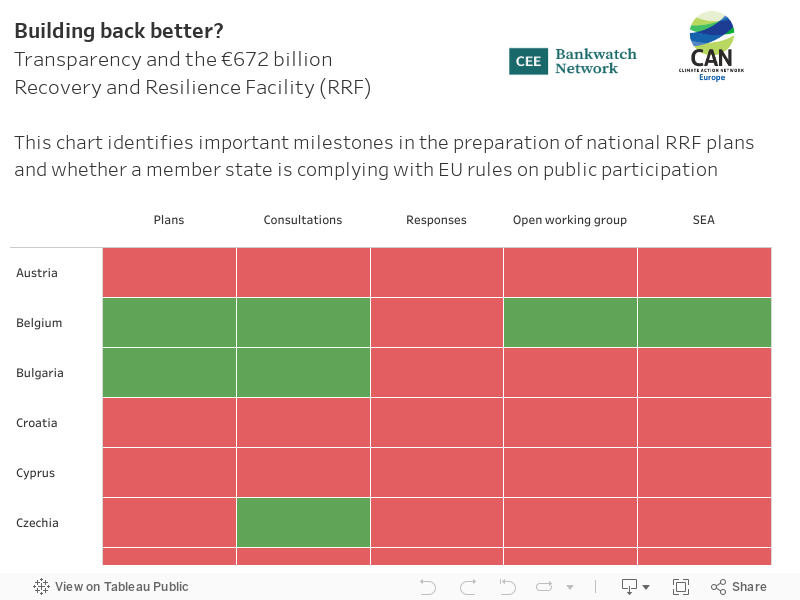
This is exacerbated by Czechia’s plans for the Recovery and Resilience Fund, which would provide the majority of funding to large companies in the electricity and heating sectors at the expense of small and medium sized enterprises, often providers of sustainable, renewable energy solutions. Similarly, there is insufficient support planned for municipalities, which could be pioneers of community energy development in Czechia.

The NECP also does not set a date for a phase out of fossil fuel subsidies, meaning that if the recovery funding is spent in line with the existing NECP, there is a risk that EU money goes into harmful projects that will end up increasing Czechia’s emissions. There are considerable doubts that the draft National Recovery Plan complies with the 37 per cent climate investment criterion.

As it stands, the NECP is a hindrance to more ambitious climate policy, as it does not provide any guidance for energy efficiency improvements and substantial renewable energy deployment. Once the EU and its Member States agree on increased 2030 targets, the Czech NECP will need a thorough revision to address its shortcomings. The Recovery and Resilience Fund should be seen as an opportunity to get a head start for the necessary decarbonisation of Czechia’s energy systems, yet in its current form it also falls short of this task.

Romanian parliament prepares to reject EU Biodiversity strategy for 2030

Members of Romania’s Chamber of Deputies, its lower parliamentary house, intended to vote on 17 November on a draft decision to reject the European Union’s Biodiversity Strategy for 2030. 

Parliamentarians said that by increasing the by-laws, strategies and action plans dedicated to nature protection and the restoration of habitats and species, attention will be diverted from carrying out concrete actions in a timely manner on local levels, such as preventing illegal deforestation and ensuring appropriate protection of forest areas. They also argue that the plans and documents for the implementation of EU policies on environmental and biodiversity protection are very dense and complex, having an unjustifiably large number of pages, which makes them difficult for citizens or interested businesses to understand. Also, parliamentarians claimed to see no connection between the current poor biodiversity protection and the insufficient legal safeguarding measures in place.

Those in favor of rejecting the Biodiversity Strategy claim that their decision will provide for an increase in the involvement of stakeholders in the management of protected areas. This is despite the fact that such a system was in place until two years ago, when the Parliament made the controversial move to retake custody of natural protected areas and remove the NGOs as administrators. Prior to that, the state had outsourced the administration of these areas to custodians and administrators, which allowed NGOs to get involved.

This isn’t the only time Parliament has been involved in controversial amendments to environmental protection legislation. In 2016, the regime of the protected natural areas was modified so that it could allow for the construction of natural gas pipelines in fully-protected areas and in the buffer zones around these special perimeters. These provisions were designed to speed up the implementation of the BRUA pipeline, which intersects seven Natura 2000 sites and comes near other five natural protected areas. Eventually, the provisions were extended to all projects of national importance in the field of natural gas.

Given the Parliament’s complicated past with the already fragile environmental protection legislation, it is no wonder that, once again, the benefits of protecting biodiversity and the environment are overlooked and rejected.

If this decision is adopted, not only would Romania be putting its biodiversity at risk, but it would also lose much needed investments in nature protection, like the EUR 20 billion per year of private funding and the post-2020 EU budget.

The draft decision will be further discussed by the specialized committees of the Chamber of Deputies and a decision will be made by the end of the year.

As Romania’s last new coal project is cancelled, a larger gas threat looms

In an interview with Euronews last week, Romania’s Minister of Economy, Energy and the Business Environment finally confirmed that no new coal unit will be built in the country. Only one such power plant was in the pipeline – the 600 MW Rovinari project, first proposed in 2012 with Chinese partners who would also be the majority shareholders. The unit was supposed to be run together with the state-owned Oltenia Energy Complex (OEC), which currently operates four power plants and 10 lignite mines.

While the project was considered implicitly cancelled because it was removed without fanfare from the National Energy Strategy in September, the Minister’s announcement makes this cancellation definitive. It also reflects the acknowledgement of an increasing number of stakeholders in Romania, including government officials and energy authorities, that coal is incompatible with climate goals and with the implementation of the Green Deal, as they seek to take advantage of generous European funding opportunities.

The warning signs were clear

The new unit’s economics were doomed from the start, as a Bankwatch analysis from 2019 showed. Even under the most favourable assumptions for the project, which have already been proven false – such as a low cost of pollution (originally estimated at a price of EUR 21 per ETS allowance, but which is today over EUR 27) – it would still have a negative cash flow throughout its first 15 years of operation. Furthermore, the unit’s revenue would cover the costs of lignite, limestone and pollution, but would leave little margin for fixed costs (salaries, operation and maintenance), depreciation and interest expenses.

Oltenia in a hole – will it stop digging?

The Minister’s announcement is expected to become official next month, when Oltenia Energy Complex’s board will approve the company’s position on the opportunity of the project to build a new 600 MW unit at Rovinari, taking into account all recent aspects of the internal and European energy markets, as well as the intention and the actual capacity to implement it. OEC has bigger concerns, as it can no longer cover its operating costs: it borrowed over EUR 100 million last year, and this year it received European Commission-approved state aid worth EUR 251 million.

Even as the company comes to terms with the fact that coal is unsustainable, it still hasn’t realised that fossil gas is not part of the solution. OEC is unable to return this year’s loan, and because of this, European state aid rules require it to prepare a restructuring plan. While this plan isn’t public, a summary was presented by the company, showing plans to build fossil gas units totalling 1.3 GW on the site of the Turceni and Ișalnița power plants. OEC also intends to build eight photovoltaic parks totalling 700 MW; however, switching the core of its business to gas shows that it still fails to understand how to make its business truly sustainable.

Lessons for the Western Balkans

The demise of the new unit at Rovinari sends a strong message to Serbia and Bosnia and Herzegovina –  now the only countries in southeast Europe which are planning new coal plants.

Like Serbia and Bosnia and Herzegovina, Romania assumed it could benefit from Chinese financing to build a new coal unit, but it didn’t take into account today’s economic realities, which render coal largely uncompetitive. The Rovinari plan was based on flawed maths and the company failed to take into account a rise in CO2 prices. Despite the fact that Oltenia still benefits from some free emission trading scheme allowances, the company is in deep economic trouble. It has ended up dependent on emergency rescue and restructuring aid, even without building the new unit.

The story of Kostolac B3 in Serbia and Tuzla 7 in Bosnia and Herzegovina might well turn out similarly, with dire consequences for the state-owned companies promoting them. Kostolac B3’s feasibility study omitted CO2 prices, arguing – without any legal basis at all – that if introduced, they would be paid by the government. Tuzla 7’s feasibility study was similarly deluded, expecting CO2 prices to be introduced only in 2034, and only at a rate of EUR 7.10.

Yet it’s clear these countries cannot continue to trade electricity with the EU without playing by the same rules as EU operators. This is why the EU is currently planning to introduce a carbon border tax and the Energy Community is examining options for the introduction of the ETS in the region.

The Rovinari project shows exactly what happens to new coal power plant plans when countries have to play by EU rules. They fail. Serbia and Bosnia and Herzegovina need to learn this lesson before it’s too late.

« Previous Page
Next Page »

Footer

CEE Bankwatch Network gratefully acknowledges EU funding support.

The content of this website is the sole responsibility of CEE Bankwatch Network and can under no circumstances be regarded as reflecting the position of the European Union.

Unless otherwise noted, the content on this website is licensed under a Creative Commons BY-SA 4.0 License

Your personal data collected on the website is governed by the present Privacy Policy.

Get in touch with us

  • Bluesky
  • Email
  • Facebook
  • Instagram
  • LinkedIn
  • RSS
  • YouTube