• Skip to primary navigation
  • Skip to main content
  • Skip to footer

Bankwatch

  • About us
    • Our vision
    • Who we are
    • 30 years of Bankwatch
    • Donors & finances
    • Get involved
  • What we do
    • Campaign areas
      • Beyond fossil fuels
      • Rights, democracy and development
      • Finance and biodiversity
      • Funding the energy transformation
      • Cities for People
    • Institutions we monitor
      • European Bank for Reconstruction and Development
      • European Investment Bank
      • Asian Infrastructure Investment Bank
      • Asian Development Bank (ADB)
      • EU funds
    • Our projects
    • Success stories
  • Publications
  • News
    • Blog posts
    • Press releases
    • Stories
    • Podcast
    • Us in the media
    • Videos
  • Donate

Home > Archives for Blog entry

Blog entry

‘Smog globe’ shows reality of polluted winters in Belgrade now

Last month, a series of artistic interventions I set up to illustrate the problem of air pollution in Belgrade got people finally discussing how coal affects their health, even when they don’t live next door to the power plants.

I grew up in Obrenovac. Obrenovac is a town in Serbia about 30 kilometres away from the capital, Belgrade. It is home to two coal-fired power plants, Nikola Tesla A and B, which for years have polluted the town’s air and created serious health problems for our community.

We were always aware of the impact of air pollution, ash and soot were visible on the snow every winter, and they were present on our terrace almost every day.

Instead of warning us about yellow snow, our parents used to tell us ‘Don’t play with that black snow’.

Air pollution was also harmful for our health. My mother’s asthma, which had affected her since childhood, only got worse once she and my father moved to Obrenovac in their early 20s. My friends and I were enrolled in swimming lessons from a very early age to help us maintain our lung capacity. But this was not enough to prevent me from developing respiratory problems, as well.

Once, when I had a cough for an extended period, our doctor advised us to go to Sokobanja, a famous retreat for patients with respiratory problems which offers natural vapour inhalation therapies. When the doctor at Sokobanja learned that my mother and I came from Obrenovac, he prescribed us inhalations a few times a day more than for other patients. He also recommended that we visit Sokobanja for a week or two twice a year, which we did for many years.

No escape from pollution

Finally, when I was in high school, we moved to Belgrade. We chose the southern part of the city, because there are some forests there and the air is usually cleaner than in the other parts of the city. But we realized that although there were no big industries within the city limits, the air pollution from power plants and other industries in nearby towns, like Pančevo, and even Obrenovac, greatly impact Belgrade as well.

The residents of Obrenovac blamed the poor environmental conditions during the 1990s on widespread corruption. There were always rumours that the filters in the plants were never changed and that money for these operations ended up elsewhere. So in the transition period of the early 2000s, people were quite optimistic that things would change.

In the last two decades, however, environmental issues have become more widely discussed in the news, and sources of information about the pollution in our country have become widespread. We now realise that not much has been done since the 1990s – we still breathe extremely polluted air all the time.

Art as an advocacy tool

In 2012, I decided to teach an art workshop about the environment for children in Obrenovac. I visited kindergartens there and I spoke with them about the environment – how we pollute and protect it, and how they feel about it in their own community.  Many of their drawings showed power plants as big polluters, or sometimes flowers coming out of plants presenting their wish for the future.

I painted their drawings on large wooden boards, which we placed next to a new canal and running trail that led to a forest. It was a reminder that children are quite aware of pollution and that because of them, we are obligated to do something about it.

Two years later, in 2014, there was huge environmental catastrophe – floods damaged the entire city, and, of course, our artistic wooden billboards. Murals I painted in Obrenovac were also destroyed by the floods.

I was especially sad about the mural I painted on the wall of centre for people with developmental disabilities. While I was painting it, many people approached and asked what the building was for. It was sad that large number of residents didn’t know about this place, but my mural had made it more visible to society.

This encouraged me to think more about what I could do as an artist for other important issues in our society. I discovered that my obligation as an artist is to create socially engaged street art available to everyone. After several projects in Serbia, I also participated in a climate change street art project in Berlin, a street art festival in Bucharest to enhance the local community, and in southern Sicily where we painted murals to show solidarity with refugees.

In order to increase awareness about the current environmental situation, I wanted to create an artistic and educational art piece in Belgrade. When the COVID-19 pandemic hit, I started thinking about the air pollution that had affected my family and my community’s health. The air pollution in our region directly impacts our lung capacity, which is so important for surviving the virus. I couldn’t help but wonder, if we had better air, would this help us fight the pandemic?

At the same time, air pollution has threatened our health for years, and will continue to do so long after the risk of COVID-19 goes away. Even before the pandemic started, some people in Serbia wore masks outdoors on days with extremely high air pollution. Social media was full of advice on which mask to buy, and some people started buying air filtering machines for their homes.

#AirPollution on the Sava quay

When Bankwatch approached me to ask if I would be interested in creating an art installation to raise awareness about air pollution, the topic felt perfect for the Sava quay in New Belgrade. This quay is very long, and many people take walks there on weekends with their family and friends. I thought it would be a perfect place to illustrate the distance a person is from coal-fired power plants from the beginning to the end of the strolling route. I wanted my installation to be eye-catching, functional and reversible.

First, I tied coloured fabric over concrete benches right next to the Sava River. I chose four colours to indicate different levels of pollution at different distances from the major coal-fired plants near Belgrade, Nikola Tesla A and B and Kolubara A.

I wanted to make people reflect on the fact that there is no safe distance from these polluters, and that just because coal fired plants are not in their neighbourhood does not mean that they have good quality air. I saw a lot of passers-by stop to read what was written, and many of them nodded worryingly.

I also created a ‘smog globe’, which was a temporary installation on the same quay. Instead of snow, as you might expect to find in a snow globe, this one has ash and soot; instead of a fir tree or a snowman, I painted a power plant. This installation was made out of painted circular panels that people could stand between and take photos, creating the effect of being trapped inside a ‘smog globe’.

Passers-by were really interested in the globe and in the informational banner I made. Some people told me they were aware of the issue but felt powerless to change anything; others asked whether the coal-fired plants were really that close to the quay. Older people talked about how it is now my generation’s turn to improve the environment. Others wanted me to tell their kids, who were interested in my installation, more about the topic. I was glad that people were willing to talk with me and that they recognized the importance of the issue.

Even though I wanted people to be concerned about the health of their families, I wanted to make a fun installation that people would remember. Everyone who saw the exhibition will recall my smog globe when they see snow globes in the winter, which is when the air pollution will be at its highest due to the heating season.

As a child, my first association with snow was the black ash that fell in Obrenovac. The idyllic snow holiday moments had a different meaning for me, so I created this installation to share my experience and to show people how far from ideal our winters in future will be if Serbia does not stop using coal and lignite.

I also created a ‘smog globe’ Facebook frame so that the topic of air pollution can continue to develop on social media. You can add the frame to your profile picture and raise awareness about pollution here (EN, SR, MK)!

Nada Krstajić graduated from the Faculty of Applied Arts in Belgrade in the wall painting department. She received professional training in art conservation and aid for cultural heritage in times of emergency. She has taught many art workshops for children, and is also a mural painter and graphic designer.

European Commission’s assessment of Romania’s final national energy and climate plan

The assessment is centred on the analysis of Member States’ final national energy and climate plans (NECPs) and the plans’ contributions to the post-pandemic economic recovery. 

Romania submitted its final plan in April 2020. According to the Commission’s evaluation, it still lacks ambition, and it should allocate more financing to projects that contribute to the green transition. 

2030 energy and climate targets

Based on the Commission’s recommendations, the policies and measures drafted for the achievement of the decarbonisation objective need more clarity. The report also notes that Romania failed to notify the Commission of its national long-term strategy (LTS), a document outlying how the country intends to reach the goal of carbon neutrality by 2050, as required under the NECP Governance Regulation. 

Although Romania increased its renewable energy target from 27.9% in the draft NECP to 30.7% in the final version, this is still below the 34% renewable share established at the European level. Thus, the country maintains a conservative approach despite its considerable potential in the renewable energy sector, such as for offshore wind. 

Romania can also improve on energy efficiency. The NECP envisages primary energy consumption at a level of 32.3 Mtep in 2030, which will generate energy savings of 45.1% compared to the PRIMES 2007 baseline scenario. The target for final energy consumption will decrease to 25.7 Mtep in 2030, but this is unambitious considering the average final consumption for the period 2016-2018, which registered a level of 22.9 Mtep. These targets are far too low to contribute to the overall European energy efficiency target of 32.5%. The planned measures and policies need to be supplemented with alternative measures and defined much more clearly. For example, the plan should prioritise the use of EU funds for the positive investments foreseen in the NECP

On energy security, Romania foresees an increase in installed capacities based on solar, wind and hydropower, but it also plans to negate the positive benefits of these renewable sources by putting gas at the center of its energy system. Romania’s NECP plans to develop the national gas transport system and facilitate investments in the Black Sea’s natural gas perimeters. Although several coal-fired power units are envisaged for replacement with gas-fired ones, a coal phase-out plan is still absent, and measures to phase out fossil fuel subsidies are still missing. 

Regarding just transition, the report recommended that Romania conduct a social impact analysis that is currently missing from the final NECP. This is important in order to anticipate the number of jobs that will be affected by the green transition in the main coal mining regions.

Post-pandemic economic recovery and resilience 

The Commission’s assessment also includes suggestions on how Romania can make the most of the new financial instruments dedicated to the post COVID-19 economic recovery in its recovery and resilience plan. 

The pandemic recovery funds should be used for green energy investments and reforms to make up for the NECP’s shortcomings. As such,  the national recovery and resilience plans should contain: 

  • Measures to stimulate renewable energy generation, the renovation of buildings and increasing the energy efficiency of district heating networks; 
  • Measures to improve transport infrastructure and sustainable mobility; 
  • Measures to support the gradual introduction of green taxation and green budgeting.

Romania’s first version of its recovery and resilience plan is still under elaboration. However, time is of the essence if Romania wants to make use of the recovery funds, which will be available once the Recovery and Resilience Facility’s regulation comes into force and Romania’s recovery plan is approved. There is no information available regarding the plan’s development, nor for any public consultation procedure on the plan. 

According to the national framework regulating the elaboration of the plan, among the projects eligible for financing are also those for the development of natural gas distribution systems. Investment projects in renewable energy sources are not included.  

Romania needs to tap into the opportunities provided by the Recovery and Resilience Facility in order to accelerate its green transition while also contributing to economic recovery. In order to do so, it must give up unsustainable investments in fossil fuels and effectively commit to a just and clean energy transition. 

Victory in Parliament: a green agenda placed at the heart of Europe’s recovery

A key step has been made for ensuring a green and sustainable recovery in Europe. On Tuesday, 13 October, the Environment (ENVI) committee presented their final opinion on the Recovery and Resilience Facility (RRF) – the largest part of the overall ‘Next Generation EU’ recovery package. MEPs voted to apply the EU Taxonomy regulation to any gas investments financed by the RRF, ensuring almost all gas investments are excluded from the scope of the Fund. 

This represents a big step forward for placing the environment and climate at the centre of Europe’s recovery, sending a clear message to the Economic and Monetary Affairs Committee (ECON) and the Budget Committee (BUDG), the two lead committees on the file, to follow suit.

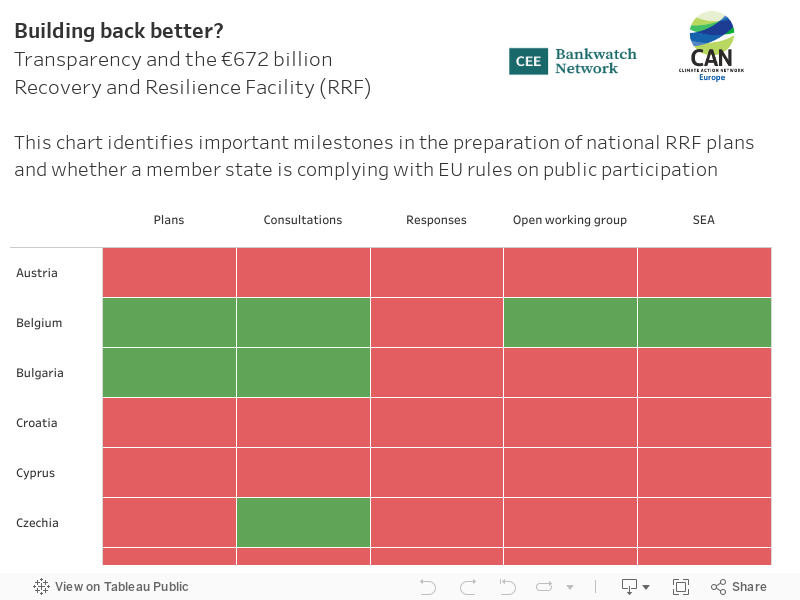
The RRF will be the largest part of the EU recovery package, providing an enormous EUR 671 billion of the total EUR 750 billion in funds to EU Member States for reforms and investments in green and digital priorities. It will therefore prove decisive in allowing for a green and fair recovery which moves away from the fossil fuel dependent status quo towards a cleaner, more sustainable future. 

This vote is a big step forward for achieving just that. As well as choosing not to finance activities that undermine the Union’s climate and environment objectives, the Committee also took an unprecedented move to back the use of the EU Taxonomy criteria for ensuring that only sustainable activities will be financed. Applying this Taxonomy to the RRF will almost entirely prevent further investments in fossil fuels, including natural gas. The Committee also voted for at least 37% of the RRF to be directed to financing climate actions and 10% towards biodiversity, something that would have been inconceivable until only recently. 

Bankwatch has long supported applying stricter criteria for accessing EU funds and ending the disastrous financing of fossil fuels. Through first hand experience, our member groups have revealed how all too easily Member States in central and eastern Europe (CEE) are able to use EU public funds and investments to directly finance projects that are harmful to the environment and climate.

Yet we have strong reasons to believe that CEE countries intend to use the recovery funding to further deepen their dependence on fossil fuels and undermine the objectives of the European Green Deal. We are particularly concerned over the region’s plans to spend substantial amounts of the Facility on supporting gas infrastructure. Some governments have also publicly announced their intention to increase development of roads and dams financed under the RRF. This is despite road transport being responsible for the increase in total GHG emissions, and the proven devastating impacts of dams on biodiversity. 

We thoroughly commend the ambitious decision presented by the ENVI Committee, but there is still a long road ahead before these amendments become officially adopted into the RRF legislation. This ENVI vote was only an opinion on the RRF: the Committee was asked to provide input to the lead Committees (ECON and BUDG), who are ultimately responsible for this file and will have the final say on presenting it before the plenary vote in November. However, as lead, they have no obligation to adopt the same amendments and opinion as ENVI and can even decide to completely disregard it. Only last month, the Committee for Regional Development voted against the full exclusion of fossil fuels within the EUR 17.5 billion Just Transition Fund.

The overwhelming support by ENVI MEPs, however, clearly demonstrates the strong and growing level of climate ambition in Parliament. The message is clear; end financing of fossil fuels and start financing a clean, green recovery. The onus will now be on the ECON and BUDG committees to act on this and deliver the green recovery that is so clearly desired.

Ukraine’s dangerous air pollution problem in desperate need of solutions

The air in Ukraine is worse than anywhere else in Europe. The World Health Organisation ranks Ukraine as the country with the highest health impact from air pollution in Europe. With almost one third of the air pollution produced by energy generation, cutting emissions from power plants has to be the first step in dealing with this health hazard.

With 70% of Ukraine’s primary energy consumption coming from various fossil fuels, which in turn emit an enormous volume of pollutants into the air, it is safe to say that fossil fuels are the main culprit of the country’s air pollution. Coal-fired power plants lead the way: the massive fleet of 20 plants constantly pumps sulphur dioxide, dust and nitrous oxides into the air.

To put the problem into perspective, the reported sulphur dioxide emissions of the Ukrainian coal power plants for 2019 are 589,557 tonnes. This is strikingly close to the 617,281 tonnes emitted in 2019 by the 16 Western Balkans power plants, which in recent years have become famous for emitting more sulphur dioxide than all of the EU power plants combined. A recent report from the Centre for Research on Energy and Clean Air concluded that Ukraine is the single biggest emitter of sulphur dioxide in Europe, with most of the emissions coming from coal-fired power plants. 

Ukrainian coal power plants also reported emissions of 104,809 tonnes of nitrous oxides, twice as much as the notorious 16 Western Balkans power plants, and 155,891 tonnes of dust, which completely dwarfs the 17,556 tonnes from the Western Balkan plants.

According to the World Health Organisation’s information on mortality and the burden of disease from ambient air pollution for 2016, Ukraine has 2,538 disability-adjusted life years (DALYs) lost annually per 100,000 people. This is the highest number in Europe and is mostly driven by Ukraine’s fossil fuel addiction.

As a European Union accession candidate and a signatory to the Energy Community Treaty, Ukraine has a long list of obligations whose implementation would lead to a significant reduction in emissions. However, Ukraine has done a terrible job upholding these obligations so far, even with seemingly simple tasks such as reporting emissions to the Energy Community and the European Environment Agency.

In the emissions reports made under the Large Combustion Plants Directive, which has been in force in Energy Community contracting parties since January 2018, Ukraine’s data have several inconsistencies. The report for 2018 is missing emissions data for 15 of the stacks that were operating during that year and should have reported emissions. Both 2018 and 2019 reports include plants, such as the Burshtynska power plant (which exports electricity to the EU), whose reported emissions match the limits set in the National Emissions Reduction Plan down to the exact figure. This raises suspicion that the numbers reported may be incorrect.

These inconsistencies in the reporting make the accuracy of the data questionable, to say the least, and in reality the emissions figures might be even higher. Also, due to the country’s old and degraded air quality monitoring system, the plants’ impact on ambient air quality is also not properly measured. 

Ukrainian citizens have taken it upon themselves to fill this information void with a wide network of citizen-installed particulate matter (PM) monitoring stations. However, indicative citizen monitoring is not a replacement for official monitoring with data available in real-time, and it certainly cannot replace continuous monitoring of emissions at the stationary sources of pollution.

It is high time for Ukraine’s government to take the air pollution problem seriously and to take concrete measures to reduce emissions at the source. This is a long and expensive process, regardless of whether it includes bringing the emissions from the power plants down to legal limits or replacing them with renewable capacities. However, further delays must not be tolerated by any party involved, including the international community. As long as Ukraine’s dangerous emissions continue unabated, people will continue to pay the cost with their lives.

Bankwatch published a publication covering the impacts of Ukraine’s energy sector on air quality and recommendations to protect human health and the environment from air pollution in Ukraine.

Publication in English, in Ukrainian. 

A Green Agenda for the Western Balkans: Where are the teeth?

Click here to view NGO recommendations from April 2020 vs this week’s Green Agenda proposal

Back in early April this year, 18 environmental organisations working in the Western Balkans put forward a set of recommendations on the EU’s Green Agenda, covering the five areas set out by the European Commission. 

While the devil lies in the numerous details that are yet to be hammered out, what sticks out overall is that the Green Agenda has plenty of good ideas, but a conspicuous absence of enforcement mechanisms.

Anyone dealing with governments in the Western Balkans must be aware that they are not really overachievers in environmental issues. Commitments made back in 2005 under the Energy Community Treaty  to cut pollution in coal plants remain woefully unfulfilled, two countries still plan new coal plants, and the whole region is suffering from a tsunami of destructive and unnecessary hydropower plants. Recycling and waste prevention are at miserable levels, while energy wastage is rampant. Rail and other public transport is being neglected, while overpriced and oversized motorways inflate the countries’ debts.

Against this background, change can be made, but usually only if politicians see clear consequences of not doing so. This has been proven again and again by the Energy Community Treaty. The Treaty has been in force since 2006 and has seen some progress with applying EU energy and environmental legislation in the region, but enforcement is seriously lagging due to the lack of penalties. A discussion is currently ongoing about introducing monetary penalties, which could finally speed up implementation as long as they are set at a dissuasive, effective and proportionate level.

But the Green Agenda has not taken this lesson on board. It is full of support, promotion, facilitation, and assisting, but short on binding measures. 

The only clear sign of extending the countries’ binding commitments is to “facilitate their swift alignment with the EU Climate Law”. This is certainly a very welcome move, but only covers one of the five Agenda areas, and still doesn’t mention how it will be enforced.

Another issue is a lack of coherence between the Green Agenda and the Economic and Investment Plan for the Western Balkans. 

While the Green Agenda promotes decarbonisation by 2050, the Investment Plan’s flagship on “Transition from coal” promotes four fossil gas pipelines presented as “future-proof” on the basis of no evidence whatsoever. 

It is hard to overstate how unreasonable this is in a region which does not have a tradition of widespread gas use. The European Commission is knowingly encouraging a set of not particularly rich countries to waste their limited resources on complex network infrastructure that will be obsolete in a couple of decades’ time and would call for yet another “transition”.

Another contradiction is on hydropower. The Green Agenda highlights the need to diversify away from hydropower and bioenergy, while the Investment Plan’s renewable flagship projects consist entirely of hydropower – except for in North Macedonia.

And while the Green Agenda mainly promotes rail and urban transport, half the Investment Plan’s transport projects are motorways.

People are sick and tired of words without deeds, and of contradictory messages. If the European Commission is serious about its Green Agenda, it has to stand behind it and find a way to make it enforceable. 

Whether this is through existing mechanisms like the Energy and Transport Communities or by changes in the Stabilisation and Association Agreements with the accession countries doesn’t matter much – the important thing is to make it stick. This way, the Western Balkans’ environment wins but the EU wins too, by finally convincing people that it means business.

Click here to view NGO recommendations from April 2020 vs this week’s Green Agenda proposal

Groundhog day: Third public consultation for Belgrade incinerator environmental studies and still no circular economy in sight

Around two years ago, the European Bank for Reconstruction and Development (EBRD) opened a public consultation on an environmental and social assessment for the Vinča waste incinerator, landfill rehabilitation, landfill gas facility and new landfill. The bank was considering financing the project and wanted to make sure that an environmental and social assessment meeting its own standards was carried out. So far, so good.

Ne Davimo Beograd and A11 from Belgrade, together with Bankwatch, submitted 92 pages of comments on the study, reflecting major deficiencies, for example a lack of data on waste projections, a lack of non-incineration alternatives, a failure to commit to the new EU Waste Incineration BREF standards being developed at the time, and the project’s negative impact on Serbia’s ability to meet EU circular economy targets.

When the responses came, they were clearly written by the project sponsor, Beo Clean Energy, without any additional input from the bank. As a result, our most important comments – eg. on the potential clashes with EU recycling targets, and the lack of recycling/prevention elements within the project – were put aside on the grounds that they were not the company’s responsibility. Yet its public-private partnership contract would clearly dictate Belgrade’s whole waste management system, locking the city into long-term incineration. 

This was already in conflict with the Aarhus Convention requirement that public participation must take place at an early stage when all options are still open, and things have only got worse since then.

Further attempts to clarify with the EBRD raised more questions than they answered. Tiny snippets of contradictory information were accompanied by bland assurances that the bank was satisfied with the Serbian authorities’ answers to its questions – presumably implying that we ought to be satisfied too. Clearly, we weren’t. We lodged an official complaint to the bank’s recourse mechanism.

Meanwhile in late June 2019, the Serbian Ministry of Environment opened a national level consultation on two environmental impact studies – one for the incinerator and landfill gas plant, and one for the new landfill. 

The national-level studies were more or less a rehashed version of the study presented to the EBRD, with the same factual mistakes, old data, missing waste projections and missing non-incineration alternatives. Despite the fact that the EU had earlier in June approved new pollution control standards called the Waste Incineration BREF, the national-level environmental study for the incinerator failed to demonstrate that the plant would adhere to the new rules.

Apart from wasting our time by having to comment on hundreds of pages of similar text twice in different formats, it was far from clear what either of these processes achieved. None of our substantial comments were taken into account – only a few minor details – and in September 2019 the Ministry of Environment approved the environmental impact assessment while the EBRD approved financing for the project.

The project promoters were clearly in a hurry, as the Ministry of Construction, Transport and Infrastructure issued the construction permit for the project on 16 August 2019 – more than a month before the environmental impact assessment process was complete, thus undermining the outcome of the process and rendering it largely pointless. 

Even an initial approval for the project to receive renewable energy incentives was issued by the Ministry of Mining and Energy on 27 September before the environmental assessment was approved, and before the final construction confirmation was issued by the Ministry of Construction on 8 October. This rendered it illegal both in terms of Serbian law and under the EU Renewable Energy Directive, which is binding on Serbia under the Energy Community Treaty. 

Under Serbian law, the approval for incentives should only have been issued once construction could legally start, while under the Renewable Energy Directive, only the biodegradable fraction of the waste can count as renewable, but the subsidies were granted for electricity from the whole plant.

Fast forward to summer 2020: Suddenly the Ministry of Environment started a new scoping process for an updated environmental assessment. 

The stated reason was that the study needed to be brought into line with the EU Waste Incineration BREF – yes, the same one that had been approved in June 2019, before the previous environmental impact assessment consultation, and the same one that we’d been highlighting in our communication with the EBRD for two years already.

So here we are again, on Groundhog Day, stuck in a never-ending cycle of submitting comments on environmental assessments of the Vinča incinerator, still with no basic data justifying the project. 

In fact, in the meantime, we found data which proves the project will conflict with EU circular economy targets, and the EIB and EC agree with us. But the EBRD, the World Bank’s International Finance Corporation and the Austrian Development Bank are sticking stubbornly with the project.

But this time it’s even weirder, as the Ministry has not made it clear whether it has annulled the previous permits and approvals for the project or not, and it is not clear whether construction on the actual incinerator has started.

Clearly this process has absolutely no integrity unless it can actually impact on the project and unless all options – including not building the incinerator – are still open.

In fact, given the fact that several appeals, lawsuits and legal complaints are pending against the project and the topsy-turvy permitting process, the most logical thing for the competent Serbian Ministries to do now would be to annul all the previous approvals and permits, and treat this environmental impact assessment as a new one starting from scratch. They will surely be reluctant, but the alternative might take even longer.

« Previous Page
Next Page »

Footer

CEE Bankwatch Network gratefully acknowledges EU funding support.

The content of this website is the sole responsibility of CEE Bankwatch Network and can under no circumstances be regarded as reflecting the position of the European Union.

Unless otherwise noted, the content on this website is licensed under a Creative Commons BY-SA 4.0 License

Your personal data collected on the website is governed by the present Privacy Policy.

Get in touch with us

  • Bluesky
  • Email
  • Facebook
  • Instagram
  • LinkedIn
  • RSS
  • YouTube