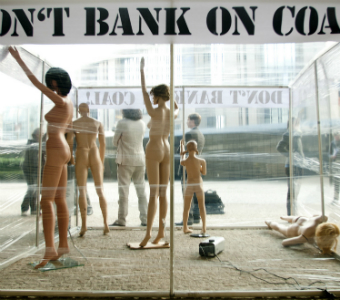
The art of sustainability is not to finance coal
Blog entry | 20 October, 2011Upset by Slovenia’s plans to build a huge lignite power plant unit in Sostanj, Slovenian artist Marko Kumer-Murc and Slovene environmentalists from Focus brought their protest to Brussels. Our media officer was on sight and brought back a few images.
Read moreStory of an artists. Leaflet against EU support for the Sostanj lignite power plant in Slovenia
Publication | 19 October, 2011Upset by Slovenia’s plans to build a huge lignite power plant unit in Sostanj, Slovenian artist Marko Kumer-Murc and Slovene environmentalists from Focus brought their protest to Brussels. The leaflet tells Marko’s story and offers a quick round-up of Sostanj and other coal power plants that are supported by international financial institutions.
Read more
Art installation at Berlaymont denounces banking on coal
Press release | 19 October, 2011Brussels – With an art installation that symbolizes EU citizens locked in a polluted environment, the Slovenian artist Marko Kumer Murč and Slovene environmentalists from Focus protest against European public and private banks pouring hundreds of millions of euros into a new lignite plant in their country, at Sostanj. Many Slovenians oppose this project and the Slovenian parliament has just refused to support a state guarantee for the banks’ loans. The action is supported by the international NGOs Banktrack and CEE Bankwatch Network, which are campaigning against the project.
Read more
There is a light at the end of the EIB tunnel
Blog entry | 18 October, 2011The European Investment Bank finally invited for a dialogue with civil society organisations. It might be a little ambitious to say that true dialogue happened there, but certainly the NGOs were able to send a couple of strong messages to the EIB Board, and, for a while, it felt like the Board was listening.
Read more
A historic event, the European Investment Bank opens its doors (a bit)
Blog entry | 12 October, 2011Ahead of a meeting next week that offers a unique chance for discussion with the EIB’s Board of Directors, Bankwatch’s EIB team leader Anna Roggenbuck gives an overview over some of the issues to which she’d like to hear some comments by the bank’s enigmatic leadership.
Read more
Potocnik says green economy, European public banks say black coal
Blog entry | 3 October, 2011The European Union’s internal and external ambitions for green economies are being countered by the activities of European international financial institutions. EU Commissioner for the Environment Potocnik can see that also in his home country Slovenia.
Read moreComplaint to European Commission: Inadequate assessment of CCS readiness for Sostanj lignite power plant project
Publication | 3 October, 2011Download the complaint as pdf
Read moreRequest for information on EIB role in Ostroleka C coal-fired power plant in Poland
Publication | 3 October, 2011Press information from September 2011 suggested that ENERGA S.A. is holding conversations with the European Investment Bank about financing a new coal-fired unit in Rzekun also referred to as Ostroleka C. With this letter, Bankwatch inquired whether the EIB is having conversations with ENERGA S.A. and if yes, at which stage they are.
Read more
Right track, weak attitude. The EU’s Resource Efficiency Roadmap.
Blog entry | 22 September, 2011The European Commission this week published its ideas on how to build a resource efficient economy in Europe. Bankwatch’s resource efficiency expert Marijan Galovic thinks the roadmap’s focus is not wide enough yet.
Read more
Bankwatch Mail 49
Publication | 21 September, 2011This edition focuses mostly on the European Investment Bank and EU funds related issues. Among the questions we discuss are: How is the EU budget, this 1 trillion euro process, shaping up, and will sustainability finally have a bigger role? and Will EIB investments in the Southern Mediterranean bring benefits to the people there or to Western companies?
Read more
