• Skip to primary navigation
  • Skip to main content
  • Skip to footer

Bankwatch

  • About us
    • Our vision
    • Who we are
    • 30 years of Bankwatch
    • Donors & finances
    • Get involved
  • What we do
    • Campaign areas
      • Beyond fossil fuels
      • Rights, democracy and development
      • Finance and biodiversity
      • Funding the energy transformation
      • Cities for People
    • Institutions we monitor
      • European Bank for Reconstruction and Development
      • European Investment Bank
      • Asian Infrastructure Investment Bank
      • Asian Development Bank (ADB)
      • EU funds
    • Our projects
    • Success stories
  • Publications
  • News
    • Blog posts
    • Press releases
    • Stories
    • Podcast
    • Us in the media
    • Videos
  • Donate

Home > Archives for Blog entry

Blog entry

Quantity over quality in EBRD food security initiative – Evidence from pig farms in Ukraine


Over the last years, the EBRD has put increasing attention to food security. In 2010 it adopted an agribusiness sector strategy (pdf) – which unsurprisingly focuses primarily on the private sector – followed by the launch of the Private Sector for Food Security Initiative to lead the bank’s operations in the sector.

While the second annual report (pdf) of the Initiative, published two weeks ago, praised the bank’s achievements in the agricultural sector, the bank’s focus on quantity and volume turns a blind eye on the quality and sustainability of food provision.

In its work, the bank frequently grants support not to small and medium private farms, but to industrial farms. Such agricultural giants, in their strive to harvest high profits, tend to leave people and the environment behind, especially in transition countries where landownership and consumer rights are traditionally less pronounced. Their intensive farming results in higher resource depletion and significant social impacts and thwart efforts towards secure and sustainable food production.

The sow stall of Europe

One of the recent examples for said pitfalls can be found in the EBRD’s operations in Ukraine. The country that is often referred to as one of the milestone countries for food production received USD 238 million in 2013 for agriculture-related projects. [1]

Among the EBRD beneficiary companies was Danosha, with a loan over EUR 35 million approved last year. The company, a subsidiary of the Danish Axzon Group, has been focusing on industrial pig farming in Ukraine since 2004. It owns five industrial pig farms in the Ivano-Frankivsk region with a total capacity to host 128 500 pigs. Two additional pig farms are under construction at the moment. Danosha’s crop production, mostly for pig fodder, is part of its full-cycle pig breading.

However, the operations at Danosha’s pig farms are associated with adverse environmental and social impacts. Local communities, suffering under Danosha’s farms have started organising themselves. (Read for example the unlikely story of 83 year old retired teacher Maria Vasylivna Antoniv.) Their long list of complaints regarding the company’s performance includes:

  • Danosha does not publish environmental information, in particular environmental impact assessments of its facilities even though these should be disclosed upon request.
  • Danosha did not implement adequate mitigation measures to protect the health of locals who still complain about headaches, loss of appetite and malaise which they say are caused by gases from the farms.
  • Danosha did not pay for lease agreements in time. In the village Sivka-Vojnyliska Danosha leased around 200 ha of lands from around 50 farmers in 2005-2012. Lease agreements are terminated at the moment, but Danosha still has not paid land use compensations to the owners.
  • Danosha’s manure management system is feared to be unsafe and may result in manure leakage. This is most worrisome in the case of Danosha’s Lany farm, located only a few metres from to the Galuch national nature park with extremely sensitive wetlands that is habitat to a number of endangered species.

For a complete list of concerns, see NECU’s letter to the EBRD (pdf) from February 5, 2014.


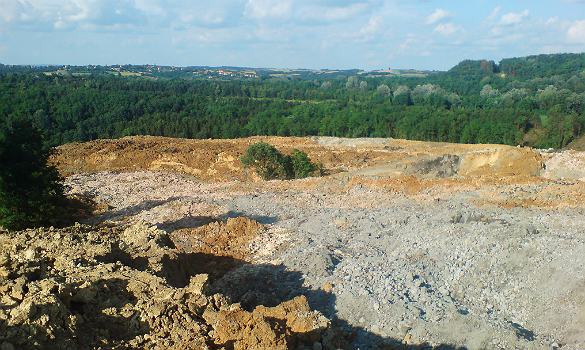
Danosha’s Lany farm (left) and just across the small glade the territory of National Nature Park begins (where the trees start on the right).

Like in many EBRD projects that Bankwatch monitors, the bank was informed in a letter from November 27, 2013 (pdf) about problems with Danosha’s performance before the loan was approved (December 17) – to no avail. The EBRD decided to finance Danosha’s activities regardless. And sure enough, just one month after the loan agreement was signed, locals affected by the impacts of Danosha’s farms filed a compliant to the independent recourse mechanism of the International Finance Corporation, another multilateral funder of Danosha. (Find more information in the letter from February 5 (pdf).)

Instead of targeting its efforts towards more sustainable small and medium scale farms, the bank finances farm factories that may secure food supply at a faster rate, but that result in significant social and environmental problems in the future. (The Danosha loan is not an isolated case. In October the EBRD approved support for another Ukrainian client that causes similar distress – MHP. Again, the EBRD had been informed beforehand.)

Avoiding responsibility

Not only does the EBRD prioritise private agribusiness giants involved in unsustainable operations, the bank also poorly acknowledges its responsibilities towards affected communities.

The EBRD filed the Danosha project under the environmental category B, claiming that “potential impacts are site specific and readily identified and addressed through mitigation measures.” This, however, is not the case when it comes to factory farms.

The EBRD’s reasoning for this classification (pdf) is that the loan’s purpose is not the construction of pig farms, but other activities – increase in feed mill capacity, agricultural machinery, construction of two bio-gas plants, etc. Yet, all of these activities are an integral part of Danosha’s bigger investment plans for Ukraine that aim at the expansion of activities and include the construction of the two mentioned factory farms. Had the company asked directly for a loan for the expansion of its facilities – each farm factory under construction will host more than 10 000 sows – the project would have been be classified as A, the highest category of environmental risk, and treated by the bank correspondingly.

Instead of acknowledging these connections, the EBRD washes its hands clean of the significant environmental and social impacts of Danosha’s factory farms and does not assume adequate responsibility.

–

With the EBRD’s preferred support of large agribusiness corporations I expect the development of large factory farms only to pick up speed. Unfortunately, striving for food security with unsustainable business practices will inevitably lead to increased environmental and social insecurities and will in the long term likely result in damages to the soil that made Ukraine the breadbasket of Europe.


1. This number includes a project to increase debt exposure to the Ukrainian MHP group which involves operations in Ukraine and Russia and is therefore classified as a regional project.

EIB commits to review tax haven policy


This article first appeared on the Counter Balance blog and was cross-posted with the author’s permission


Compared to 2013, when the EIB’s energy policy dominated the meeting, a wider number of cross-cutting issues were raised by civil society organisations during this year’s discussions. The bank’s accountability and transparency, however, quickly emerged as central themes – topics on which the EIB showed only limited progress in the recent years.

The EIB repeated its commitment to a high level of transparency in its operations, including via the announcement of the revision of its transparency policy in 2014. However, the civil society organisations were adamant that the EIB needs to more seriously tackle the issue of its lending though financial intermediaries. The different sessions especially saw Dotun Oloko – whistleblower in the Ibori case – highlighting the poor due diligence of the EIB when operating through private equity funds and its lack of seriousness in dealing with fraud and corruption allegations.

Faced with calls for more accountability and taking into account the recommendations from its own Complaints Mechanism, the bank remained elusive. The vice-president Pim van Ballekom noted that the EIB is asked by EU institutions for more transparency, monitoring, evaluation, democratic scrutiny and a zero tolerance on tax and fraud issues, but that ultimately it is up to the bank to strike a balance. Indeed, testimonies from local activists – such as those fighting the Castor Project in Spain – demonstrate that the way the EIB strikes this balance does not testify for a genuine consideration of public participation and greater inclusion of affected communities in its activities.

Also lacking was the bank’s vision on the social impacts of its operations. At the first meeting of this kind in 2011, former president Philippe Maystadt openly put forward the willingness to place human rights consideration at the heart of the bank’s lending – without concrete results though. Three years later, the EIB did not take any commitment in this regard and avoided most critical views.

However, the EIB explicitly proved ready to pursue its way on a green path via strengthening its Emissions Performance Standards and launching a public review of the climate impact of its lending portfolio in 2014.

Finally, a disappointing note was the minimal involvement of the Directors of the EIB in the meeting which was largely monopolised by the management of the bank. Opening discussions with the governing board of the EIB – despite diverging views – is crucial if the bank wants to become a fully accountable institution.

GMOs, water grab and ice cream for the masses – the EBRD gets involved with Nestlé Egypt

Update: The EBRD clarified in its correspondence with Baby Milk Action that its loan will not be used to finance infant nutrition.


The EBRD’s board of directors yesterday approved a USD 20 million loan for the expansion of Nestlé Egypt food production company. Leaving aside the question whether Nestlé – one of the world’s largest companies from one of the world’s richest countries – really qualifies for multilateral development finance, there are several reasons why this decision is problematic.

Nestlé is the largest artificial baby milk producer with 40 per cent of global market share and has been operating almost everywhere in the world under the label of “good food, good life”. But what about the highly questionable practices Nestlé has been implementing across the world for the past decades? 

GMO

Nestlé openly acknowledges the fact that it uses genetically modified foods. Since 2009, Egypt has banned the import and export of GMOs.

While the country is seeking a way out of a difficult transition period, the regulatory framework on the use of GMOs or products deriving from GMOs has been the subject of a court order (released all in Arabic) and grassroots organisations have been fighting the work of GMO giants such as Monsanto for a few years. How can the company ensure that it is only using ingredients allowed for sale in Egypt? Does it even label products containing GMOs?

Let them eat ice cream

According to the EBRD,

“The operation will enable the Company to finance foreign currency working capital needs and investments into the expansion of the Company’s food production capacity (ice cream, confectionery) to meet the growing demand […]” (emphasis added)

But what sort of priority is that? The majority of Egyptians cannot afford to buy the Nestlé and Movenpick ice cream produced by the company. Only the upper middle and high classes can afford this luxury whereas most Egyptians struggle just to afford bread, eggs or drinkable water.

If the EBRD can’t do better than financing Swiss multinationals in its new countries of operation, I’m not sure that the people of Egypt are going to be too convinced about its development impact.

Artificial milk

Nestlé, who has been operating in Egypt for more than a century, has been repeatedly criticised for unethical marketing practices of its infant formula milk. In addition, the artificial Nestlé milk sold in emerging countries is so expensive that mothers dilute it with water usually unfit for human consumption to make the artificial milk last longer. Unfortunately, these practices have led to fatal diseases and malnutrition when mothers should be supported and encouraged to breast feed their babies whenever possible. The baby milk scandal created such an uproar that a network was created in response to this, the Baby Milk Action who called for a boycott on Nestlé’s products “because it contributes to the unnecessary death and suffering of infants around the world by aggressively marketing baby foods in breach of international marketing standards.”

Water grab

Unfortunately, there is something much uglier about Nestlé and its practices, and it has to do with one of the most basic human rights, the right to water. Surprisingly, Peter Brabeck-Letmathe, Chairman and former CEO of Nestlé has on numerous occasions declared that “one opinion, which I think is extreme, is represented by the NGOs… As a human being you should have a right to water. That’s an extreme solution.” According to him, water is a commodity, just like any other commodity such as food, and therefore should have a market value. Nestlé is the biggest producer of bottled water worldwide so it seems obvious that the company has a major interest in privatising water supply. I suggest you watch journalist Abby Martin debunk Nestlé’s water rhetoric as it is quite edifying.

It is clear to me that Nestlé puts the profit of the world biggest food producer before basic human rights and basic health. I would be very curious to know what are the EBRD’s views on this specific topic and the EBRD’s true motivations to assess Nestlé as a suitable candidate to benefit from such a loan.

Georgian hydro projects are a test case for the EBRD’s good governance policies


Yesterday in Tbilisi, during a public consultation on the good governance policies of the European Bank for Reconstruction and Development, an unexpected thing happened.

A Georgian activists movement staged a protest action against two potentially harmful hydropower projects, the Dariali and Shuakhevi HPPs, which had appeared in the EBRD’s project pipeline. The activists held banners asking the bank not to fund the two projects for they would destroy the gorges of Dariali and Adjaristskali.

The activists specifically referred to the case of the Paravani hydropower plant (HPP) as a reminder for the bank’s management not to repeat the mistakes made earlier. The 87 MW Paravani HPP includes a 14 km derivation tunnel to divert water from the Paravani river to the Mtkvari river upstream of the village of Khertvisi. In some periods this would leave only 10 percent of water in the Paravani river – inadequate to ensure the survival of downstream flora and fauna – while at the same time, the project creates a significant risk of flooding Khertvisi.

Beyond exemplifying what can go wrong in small hydro projects in Georgia, the Paravani case also clearly illustrates the shortcomings of the EBRD policies that were under discussion yesterday. As Bankwatch reported in January, the EBRD’s Project Complaint Mechanism concluded (six months after we filed our complaint (pdf)) that three sections of the EBRD’s Environmental and Social Policy had been breached. The current review of the bank’s policies can be an important turning point to avoid similar debacles and strengthen independent control mechanisms.

Pleasantly EBRD staff agreed to listen to the activists’ concerns which were presented by one activist and which I summarise below these images from the action.

Shuakhevi HPP

The Norwegian company “Clean Energy Invest” plans to construct a cascade of three HPPs on the Adjaristskali river in the Autonomous Republic of Adjara. The cascade includes the 185 MW Shuakhevi HPP, the 150 MW Koromkheti HPP and the 65 MW Khertvisi HPP. According to the project information of the EBRD, the Bank plans to fund the first HPP from the cascade Shuakhevi HPP.

The project includes the construction of a 22 metres high Skhalta Dam with a flooding area of 19 hectares) and the 39 metres high Didachara Dam (16.9 hectares) as well as three diversion tunnels. The project envisages leaving only 10 percent of the average annual water flow of the Adjaristskali river downstream from the dam.

Dariali HPP

The Dariali hydro power plant (HPP) project envisages the construction of a derivation type hydro power plant with an installed capacity of 110 MW on the river, in the Kazbegi municipality, close to the Russian-Georgian border.

The project would divert the greatest part of Tergi’s water, about 90 percent, leaving an approximate eight-kilometer section of the Tergi River without water. This would result in the landscape being radically changed on the eight-kilometer section of the Dariali gorge with a total length of 11 kilometers. As a result of the water diversion, the Gorge will additionally lose its historical cultural-ethnographic values and tourism importance.

In additional to causing environmental damage, the project would also harm the historical and cultural heritage as well as the local economy. The Tergi river was a source of inspiration for famous Georgian writers and poets like Ilia Chavchavadze, Alexander Kazbegi and Grigol Orbeliani. The river and its adjacent landscape are also attracting tourists, who would inevitably stay away, if the Dariali HPP project were implemented in its current form, resulting in adverse effects on the incomes of locals engaged in the tourism industry.

Ukraine and the EBRD: More than technicalities derail the fight against corruption


Tomorrow the EBRD is consulting with the public in Kiev its policies on the disclosure of public information and its safeguards for people and the environment against negative impacts from its investments. The EBRD invests close to a billion euro in Ukraine every year in different sectors – energy, agribusiness, manufacturing, municipal infrastructure. Close attention from Bankwatch on several of these investments have showed that a lot more can be desired, not only from project promoters like the state-owned company, Energoatom, but also from the EBRD itself, which still actively hides information on projects that can have significant impacts on Ukrainians.

Yanukovich and technicalities in fighting corruption

The roots of the recent political crisis in Ukraine can be seen in the deteriorating economic situation in the country and the inadequate political steps that the government took to address it. Instead of tackling rampant corruption that stripped this rich country of revenues and hence benefits for a wider society, Yanukovich thought he could impose a dictatorship and disregard the will of his people.

There are no technical reasons at play here, but the EBRD’s very specific emphasis on ‘business confidentiality’ and a range of political interests in Ukraine. Public interests on the other hand take the back seat yet again.

Read also


Leaked document: Doubling of electricity tariffs in Ukraine, condition for EBRD nuclear safety loan
Press release | January 27, 2014

Ukrainian nuclear sector in defiance and in financial trouble
Blog post | December 4, 2013

Yanukovich did not only try to dodge the demands of Ukrainians, but also pressure coming from the EBRD, however, by opting out from a Memorandum of Understanding with the EBRD to join forces against corruption and improve the investment climate in the country. The government quoted “technical reasons” as an excuse back in November, and progress on the MoU since has been further overshadowed by Ukraine withdrawing from an association agreement with the European Union and its subsequent plunge into a deep political crisis.

The EBRD and technicalities in increasing transparency

Interestingly, also the EBRD is using “technical reasons” as an excuse for failing to increase its transparency – one of the most important factors in tackling corruption. The bank is not embarrassed to repeatedly quote limited capacity as a reason for its lack of reform.

For example, at the first round of consultations on the EBRD’s Public Information Policy in Istanbul, the President of the bank, Sir Chakrabarti, agreed that the EBRD should do more to communicate the impacts of its projects. At the same meeting EBRD staff confessed that their disclosure on projects lags behind that of the IFC for example, but pointed to their lack of capacity to up-date project information on the bank’s website and upload mitigation plans and monitoring results.

Are ‘technical reasons’ a good excuse to keep the public in the dark about EBRD operations?

Environmental groups from the EBRD region and IFI-watchers from Western shareholding countries have demanded serious changes to the Public Information Policy on several occasions in the last 3 years, only to achieve minimal concessions.

Therefore not surprisingly, the 2013 Aid Transparency Index, ranked the EBRD as the worst among 17 multilaterals in a list of 60 donor organisations. With a 24.5% score the EBRD scored worse than the European Investment Bank with 26.6% (both banks landed in the ‘poor transparency’ category).

Claiming moral high ground on the battle against corruption but failing to be transparent and accountable

Speaking on the EBRD’s efforts in fighting corruption, EBRD president Suma Chakrabarti said last year:

“We first and foremost act via our investments. In all our projects, we aim to promote the highest possible standards of governance, integrity and transparency among the companies in which we invest.”

So how does the EBRD show the way on transparency and democratic consultations through its projects? Let’s take a look at Ukraine, one of the biggest recipient countries of the EBRD with an annual lending volume reaching one billion euros. Setting a good example through EBRD operations could potentially have a transformative impact on business conduct and transparency, which are instrumental in fighting corruption and allowing the public to take part in important decisions.

The reality, however, looks completely different: The EBRD’s biggest recent investment in Ukraine, a project resulting in the lifetime expansion of Ukraine’s nuclear reactors, comes as an excellent case in point. The EBRD approved a loan to the public company Energoatom in March 2013 but refused to disclose not only loan conditions, but even the project’s additionality (i.e. the added value beyond the financial bottom line) and the expected transition impact (the EBRD’s raison d’être).

Now that those details have been made public in a leaked document the very real consequences of such exaggerated confidentiality are becoming clear: Socially important issues (in this case doubled electricity prices) that are directly connected to the bank’s investments are discussed only within a small group of people with vested interests. Moreover, even members of the Ukrainian parliament who are to ratify an agreement with the EBRD have no clue about financial obligations attached to the loan.

As a consequence of the exaggerated confidentiality also some of the welcomed loan conditions remained unknown (such as provisions to ensure that money will be set aside for decommissioning the reactors) thus preventing public oversight over their implementation.

Instead of stimulating the Ukrainian government to initiate a wider public (and democratic) debate on the true costs associated with the nuclear industry the EBRD “united forces” with the state’s nuclear company Energoatom and with the government to keep all relevant details a secret.

There are no technical reasons at play here, but the EBRD’s very specific emphasis on ‘business confidentiality’ and a range of political interests in Ukraine. Public interests on the other hand take the back seat yet again.

[Campaign update*] Georgian government and investors reject Ombudsman’s offer to mediate in controversy over Khudoni mega dam


Today, an extraordinary meeting of the whole Svan community is being held in Khaishi in the Georgian Svaneti mountains. The meeting deals with the Khudoni hydropower plant project which has been stirred up Georgian emotions since summer last year.

The new intensification of the controversy was triggered by land survey works that the Khudoni investor Transelectrica had started in the end of January. Noticing the works, locals blocked the central road in Kaishi with big rocks and built tents for people to guard the village day and night.


Protesters warming around a small stove in the tent. (More images below.)

Read also


Growing solidarity with local communities in Georgia puts Khudoni dam in spotlight
Blog post | October 4, 2013

In Georgia, dam builders do not welcome peoples’ concerns
Blog post | September 24, 2013

In Georgia, locals voice opposition to mega dam during consultations despite intimidation
Press release | September 17, 2013

The main contention concerns the fact that in 2012 more than 1500 ha land were sold by the Georgian state to Transelectrica for 1 USD. Locals were not informed about the deal that included land traditional owned by the local population but not officially registered. The plight of the Svans from Kaishi has since then found more and more support among the Georgian population.

Earlier this week, Georgia’s Ombudsman Ucha Nanuashvili, who has already voiced his concerns about the project, stated after meeting locals [ka] that (own translation):

“there are serious violations and too many questions to which the investor company Transelectrica has to answer. It is incomprehensible why measurements and registration of the property should happened now even though the property was already transferred to the company.”

Background: hydropower in Georgia


Find out more

Nanuashvili offered to organise and facilitate a dialogue between locals, Transelectrica and the Georgian Ministry of Energy on February 4. Yet neither Transelectrica nor the ministry sent representatives to the meeting. Nanuashvili regretted their refusal, noting that it will further complicate reconciling the increasingly entrenched positions.

Nanuashvili proposed another public meeting of all interested parties (including the ministry and the investor) for February 28 to discuss specifically the human rights dimension of the Khudoni project.

The meeting would be held shortly before the Ombudsman offices publishes its final report on the project in March [ka], according to official information. The report is the result of the Ombudsman’s investigations after the local population of Khaishi officially requested the protection of their rights several months ago.


The protest tent in Kaishi.


Machinery used for the road block.


* Campaign updates on the Bankwatch blog highlight news from projects we monitor as well as from our member groups and partners.

« Previous Page
Next Page »

Footer

CEE Bankwatch Network gratefully acknowledges EU funding support.

The content of this website is the sole responsibility of CEE Bankwatch Network and can under no circumstances be regarded as reflecting the position of the European Union.

Unless otherwise noted, the content on this website is licensed under a Creative Commons BY-SA 4.0 License

Your personal data collected on the website is governed by the present Privacy Policy.

Get in touch with us

  • Bluesky
  • Email
  • Facebook
  • Instagram
  • LinkedIn
  • RSS
  • YouTube