• Skip to primary navigation
  • Skip to main content
  • Skip to footer

Bankwatch

  • About us
    • Our vision
    • Who we are
    • 30 years of Bankwatch
    • Donors & finances
    • Get involved
  • What we do
    • Campaign areas
      • Beyond fossil fuels
      • Rights, democracy and development
      • Finance and biodiversity
      • Funding the energy transformation
      • Cities for People
    • Institutions we monitor
      • European Bank for Reconstruction and Development
      • European Investment Bank
      • Asian Infrastructure Investment Bank
      • Asian Development Bank (ADB)
      • EU funds
    • Our projects
    • Success stories
  • Publications
  • News
    • Blog posts
    • Press releases
    • Stories
    • Podcast
    • Us in the media
    • Videos
  • Donate

Home > Archives for Blog entry

Blog entry

Shale tale: Unconventional gas and the European Bank for Reconstruction and Development


In February this year the EBRD’s managing director for energy and natural resources, Ricardo Puliti, welcomed Shell’s move into Ukrainian shale gas, with a twist on energy independence for the country, while inviting smaller companies to follow Shell for the crumbs. While this doesn’t mean that the EBRD will finance Ukrainian shale gas operations, the invitation may be an indication of EBRD positioning, where it sees itself making some business.

In May, statements from the EBRD’s top banker in Poland, Lucyna Stanczak, gave us more reason for concern. Stating that shale gas is one of the priorities of Poland’s energy policy, she said that the bank could not ignore it. As Reuters reported, the EBRD plans to include shale gas operations in its upcoming country strategy for Poland for the coming three years.

Leaving aside the very controversial debate on shale gas in Poland, my prediction is that at the end of the day, the economics of shale gas (pdf) – which look less and less convincing – will most likely prevent the EBRD from joining such projects. What is this blog post all about then, you ask? In my view, the EBRD’s pitches into shale gas undermine the bank’s efforts to be seen as a responsible investor that chooses the least damaging option.

Considering the water contamination and the (not so small) carbon footprint of shale gas, one can argue that lignite is less damaging. Should this be an excuse then for the EBRD to go and continue financing lignite projects like the Sostanj power plant? Rather not. Choosing between one very harmful fossil fuel and another is a false choice when one should be concentrating on energy efficiency and sustainable renewables. Yet for a “down-to-earth” institution like the EBRD, a marginal improvement can be good enough, as long as it is economic feasible. Business is business, after all.

The EBRD’s energy policy, applicable to all its countries of operation, is currently being revised, with a draft to be open for consultation in June or July. The European Investment Bank is also expected to publish its draft energy policy in June. With statements like these on shale gas (or like others on coal), I’m very curious to see what these European banks have in stock for climate action and public benefit.

[Campaign update] The reality of resettlement in Kolubara: Out of the frying pan into the fire


During a recent visit to the headquarters of the European Bank for Reconstruction and Development in Belgrade, Bankwatch staff and journalists met with the bank’s country director and senior advisor for power and energy, Mr. Ian Brown (as reported here and here).

His presentation of the Kolubara lignite mine project included a picture of a beautiful new house, supposedly intended for the people that needed relocation due to the Kolubara mines expansion, aided by an EBRD loan. On enquiry, Brown confirmed that the type of house (which looked almost like stock photography) was only an illustration of the resettlement in Vreoci, a village adjacent to a mining field that the EBRD – as it often points out – did not support.

It wasn’t entirely clear to us whether we had seen the picture of an unrelated house or really the new home of a resettled family. [*] But we had a hunch that this beautiful house may not represent the situation for all resettled people.

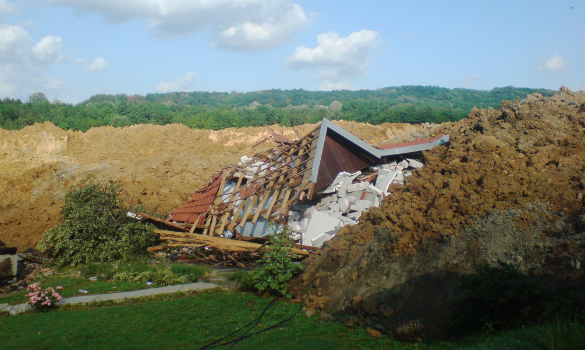
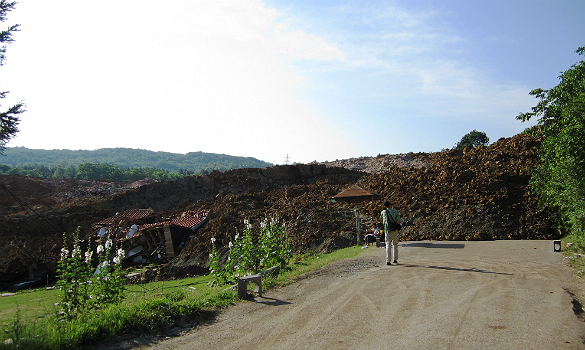
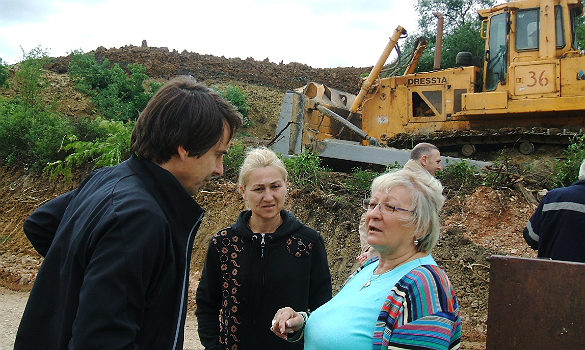
A few days ago we met Selimir Milutinović from Radlievo, who was relocated to a nearby spot by the Kolubara mines. The house that Selimir was resettled to was a far cry from what Mr. Brown had shown to us. It is an old house left behind by someone else. The cracks in the house (due to the mining works) are clearly visible on the images we took (see below).

Selimir told us the mining company still owns the house but doesn’t want to invest in its renovation. Neither does Selimir, since it is not his property.

We have already heard from the EBRD that they appreciate on-the-ground information that NGOs like Bankwatch provide. But the EBRD is the one dealing out about 80 million euros to the project company EPS, a wildly controversial company. It should therefore not shy away from assessing the real situation, even if it means uncovering some unpleasant truths about their client EPS. Instead, by showing an archetype resettlement case (realistic or not) from Vreoci, the EBRD is supporting EPS’s claims that they are carefully adhering to international standards for resettlements. If the EBRD really wants to offer “additionality” by improving social and environmental standards, it has to exercise pressure, not bury its head in the sand.

The real situation


[*] Update (June 4, 2013): The text has been updated to reflect that the house presented by Ian Brown was not necessarily stock photography, but an illustration for resettlements that the EBRD had not been involved in.


Campaign updates are a new feature on the Bankwatch website intended to highlight news from projects we monitor as well as from our member groups and partners.

Face the future: Members of European Parliament discuss energy lending of European public banks


Cross-posted and slightly edited version from the Counter Balance blog.


“It’s your energy” goes the slogan of Electrabel, Belgian’s primary energy company. But of course that’s not true. If it was my energy, most of it would not be generated in the first place and what I used would not come from nuclear power plants, coal or other kinds of fossil fuels. Ownership over energy implies having a say in how it is generated – given the different impacts of different energy sources – and as well managing the eventual profits.

It is one thing for such misleading claims to be included in advertisements, but it is entirely another when you realise publicly-owned banks like the European Investment Bank and the European Bank for Reconstruction and Development – which finance a great deal of our energy infrastructure – spend public money to finance outdated forms of energy generation like coal and other fossil fuels.

Now is the time for the banks to change course as both are currently reviewing their energy policies. Since most of these processes happen inside the banks behind closed doors, Bankwatch and Counter Balance decided to broaden the debate by holding a public event earlier this week in the European Parliament. Hosted by Parliamentarian Sabine Wils with the attendance of other MEPs and civil society organizations, the event was particularly noticeable for those not in attendance, namely the the EIB and EBRD. In spite of advanced invitations to attend, the banks apparently deem earlier consultations as sufficient forms of public debate.

But the implications of the banks’ energy finance needs urgent attention given warnings about limiting global temperatures to two degrees. This means greenhouse gas emissions should come down in Europe by 95 percent by 2050, with two thirds of proven fossil fuels to remain in the ground, and massive investments are needed in energy savings and the generation of renewable and sustainable energy sources – quite a tall order given the current policies in place at the bank.

Two European public banks are currently reviewing their energy lending policies. We call for an end to coal subsidies.

Data, demands and expert comments

From across Europe, the case against coal

Against this backdrop MEP Claude Turmes warned during the event, “Any new coal fired power plant is a disaster, especially if financed with public money.” Investment in fossil fuel related infrastructure will increase the weight of fossil fuels in our energy mix for at least another 40 years.

While the EIB and EBRD have increased investments in renewables and energy efficiency in recent years, their continued investments in fossil fuel projects undermines their claims as leaders in the fight against climate change. For instance EIB president Werner Hoyer said that the Sostanj lignite power plant, in spite of swallowing all of Slovenia’s carbon budget until 2050, “is not a bad project.” Also the head of energy at the EBRD Ricardo Puliti has labelled disinvestment from carbon intensive projects as “ideological”.

To highlight the schizophrenia of the banks’ energy lending, the event brought together testimonies from across Europe of the damaging coal-fired power plants the banks financed or intend to finance. Lidija Zivcic from Slovenian NGO Focus pointed to the harmful environmental and social impacts of the Sostanj plant, which is being supported by both the EIB and EBRD and currently facing corruption investigations by Slovenian officials and the EU’s anti-fraud office

Further south in Greece, Michalis Prodromou of WWF Greece discussed the Ptolemaida lignite plant (pdf), which the EIB is considering for financing in spite of the project’s disastrous impacts on human health and the environment. While it is often argued, particularly in a climate of austerity in Greece, that the project will create jobs, Prodromou debunked this myth, highlighting that the project would create only a limited number of jobs compared to the photovoltaic sector which already employs 20 000 people in Greece at the moment.

Finally Arberesha Loxha from the Kosovo Civil Society Consortium for Sustainable Development (KOSID) in Pristina explained the problems with the 600 MW lignite Kosova e Re project. In a country 95 percent dependent on coal for its energy mix and in spite of local opposition to the project, public financing from the World Bank, the US and likely the EBRD is unacceptable. MEP Ulrike Lunacek, who was at the event and has visited Kosovo many times, is concerned about the environmental and social consequences of the project. She highlighted the political interests pushing this project forward. “Looking at sustainable alternatives in line with EU long term climate objectives is the best way forward,”, she said.

The event in Parliament also showed that coal is not the only problematic energy sector in which the banks are investing. Olexi Pasyuk from the National Ecological Centre of Ukraine presented the case of an EBRD loan for so-called safety upgrades of nuclear power plants in Ukraine. Although the EBRD denies its loan is related to the extension of the plants’ operations, twelve units that are supposed to be closed before 2020 will most likely operate for another 20 years. NECU is asking that the banks put an end to supporting any extension programmes (both lifetime and capacity).

The responsibility of the Commission

Investments in coal by the EIB and EBRD also contradict the mandate given to the banks by the European Commission, who is a shareholder in both. In reply to a written parliamentary question from Bas Eickhout, another MEP present at the event, the Commission called on the new EIB energy policy to

“reflect the EU energy policy priorities which have been identified inter alia in the Europe 2020 Strategy, the Energy Infrastructure Package, the Energy 2050 Roadmap – in particular the “no regrets” solutions (infrastructure, efficiency as well as renewables, phasing out of harmful fossil fuels subsidies) – and the recently adopted Green Paper on a framework 2030 for climate and energy policies”.

Referencing the EU’s long-term climate objectives and the need to phase out fossil fuel subsidies is a step in the right direction for the Commission in asserting its interests at the bank and those of the European public it executes for.

Time to face the future

The event provided substantial inputs for the banks to consider in revising their energy policies. How much of it will be taken into account is uncertain, but the purpose of this roundtable to invite democratic debate in the Parliament and engage MEPs on the issue is an important first step.

As the new energy policies are being drafted in this moment, much can still be done.

  • First we should recognise that divesting from coal is not unrealistic – both the Nordic Investment Bank (pdf) and Agence française de Développement no longer fund coal-related projects.
  • An important discussion is unfolding in Brussels about the EU’s mid-term climate targets until 2030, those discussions are not currently taking place within both banks.
  • The Commission must play a key role in pushing the banks to adopt a more progressive stance to support the people in the countries where they operate. The event identified an unwillingness of the Commission to hold the banks accountable, particularly when it tacitly approves the types of harmful projects described above.
  • The European Parliament should also urge the Commission to exercise its responsibilities at the banks – through its Board representatives – by blocking provisions in the draft energy policies enabling funding for coal.

Read more

More on our campaign for an energy lending for people and planet >>>

Victory for civil society as EBRD cancels loan for controversial Croatian dam

Today we’re relieved in Zagreb as one energy project that could have had a destructive impact on Croatia’s future has lost its financing and thus its chances of going ahead are drastically reduced: I’m speaking about the infamous Ombla dam, a project for an underground hydropower plant that would have practically destroyed a protected area close to Dubrovnik.

Yesterday, the project developer, state energy company HEP, announced that the main financier of the future dam, the European Bank for Reconstruction and Development (EBRD), pulled out. Although an official reason was not given, it is clear that it was because of the project’s serious impacts on biodiversity.

Ombla had attracted widespread criticism from civil society groups and experts due to its impacts on the Vilina Cave – Ombla Spring protected area, which is home to 68 identified cave species, of which as many as 14 species are endemic to this site alone.

Uncertainties about the technical and economic credentials added to the widespread criticism of the project, as did the chaotic project development procedure, including the use of an old 1999 Environmental Impact Assessment and public consultations taking place only as a cosmetic measure long after the legal permits had already been issued.

In November 2011, the EBRD approved a loan of EUR 123 million for the new plant (whose total costs are estimated to reach EUR 152.4 million) on the condition that a nature impact assessment was completed before disbursement. When this study came out in March this year, it showed that the project could harm many of the 68 identified cave species, including the endemic ones.

Together with our colleagues from Zelena akcija in Zagreb, we’ve been for more than a year and a half explaining to the EBRD that the project comes with too many environmental costs and too much uncertainty about its economical and even technical feasibility to be promoted by a public institution.

We are very heartened that the bank was brave enough to pull out of this ill-fated project. We also hope that the EBRD will have learnt something from this experience: as the EBRD revises its Energy Operations Policy and its Environmental and Social Policy (both these revision processes are ongoing at the moment), it must make sure to include in the new blueprints criteria that will ensure the true sustainability of hydropower projects the bank finances in the future as well as their full compatibility with EU legislation.


Update: In its response to the open civil society letter, received on June 4, the EBRD confirms its withdrawal from the project. Download the response as pdf.

EU leaders support green energy campaign: The European Council calls for phasing out fossil fuel subsidies


One of the agenda points of Wednesday’s meeting of the European Council concerned Europe’s energy market. The summit’s conclusions (pdf) contain a number of interesting provisions, but one of them is particularly interesting in light of Bankwatch’s ongoing campaign to end the EIB’s fossil fuel lending.

The conclusions read (emphasis added):

As regards action taken to facilitate investments, priority will be given to:

[…]

(c) the revision by the Commission of state aid rules to allow for targeted interventions to facilitate energy and environmental investment, ensuring a level playing-field and respecting the integrity of the single market;

(d) phasing out environmentally or economically harmful subsidies, including for fossil fuels;

[…]

To end fossil fuel subsidies is a call that has been made now by a number of institutions and experts. Such a call coming from Europe’s political leaders in the European Council, and set explicitly in the context of exiting the economic crisis is still notewothy. Difficult economic circumstances are often rather taken as an excuse to continue financing allegedly “cheap” energy sources (coal and other fossil fuels).

As Bankwatch and other organisations have been arguing, targeted investments in renewables and energy efficiency can provide economic stimulus and create jobs. This is what public banks should be focusing their energy lending on as we are trying to illustrate in our new interactive infographic on the EIB’s beneficial and harmful energy lending.


(More details and a pdf version of the infographic are on our website.)

With the European Council’s conclusion, another political heavy weight can be added to the list of institutions that are calling for an end to public financial support for fossil fuels.

The EIB and other public banks must stop subsidising dirty energy, especially coal as soon as possible or it will continue inhibiting its own efforts to help create a clean and green European energy market.

Energy efficiency becoming more central to future EU spending in the Czech Republic – thanks to NGO calls


In recent weeks a promising response has emerged to one of the top demands from Czech NGOs engaged in the current programming process for future EU spending in the country. In April, the first draft of the Operational Programme Environment was disclosed for public consultations – it contains a new priority spending axis named ‘Energy savings’, included now in addition to those that had been previously announced by the Czech authorities.

This is a welcome move from the Czech Ministry of Environment, recognising the still drastically high levels of wasted energy use that pervades the Czech economy and society in general. According to Eurostat, the Czech Republic continues to require twice the amount of energy per unit of economic outcomes than the EU average.

This introduction of a separate priority axis, though, is just a first step towards fully realising the economic and climate potential of reducing our energy consumption.

Under the new priority axis, EU public financial support will be available for the thermal insulation of public and residential buildings, small renewable sources of heat and innovative technologies such as heat recuperation. A necessary precondition, however, to fully realise the high potential for heat savings in buildings remains – adequate levels of funding.

Greening EU funds to exit the crisis


More on our campaign

The Centre for Transport and Energy and Hnuti Duha-Friends of the Earth, Czech member groups of Bankwatch, are proposing an allocation of CZK 10 billion (EUR 400 million) a year for this purpose.

Our estimation of absorption capacity is in line with energy consultancy Porsenna’s estimation of CZK 500 billion being required to achieve economic efficiency potential in residential buildings by 2030 – the 25 percent public financing rate involved works out at CZK 7.81 billion (EUR 312 million) a year.

The Ministry of Environment has also weighed in with its calculations – a recent presentation given by vice-minister Tomas Podivinsky estimates the necessary public finance for energy renovations of residential buildings alone at CZK 250 billion over the next 30-40 years. That is, roughly CZK 8 billion (EUR 320 million) a year via public money sources.

The scale of the necessary investment level for energy efficiency in the next seven year period should be seen in the context of the overall Czech allocations, expected to total CZK 500 billion.

If the necessary ambition on energy efficiency is to be allowed to breathe, then around 15 percent of the total Czech EU pot needs to be devoted to this sector. A significant figure, then, but not a major leap into the dark when you consider energy efficiency’s deep cross-cutting benefits: reduced bills for homes and business, a lot of new jobs and big cuts in emission levels. And the ambition, crucially, must be to include both public and residential buildings full square in the priority spending axis – unfortunately there are signs that the Czech plans as currently conceived will not give enough priority to residential energy efficiency.

Another necessary element for proper energy renovations is the appropriate establishment of strict efficiency criteria which will ensure that funds are invested in line with the EU objectives – energy savings – and not just into plain refurbishment with low efficiency ambition.

Insufficient parameters for thermal insulation in EU funded projects was specifically criticised by the European Court of Auditors (ECA) at the beginning of the year. According to the ECA’s findings, member states used finance reserved for energy efficiency measures to simply upgrade their real-estate: “A more important consideration than energy efficiency was the need to refurbish public buildings.”, the ECA report conludes.

Funding in the new programming period must be set in a way so as to compel beneficiaries to achieve efficiency parameters more ambitious than current legal requirements. We believe that beneficiaries who opt for higher efficiency rates and install renewable sources should receive a motivational premium.

Practical examples of what can be achieved are out there.

Energy renovations carried out on pre-fab estates in Brno-Liskovec, for example, have shown that it is possible to achieve annual heat consumption as low as 40 kWh/m2 with only thermal insulation in typical communist-era ‘panel’ blocks – this is a much lower rate than required by the low-energy standard (50 kWh/m2).

Equally, the EU funded energy renovation of a school in Prague-Slivenec achieved 89 percent energy savings, with final annual heat consumption of 21 kWh/m2. Technologies typical for passive buildings, such as forced ventilation with heat recuperation, used in this renovation dramatically improved air quality in the classrooms. School children in Slivenec now appreciate the benefits of EU funding for energy efficiency, as this video clip illustrates.

Other than the successful NGO demand for a separate priority axis for energy efficiency, the Ministry of Environment has also accepted several of our other key demands. Departing from original plans, future EU funds in the Czech Republic will not now finance the production of bio-fuels. And in another improvement, EU support for water sewage treatment will be eligible in small communities, not only in those with over 500 inhabitants as previously planned.

All the same, the Czech programming process contains a number of problematic aspects that remain on our radar. Not least of which is the proposal to keep EU financing open to waste incinerators.

EU funding for these highly controversial waste ‘solutions’ has been perhaps the greatest single fiasco in the Czech Republic’s current 2007-2013 financing period. Not a single crown out of their huge allocation for 2007-2013 has been spent as a result of various controversies and local community/NGO campaigning.

« Previous Page
Next Page »

Footer

CEE Bankwatch Network gratefully acknowledges EU funding support.

The content of this website is the sole responsibility of CEE Bankwatch Network and can under no circumstances be regarded as reflecting the position of the European Union.

Unless otherwise noted, the content on this website is licensed under a Creative Commons BY-SA 4.0 License

Your personal data collected on the website is governed by the present Privacy Policy.

Get in touch with us

  • Bluesky
  • Email
  • Facebook
  • Instagram
  • LinkedIn
  • RSS
  • YouTube