• Skip to primary navigation
  • Skip to main content
  • Skip to footer

Bankwatch

  • About us
    • Our vision
    • Who we are
    • 30 years of Bankwatch
    • Donors & finances
    • Get involved
  • What we do
    • Campaign areas
      • Beyond fossil fuels
      • Rights, democracy and development
      • Finance and biodiversity
      • Funding the energy transformation
      • Cities for People
    • Institutions we monitor
      • European Bank for Reconstruction and Development
      • European Investment Bank
      • Asian Infrastructure Investment Bank
      • Asian Development Bank (ADB)
      • EU funds
    • Our projects
    • Success stories
  • Publications
  • News
    • Blog posts
    • Press releases
    • Stories
    • Podcast
    • Us in the media
    • Videos

Home > Archives for Blog entry

Blog entry

Paved with good intentions: text of EU emergency regulation on renewables permitting agreed

The EU Council yesterday agreed on the text of an emergency regulation aimed at speeding up renewables deployment during the next 18 months while updates to the Renewable Energy Directive take effect. Formal approval is expected on 13 December at the next Energy Council.

Action to speed up small-scale solar and heat pumps is more than needed. But the regulation is a prime example of the phrase ‘the road to hell is paved with good intentions’.

In its good intention to speed up renewable energy deployment, the European Commission, which published the proposal two weeks ago, has proven to be easy prey for industry lobbyists trying to dismantle EU environmental legislation by the back door.

Of overriding public interest – or just riding roughshod over EU environmental law?

The most controversial part of the regulation is Article 2, which would see all renewable energy projects presumed to be of ‘overriding public interest and serving public health and safety’. For example, if it is deemed that there are no suitable alternative solutions, a hydropower project could be built, no matter how much it damages Natura 2000 sites or degrades river water quality. 

This undermines existing EU environmental legislation which allows such harmful developments only after assessing projects on a case-by-case basis.

It is also likely to increase public opposition to the most controversial renewables projects with impacts on protected areas or pristine rivers, because it will increase the impression that the projects are being pushed through irrespective of local opinion.

But the most painful part is that it’s unlikely to make a major difference to the EU’s overall renewable energy capacity. Existing EU law is already flexible on this issue and allows many projects to be built despite having significant impacts, so just a few most damaging projects will benefit from this change.

Abuse of emergency powers

The emergency regulation has been adopted under Article 122 of the EU Treaty, which allows the EU to take emergency action, particularly to overcome energy supply difficulties. But the text goes far beyond economic measures with severe and disproportionate effects on key environmental laws. 

And some of the measures – particularly on overriding public interest – are not only of marginal importance for the overall energy supply, but they will anyway not have an impact on time to tackle the current energy crisis.

Even if a damaging renewable project – say a hydropower plant or a wind farm in an area important for birds – is declared to be of overriding public interest now, the chances of it being built in the next year or so are almost zero.

Sidelining the European Parliament

Major changes to EU environmental law should not be carried out via emergency regulations. Existing legislation should be reviewed for its effectiveness – the so-called fitness check, and any adjustments should be proposed by the Commission, accompanied by an impact assessment, and agreed on by the European Parliament and the Council. 

In fact, the last fitness check on the Habitats Directive found that it was fit for purpose, and the same goes for the Water Framework Directive. So any changes would have to be particularly well-justified. This was not the case here – as this is an emergency regulation, no impact assessment had to be carried out, and the Parliament did not have to be consulted.

To make matters more complicated, the emergency regulation includes some of the same measures currently being discussed by the European Parliament as amendments to the Renewable Energy Directive, but with different wording. Even if the Parliament later votes against such measures or votes to change them, they will anyway be in place for the next 18 months, rather undermining the Parliament’s decision-making role.

Welcome to legal chaos

The existing EU environmental laws and national laws are still in place, so the new regulation has created a parallel system for renewables that creates clashes and contradictions. This is likely to lead to more lengthy court battles, not fewer. 

Among the most absurd provisions is that the new regulation allows Member States to change the permitting rules half way through for projects already undergoing permitting: ‘Member States may also apply this Regulation to ongoing permit granting processes which have not resulted in a final decision before [starting date of application of this Regulation], provided that this shortens the permit granting process and that pre-existing third party legal rights are preserved.’  

In theory, this makes it more likely that the regulation would have a quicker impact, targeting projects which are already undergoing permitting rather than those which have not started yet. But in practice, it’s hard to imagine this leading to anything other than legal chaos. 

Remember, when it comes to overriding public interest, we are talking about only the most controversial projects which wouldn’t be able to be built without these new changes. So on one hand, project promoters will be pushing to have their projects assessed under the new rules, no matter where in the process they are. And opponents of the projects will push to ensure their rights to consultation and to legally challenge permitting decisions are preserved. It’s not hard to see who will win in this case, but this will just unleash a new round of legal challenges.

What next?

Given that the Commission and Council have likely overstretched the definition of emergency measures in this case, it remains to be seen whether the regulation will be subject to legal challenges,

But in any case, Member States have considerable flexibility in applying these new provisions, so it will be partly up to them to minimise the amount of chaos and dissatisfaction stemming from the new rules. 

And most importantly, similar provisions are currently being discussed for the longer term as amendments to the Renewable Energy Directive. So it’s crucial for the Parliament, Council and Commission to take a long, hard look at whether trashing EU environmental legislation is going to make a serious contribution to upping the EU’s renewable energy share. We can’t solve the climate crisis by destroying nature, after all.


Is Estonia doing enough to reach 100 per cent renewable electricity, and can it do even more with the help of REPowerEU?

Investments in renewable electricity production and storage 

The energy and climate-related investments and reforms in Estonia’s operational programme and recovery plan include a wide range of interventions. Altogether, they make up a coherent policy mix that supports the move towards 100 per cent renewable electricity and include:  

  • Incentivising renewable electricity production in industrial areas.  
  • Strengthening the electricity grid to allow for the integration of new generation capacities. 
  • Piloting renewable electricity and heat storage to balance production and consumption when the amount generated fluctuates based on the weather. 
  • The deep renovation of buildings in regions outside the larger cities. 

As the Estonian government prepares to add a new chapter to its recovery plan under REPowerEU, we in the Estonian Green Movement would like to emphasise which investments and reforms should be introduced, improved and prevented. 

Biogas can offer an alternative to fossil gas 

Fossil fuel phase-out will be necessary not only in the electricity sector, but also in the whole energy system, including in heating and transport. In light of the current gas crisis, it is especially important that Estonia uses EU funds to scale up the production of alternative gases such as biogas and renewables-based hydrogen.In order to assure sustainability, we propose the call for proposals contain criteria that would allow for biogas production only from residue and waste, not energy crops. 

Estonia’s operational programme incentivises biogas production with demand-side investments. A EUR 12 million investment is planned for  procuring  biomethane buses for public transport in larger cities and building biogas fueling stations. The buses will consume around 55 gigawatt hours per year of biomethane, and it is expected that the increase in demand will spark a corresponding rise in domestic biogas production. In the future, biogas from these production facilities can also be used for electricity and heat production in hours of peak demand instead of fossil gas.  

Hydrogen use has to be carefully prioritised 

Estonia’s recovery plan will support the uptake of renewables-based hydrogen technologies, making EUR 50 million available for pilot projects that aim to build up whole value chains. Projects must require that hydrogen be produced from electrolysis with the use of renewable electricity, financing for transmission and storage infrastructure, and specific technologies for hydrogen consumption. Although green hydrogen is not a bad solution in principle, it should be used only in sectors where reducing emissions by other means is very difficult, such as the steel and chemicals industries, aviation, long distance shipping and heavy duty road transport. We propose the call for proposals includes criteria that prioritise the production and consumption of hydrogen only in the aforementioned sectors where better alternatives for decarbonisation, such as electrification, alternative fuels, a modal shift, do not exist or are not competitive. 

If the sectors that can apply for EU funding to develop hydrogen capabilities are not limited, financial support may be used to build up hydrogen value chains in sectors that are not economically viable or environmentally optimal. An example of such a project has already emerged in Tallinn, where hydrogen will be produced from wood biomass and used as fuel for city taxis. These options are not reasonable: first, electrolysis requires a very large amount of electricity and wood biomass is a very limited resource; second, in the case of passenger cars (including taxis), direct electrification (electric vehicles) is a significantly more efficient and environmentally friendly solution than hydrogen fuel cell vehicles. 

Gas demand must be reduced 

Estonia must also avoid using EU funds to build additional permanent fossil gas infrastructure such as LNG terminals. Instead, Estonia should seek to reduce gas demand as much as possible and to invest in biogas and hydrogen production where the highest environmental standards for its use can be met (as indicated in the previous sections).  

At the moment, gas is primarily used for heating: approximately 45,000 households in Estonia are heated with gas boilers. To reduce the dependence on imported fossil gas, buildings with gas boilers should be connected to a district heating network or their boilers replaced with heat pumps as soon as possible. The Estonian Heat Pump Association has estimated that around half of these households would need financial support to purchase a heat pump. We propose to allocate additional funds for replacing gas boilers with heat pumps or  district heating. 

Energy poverty has to be addressed 

It is welcome that the Estonian recovery plan intends to implement differentiated financial support for renovation, with higher support rates in rural areas where property values and the residents’ capacity to invest are low. However, the inability to renovate may be correlated more with household income rather than the area of residence. At the same time, in the current energy crisis, low-income households who are unable to renovate are the ones who need renovation the most to lower their energy bills. We propose that Estonia differentiate reconstruction subsidies based on household income (or, in the case of apartment buildings, the average household income), whereby low-income households would receive higher subsidy rates. 

Energy communities need a nudge 

Although the EU’s new solar energy strategy foresees the creation of at least one citizen energy community in every city that has at least 10,000 inhabitants by 2025, so far the electricity production in Estonia has been heavily centralised in the hands of a few oil shale companies. No support is currently foreseen for establishing energy communities in the Estonian operational programme or recovery plan, making cooperative electricity production an untapped opportunity that could help to increase local communities’ support for renewables and improve their energy security.  

However, local communities may not have enough funds to initiate the planning of large-scale solar and especially wind farms. We believe Estonia should follow the lead of other European countries that support energy cooperatives through direct grants in the early stages. The grants could be used for conducting preliminary studies, establishing the feasibility of the projects and attracting investors from the community. 

Wind farms do not belong in forested areas 

To increase the uptake of renewables in the energy mix, the REPowerEU plan proposes to accelerate the permitting process for wind and solar farms by largely abolishing the requirement to conduct an environmental impact assessment. This would, for instance, make it easier to clearcut forests to make way for wind and solar farms.  

Although it is necessary to shorten some parts of the permitting process, it should not be done by abolishing environmental legislation and excluding the voices of affected stakeholders. Estonia should not finance the building of wind and solar farms in forested areas under REPowerEU, as the necessary clearing of forested land creates new carbon emissions, reduces carbon sequestration and damages biodiversity. Following Estonia’s Land Use, Land Use Change and Forestry (LULUCF) sector sequestration target for 2030, preference should be given to sites other than forested areas when planning wind parks. Replacement afforestation cannot outweigh decades of carbon sequestration deficit and biodiversity loss related to massively increased clearcutting. 

Suggestions for Estonia’s REPowerEU chapter 

Estonia is taking steps in the right direction, but there are still some measures that could and should be improved in Estonia’s recovery plan. REPowerEU offers an opportunity to do so, but there are loopholes that should be avoided. We suggest the Estonian government:  

  1. increase support for replacing gas boilers with heat pumps or district heating, 
  2. carefully prioritise support for green hydrogen production and consumption in sectors where better alternatives don’t exist,  
  3. differentiate renovation support based on household income,  
  4. introduce a subsidy for emerging energy cooperatives to conduct preliminary studies, and  
  5. avoid financing wind and solar farms in forested areas. 

Sustainable district heating gives hope to the Romanian city of Motru, in a coal mining region

It’s not often that a town in a coal dependent region leaps to a fully renewable district heating system. Sometimes it is not even technically possible; other times, decision makers are just too rooted in ‘how we’ve always done things around here’ and keep old polluting heating systems on life-support because it’s the easier political decision. But the city of Motru in Romania benefits both from political will and from diverse sources of sustainable energy and can be a leading example for other municipalities in the country in their efforts to decarbonise the heating sector. 

On 17 November, the study Heating from renewable and alternative energy sources for the city of Motru. Solutions and recommendations was launched in Motru, Gorj County, with the support of the mayor and representatives of the local council. The study, which presents five alternative scenarios to the current coal-based district heating system, was carried out by the Institute for Studies and Power Engineering (ISPE) at the request of Bankwatch Romania. Its goal is to assess whether the need for heating and hot water of the 5,000 homes connected to the system can be met in a sustainable way, using renewable energy sources, with minimal negative impact for residents’ health and the environment. 

The coal-based district heating plant is managed by the local council and has been providing hot water and heating to Motru’s residents since 1970. Currently, it supplies 86 per cent of Motru’s population, 8 per cent of the public institutions and only 6 per cent of the private ones.

The end of an era?

In recent years, the increasing costs of CO2 allowances – up from EUR 7 per tonne of CO2 at the end of 2017 to over EUR 70 per tonne of CO2 now – and the health-damaging pollution caused by the aging power plant, have made it increasingly difficult to operate it. The wear and tear on both the thermal power plant and the hot water distribution system also results in a lot of lost heat: the system’s registered thermal energy losses in 2021 stood at an eye-watering 46.8 per cent. 

At the end of 2021, the company running the plant just barely managed to get out of the insolvency process it had been mired in since 2016. To continue providing heating and hot water for the residents of Motru, the operator received at least EUR 6.5 million in financial aid from the local budget. 

Because the financial problems were projected to deepen month after month, the mayor of Motru and Bankwatch Romania decided to look for sustainable, financially viable and non-polluting solutions. 

A fully renewable energy scenario is possible, even in a coal dependent town 

The study includes the analysis of five scenarios with different technologies for the production of thermal and/or electrical energy. These technologies range from conventional ones, which are expensive to operate and have considerable environmental impacts (such as fossil gas boilers, a municipal waste incinerator), to a biomass cogeneration plant, to photovoltaic (PV) panels on the ash deposit and heat pumps. 

Out of all five scenarios, the 100 per cent renewable one stands out as the best choice for modernising the thermal power plant. It involves the use of heat pumps powered by solar PVs mounted on the heating substations and on the ash disposal sites. The electricity required to power the heat pumps when the solar PVs cannot provide it will be taken from the national grid. Along with a deep renovation of the apartment buildings stock, and the rehabilitation of the distribution system, the scenario is possible, viable from a technical-economic point of view and ‘easier to manage and safer from the point of view of continuity and safety of supply’, according to the authors of the study. 

The income from the system’s operations fully covers the annual operating expenses. The EUR 23.5 million original investment is estimated to be recovered eight to nine years after the new heating system is put into operation. After the ninth year of operation, the new district heating system would begin making profits. An important part of the cost cuts is because the plant will no longer have to buy CO2 allowances. In 2022 alone, the plant operator had to buy over 45,000 CO2  allowances, with a cost burden of approximately EUR 2.5 million. 

The 100 per cent renewables scenario will also significantly improve the local air quality, as current emissions from the district heating plant (sulphur dioxide, nitrous oxides and dust particles) would disappear altogether. 

The fully renewable scenario ensures the district heating system will be independent from potentially unreliable, unavailable or expensive fuel sources such as gas, waste or biomass. The fully renewable solution eliminates the risk of having production outages and it gives more predictability to consumer prices. 

Funds exist – Motru just has to go for them 

The investment needed for a 100 per cent renewable district heating system in Motru is estimated at EUR 23.5 million, which the local administration must fundraise. Fortunately, the palette of available sources of funding is wide, and it ranges from grants to low-interest loans. The Modernisation Fund, the Just Transition Fund, Romania’s COVID-19 recovery plan, and its operational programmes all prioritise investments in renewables, especially in district heating. Motru is a just transition region and has a Territorial Just Transition Plan, so it ticks all the boxes to qualify for this funding. International financial institutions (such as the EBRD) would gladly lend to such projects as well, but when grants are available, they should be the municipality’s preferred option. We can only hope the local council sees all these benefits and opportunities and approves Motru’s way forward on its sustainable path. 

The city of Motru is the first town in one of Romania’s coal regions to take such a step towards the use of renewable sources and thus towards decarbonising thermal energy production. The initiative is in line with EU policies and the commitment to increase renewable energy production and improve energy efficiency. Moreover, it will set an example for other towns in similar situations. The well-being of Motru’s citizens will depend on the modernisation of its heating sector. 

Ukraine Reconstruction Platform: nothing to write home about

Since May 2022, when the European Council tasked the European Commission with designing the ‘Ukraine reconstruction platform’ to streamline international effort to rebuild Ukraine, no progress has been made. At the Ukraine Reconstruction Conference in Berlin in October 2022, Ursula von der Leyen, President of the European Commission, reiterated the same pledge without elaborating on the issues that have caused frustration among crucial shareholders in the process – civil society organisations in Ukraine and internationally.  

Coordination platform: a lot of hot air 

The objectives of the latest Berlin conference were formulated around how to involve different sectors and actors, how to map investment needs, how to coordinate action, and, of course, how to channel resources in a reliable and accountable way. Yet these objectives, set by one of the conference’s organisers, the European Commission, were not achieved. The discussions were primarily centred around ‘what?’, not ‘how?’, postponing answers for another occasion – maybe even until the next donor conference, which will take place in summer 2023.  

On the other hand, Ukraine’s government should keep abreast of the decisions taken regarding the Reconstruction Fund as well. Ukraine’s prime minister proposed the concept of a ‘financial Ramstein’, which became a new buzzword following the meeting, as one way to do this. This proposal would most likely consist of regular decision-making meetings resembling those of the Ukraine Defense Contact Group (the ‘Ramstein’). Yet there is no clarity if Ukraine’s partners would support such a format. 

Sleepwalking into ‘build back as it was before’ 

It is not just the process of preparing for Ukraine’s reconstruction that is worrisome, but also the fact that the European Commission and other international partners seem to be ignoring civil society’s requests for its implementation. Civil society organisations want to see green and sustainable principles at the core of the planning for Ukraine’s reconstruction. Sporadic, fast repairs and preparations for the winter are already happening as we speak. If there is no common understanding and overarching agreement that Ukraine’s post-war reconstruction must be green, we may find ourselves sleepwalking into a situation where Ukraine’s reconstruction is not in line with its Green Deal commitments.  

This year, COP27 has already shown that the leadership of the developed world envisions Russia’s full-scale war on Ukraine as an impetus to accelerate decarbonisation, not an excuse to ease green transition. Ukrainian civil society organisations and their partners in other countries should have a seat at the negotiation table to prevent fossil fuels from being allowed under the RebuildUkraine reconstruction plan.  

Delivering on the previous achievements  

Since Ukraine has become an EU candidate country as of 23 June 2022, the country’s reconstruction will be closely linked to closing the sectoral chapters of the accession process. The European Commission’s civil servants have been working with the Ukrainian government since 2014 when the parties signed the Association Agreement: this means there is a certain institutional memory to build on in the reconstruction and accession processes.  

The European Commission – more precisely, DG NEAR, a dedicated Support Group for Ukraine and the EU Representation in Ukraine – already constitutes the key coordination and institutional mechanism to monitor the EU-Ukraine Association Agreement. To avoid additional coordination burden and further slow-down of the procedures, the future Ukraine reconstruction fund secretariat should be integrated with the already established workstreams. On the Ukrainian side, aligning the reconstruction and EU candidacy workstreams will motivate Ukrainian civil servants and further the professionalisation of Ukraine’s institutions.   

The question of who should lead in coordinating the donors has been discussed many times recently, and several parties would have a say in it. Still, the European Union constitutes the most stable counterpart when it comes to long-term commitment, which post-war reconstruction is. The US policy towards Ukraine may change depending on the country’s leadership, adding one more argument to keep the EU at the head of the reconstruction coordination platform.  

At the implementation level, a bankable, EU-candidacy-aligned national reconstruction plan should receive the green light from the wider group of Ukrainian stakeholders and recognition from civil society. While Ukraine lays out its own plans, it is necessary to set up an inclusive overall planning process for those plans and aligning it with EU goals and priorities.  

Ukrainian state bodies sometimes provide contradicting messaging, which is understandable due to the effort dedicated to defending the country against Russia’s military aggression. However, if we want to be ready to deliver changes swiftly upon Ukraine’s victory in this war, forward-looking thinking and partnership should be at the core. This is where the experience of EU agencies and civil society might be helpful, but civil society should have inclusive communication channels, equal opportunities, and a fast pace if it wants to influence decision-making. The European Code of Conduct on the Partnership Principle may provide insight into how to implement public involvement from all stakeholders’ perspectives. There is little point in waiting until next summer’s donor conference in the UK when we can have all hands on deck now, hammering out solutions that will serve Ukraine’s green, people-centred reconstruction.  

Western Balkans: EUR 1 billion in EU funds to tackle the energy crisis – with gas?!

During a tour of the Western Balkans last week and at the Berlin Process Summit on 3 November, President von der Leyen made a series of statements announcing a total of EUR 1 billion in grants for the Western Balkans to help tackle the energy crisis. 

The Commission has pledged to provide EUR 500 million budget support by January to support households and small and medium sized enterprises to survive energy price increases and their impact. In addition, the Commission has promised another EUR 500 million for energy diversification, renewable energy generation and gas and electricity interconnections through the Western Balkans Investment Framework. 

The first question is whether this is new money at all, or whether it’s just a re-labelling of the EUR 9 billion already promised to the region as part of the Instrument for Pre-Accession. This has yet to be clarified. 

It’s also unclear why no funds were announced for Montenegro, and whether funds approved in such a hurry will really be used as effectively and strategically as possible.

But whatever the source of the funds, it’s unbelievable that President von der Leyen is yet again promoting fossil gas in the Western Balkans. Thirty-six civil society organisations working in the Western Balkans have already written to her this year specifically asking the Commission to stop doing this.

The Western Balkans are not as dependent on gas as most of the EU so preventing more gas lock-in in the region is an absolute must. The idea that gas is somehow necessary as a stepping stone to decarbonisation is the product of extensive lobbying by the gas industry, not a technological or economic reality.

Gas is as much a fossil fuel as coal. It will need to be phased out in the next couple of decades, so there is no point in building expensive new gas infrastructure now. The region’s experience with coal shows that once a certain fuel becomes entrenched in the energy mix, it takes decades and decades to move away from it.

Russia’s brutal invasion of Ukraine has once again underlined that increasing reliance on imported fuels — especially from authoritarian regimes like Azerbaijan’s — makes no sense. It’s unfathomable that the EU hasn’t learned this lesson by now. 

In addition, much of Azerbaijan’s gas infrastructure is partly owned by Russia’s Lukoil, so this also brings tax income and potentially sensitive information for Russia.

The European Commission often claims that gas infrastructure in the Western Balkans could be used for renewable gases in the future, but so far these are fairy tales with no evidence or studies to back them up. There will never be enough affordable renewable gases to fill large gas networks and hydrogen anyway requires different technical standards than fossil gas.

EUR 1 billion is very little even to tackle the immediate crisis with, if we look at the billions already spent on electricity imports (e.g. Serbia). If it is spent on investments which will really help households such as rooftop solar, housing insulation and heat pumps, or on tackling electricity distribution network losses, it can help. But the EU simply must stop promoting gas in the region if it wants to have any credibility in advancing a sustainable energy transition. 

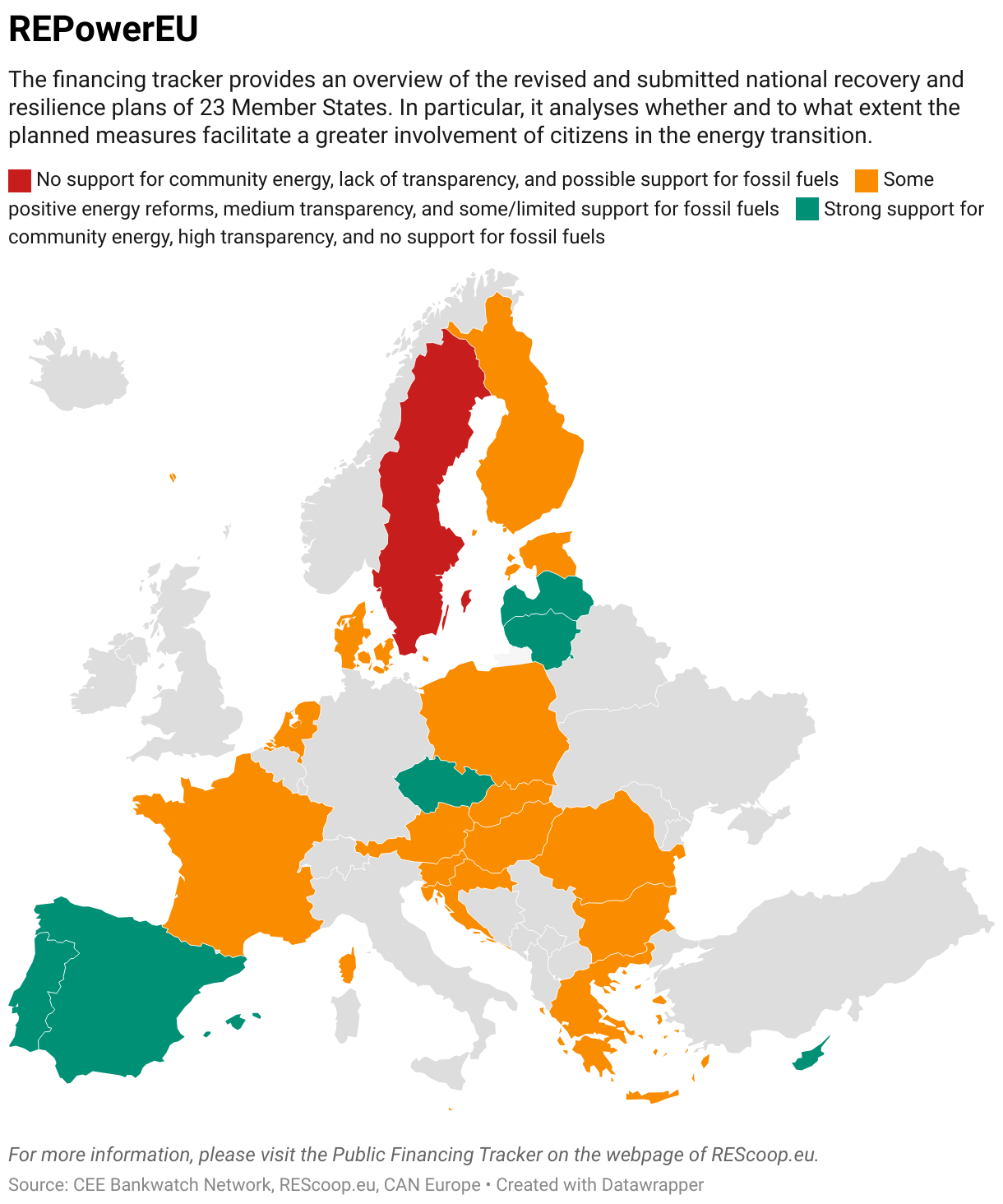
Europe cannot be “REPowered” if citizens are not at the centre of the transition

On 9 November, members of the European Parliament (MEPs) in plenary will vote on the European Commission’s proposal to revise the Recovery and Resilience Facility (RRF) regulation to integrate REPowerEU chapters into the existing recovery plan. The vote will be crucial in determining the direction of the energy transformation in the EU and will have a huge impact on people’s lives; while institutions are negotiating the details of the revision, the energy crisis is already affecting citizens, who are struggling to cope with the very high cost of living all around Europe. 

However, it seems that once again citizens will have practically no voice whatsoever in the discussions over which investments and reforms will be enacted under REPowerEU. Concerning transparency and openness, the European Commission’s proposal for the new chapters simply replicates what was already written in the RRF regulation: vague and weak provisions on stakeholder engagement and consultations, which enabled member states to make important decisions behind closed doors, without opening plans up to public scrutiny during the preparation of the recovery plans.  

Together with other civil society organisations, CEE Bankwatch Network condemned this growing tendency and called for action in a letter to the European Commission in May 2022 asking the EU to acknowledge its responsibility as a proponent of democratic governance and to open the room up for participatory democracy. Promoting a bottom-up approach and involving citizens, cities and regions is essential for moving forward to a green and just transition of our economies and societies. Despite this, we are not witnessing any positive development at the moment: REPowerEU, as it is proposed now, is another big step back for citizens’ involvement and democratic governance. 

Aside from the European Commission’s proposal, the position of the Council of the EU is even more alarming. On 4 October, ministers agreed to remove any reference to consultations with stakeholders. Although we expect it to be amended in the negotiations with the parliament, this position is worrying and dangerous, as it removes democratic accountability.  

What we are witnessing today is the compromise of democracy for the sake of rapidity. However, the European Parliament has the chance to reverse this trend and give the public a voice in the discussions in November. MEPs should look back at examples of successful participation during the preparation of the recovery plans, like in Bulgaria, where pressure from civil society organisations led to the removal of a very harmful measure: the coal-to-gas conversion of the Maritsa East 2 power plant.   

For now, the text adopted by the committees for budgets and economic and monetary affairs on 25 October sends signals of hope; MEPs on the committees amended the proposal, adding mandatory consultations with partners and a reference to the Code of Conduct on the Partnership, which is one of the cornerstones of the Cohesion Policy. This is the only way forward: mandatory interaction with citizens and the compulsory establishment of monitoring committees.  

When the 9 November plenary comes, it will be time for civil society’s voice to be heard and for REPowerEU to be fully opened up to participatory democracy. In the context of the overlapping crises that are affecting European society, institutions cannot continue to ignore people’s concerns. It’s up to the whole European Parliament to make the right move. 


« Previous Page
Next Page »

Footer

CEE Bankwatch Network gratefully acknowledges EU funding support.

The content of this website is the sole responsibility of CEE Bankwatch Network and can under no circumstances be regarded as reflecting the position of the European Union.

Unless otherwise noted, the content on this website is licensed under a Creative Commons BY-SA 4.0 License

Your personal data collected on the website is governed by the present Privacy Policy.

Get in touch with us

  • Bluesky
  • Email
  • Facebook
  • Instagram
  • LinkedIn
  • RSS
  • YouTube