• Skip to primary navigation
  • Skip to main content
  • Skip to footer

Bankwatch

  • About us
    • Our vision
    • Who we are
    • 30 years of Bankwatch
    • Donors & finances
    • Get involved
  • What we do
    • Campaign areas
      • Beyond fossil fuels
      • Rights, democracy and development
      • Finance and biodiversity
      • Funding the energy transformation
      • Cities for People
    • Institutions we monitor
      • European Bank for Reconstruction and Development
      • European Investment Bank
      • Asian Infrastructure Investment Bank
      • Asian Development Bank (ADB)
      • EU funds
    • Our projects
    • Success stories
  • Publications
  • News
    • Blog posts
    • Press releases
    • Stories
    • Podcast
    • Us in the media
    • Videos
  • Donate

Home > Archives for Blog entry

Blog entry

New Bankwatch publication: Eight steps for a just transition in the Western Balkans

The European Commission has committed to making Europe climate neutral by 2050, and most EU countries are now either coal-free or have set targets to phase out coal by 2030. Yet in nearby Western Balkan countries, key decision makers still make the argument that a fast transition to clean energy sources is too difficult. 

That is no longer the case. A critical mass of international bodies have now committed to assisting non-EU Member States in the region with expertise and cash to make the energy transition work. The Energy Community Secretariat is committed to the goal, and a new Platform for Coal Regions in the Western Balkans and Ukraine was set up in 2020 to help coordinate the process. The Energy Community, the European Commission, the World Bank and the European Bank for Reconstruction and Development, among others, are also involved. 

Civil society groups, Bankwatch included, can share their valuable experience of working with local communities in coal regions and show similar communities in the Western Balkans how to make sure their voices are heard by the international actors with the power to push the money where it’s needed.

Where we’re at in the region

In November 2020, the leaders of Western Balkan countries signed on to the Green Agenda for the region, thus committing to decreasing pollution and decarbonising their economies by 2050, as the EU block. Effectively, this would mean stopping all plans for new coal units and determining closure dates for operating ones.. To realise this pledge, countries in the region have to adopt ambitious national energy and climate plans (NECPs). 

The six countries in the Western Balkans are currently working on NECP draft development, with North Macedonia – a clear frontrunner – already submitting its document to the Energy Community.  

North Macedonia, although making progress towards a more substantial deployment of renewables, is nevertheless counting on gas to make the switch away from coal. The country’s leaders, and other leaders in the region too, need to understand that relying on gas as a transition fuel is a trap: it means building new gas infrastructure and relying on imports, all of which will end up as stranded assets only a few decades from now. The momentum created for just transition in the region today must be fully used to transform energy systems towards those based solely on fully renewable sources. 

Serbia, meanwhile, has adopted both a climate change law and an energy legislation package with provisions concerning renewables, energy efficiency and mining, including measures to unbundle electricity and gas transmission system operators. However, there is still a contradiction between Serbia’s declarative commitment to decarbonisation and the government’s actions. Alongside Bosnia and Herzegovina, it is the only country in the region still actively planning to bring new coal capacities online, and its Spatial Plan covering the period 2021-2030 – which was under public consultation in April – foresees no less than 2.1 GW of new installed capacity from four new lignite power plants.

At the same time, Kosovo’s newly appointed government has reassured its international partners about its intentions for climate neutrality and is looking for support with short- and medium-term reforms in this direction. 

The good news from the region is that several governments have understood the need to drop plans for new coal units, which were still being considered as recently as one year ago. Sadly, the closure of existing plants is mostly being postponed. Gas is also cropping up as a transition fuel too often in planning. Leaders of Western Balkan countries need to be more ambitious when it comes to conceptualising the transformation – the resources and expertise are there. 

Crucially, support for a just transition among communities in coal regions is growing by the day. In Pljevlja, Montenegro, a Just Transition Platform was created by locals. The Platform is both popularising the concept and pushing for its implementation in the region, with the involvement of local communities. 

The guide

For both national leaders and interested local communities, the Bankwatch Eight steps for a just transition guide is a source of hands-on knowledge, derived from the experience of other communities in the EU confronted with a similar process. The publication lays out what needs to be done, at the national, regional and local levels, for the just transition process to be kicked off in the right way: from clarifying the concept of just transition, to clarifying the potential of the region, getting decision-makers on board and involving the local communities, to finding sources of financing. Case studies show how, for each of these aspects, communities in other countries have made it work. 

The guide can serve as a starting point for anyone working on just transition in the Western Balkans. More in-depth materials are available from Bankwatch and other partners.  

Drina dam “groundbreaking” event met by scepticism and protests

Plans to build the Buk Bijela dam on the river Drina have been around since the 1970s, when a larger version of today’s project threatened to flood Montenegro’s legendary Tara canyon. The project was stopped then but revived in the early 2000s. After strong opposition and a highly critical report by a UNESCO delegation, the project was again shelved, but Republika Srpska began work on planning a smaller version of 93 MW, whose reservoir would supposedly not encroach on Montenegrin territory. 

The project is planned in BiH’s Republika Srpska entity a few kilometres upstream from the town of Foča. Its reservoir would stretch right up to the Montenegrin border, where the river Tara and river Piva join to form the Drina. 

An environmental impact assessment process was carried out between 2011-2013 but after the then investor pulled out, the project again lapsed until 2018, when Elektroprivreda Republike Srpske tried to renew its environmental permit.

Currently, a company 49 per cent owned by Elektroprivreda Republike Srpske (ERS) and 51 per cent owned by Elektroprivreda Srbije (EPS) is not only planning to build Buk Bijela on the upper Drina, but also Foča and Paunci. Together, these three would have a total capacity of around 180 megawatts.

Water sports tourism and endangered Danube Salmon under threat

Despite the fact that the three dams would turn the crystal-clear Drina into a series of stagnant reservoirs with a total length of around 30 kilometres, each of these projects is being treated as separate, with individual permitting procedures, presumably to play down their environmental impacts. 

But what they all have in common is that they would destroy the most important remaining habitat for the globally endangered Danube Salmon (Hucho hucho) and wipe out the area’s burgeoning outdoor sports tourism. 

Nature Lovers Montenegro showed their opposition to the Drina dam plans today.

The latest in a long line of premature groundbreaking ceremonies

Another thing the dams have in common is that they are nowhere near ready to be built, so today’s groundbreaking ceremony is premature, to say the least. This is not the first time that such ceremonies have been organised for energy projects that are nowhere near ready in Republika Srpska – a foundation stone was laid for the Gacko II coal plant in 2007 and Mrsovo hydropower plant in 2014, but to this day neither of the plants have been built.

In July 2017, a memorandum on construction of Buk Bijela was signed with the China National Aero-Technology International Engineering Corporation (AVIC-ENG), but no final construction contract appears to have been signed. The only building permit issued for the project so far is for preparatory works.

Neither has any loan contract been signed, so the source of financing remains unclear. And no feasibility study has ever been published. In 2018 it was revealed that none existed at the time, but if any has been carried out in the meantime, the results are unknown to the public. Dams are particularly vulnerable to the Balkans’ increasingly erratic rainfall patterns, so updated hydrological studies and feasibility studies are crucial.

Legal challenges

Despite the fact that the Drina forms part of BiH’s border with Montenegro and Serbia, no consent has been sought from the BIH state institutions to build the plants, a fact that was today reiterated by BiH’s Minister for Foreign Affairs, Bisera Turković.

In December 2020, 24 members of the House of Representatives launched a constitutional court case against Republika Srpska’s decision to issue a concession for the construction of the upper Drina hydropower plants, as they state that decisions regarding state property such as rivers on international borders can only be taken at the state level.

The Aarhus Center in Sarajevo has also submitted two cases to the Republika Srpska high court on the Buk Bijela and Foča plants. The first is challenging the Ministry for Spatial Planning, Construction and Ecology’s 2019 decision to allow ERS to rely on a poor quality environmental impact assessment of Buk Bijela written a decade ago, instead of requiring a new study when it applied for a new environmental permit. The second challenges the Banja Luka District Court’s failure to quash the environmental permit for Foča even though ERS breached the legal deadline for requesting its renewal.

A case is also pending at the Espoo Convention Implementation Committee due to Bosnia and Herzegovina’s failure to consult Montenegro about the transboundary environmental impacts of the upper Drina hydropower plants. A group of NGOs submitted a complaint to the Committee in May 2020, as did the Montenegrin government in December 2020.

Buk Bijela’s outdated environmental assessment claims that there would be no transboundary impact from the plant, but it provides no evidence. In fact, according to scientists, damming this section of the Drina would disrupt the migration of the endangered Danube Salmon from the Tara upstream, where steep cliffs protect the river from human influences but do not offer many suitable spawning grounds. 

In addition, there is a dispute about whether the reservoir would enter Montenegrin territory. If the reservoir reaches up to 434 metres above sea level, as claimed in the environmental assessment, then it would encroach on Montenegro’s territory, as the border is at 432.37 metres.

Rafting regata participants from Serbia and BIH showed their opposition to the Drina dam plans this weekend.

Endless limbo for local inhabitants

Local people have been told for more than four decades that Buk Bijela will be built, and during this time they have not been able to properly invest in their land or businesses. The road from Foča to the Montenegrin border has been woefully neglected, waiting to be fixed as part of the dam project that never arrives. 

Yet the Drina’s natural beauty has increasingly been recognised by tourists visiting for rafting, kayaking or angling trips and facilities to accommodate them have been built above the river. These have not been taken into account at all during the project development process, being seen as a temporary phenomenon that will simply be erased when the dam is built, rather than a source of income-generating local development.

Protection needed, not destruction

Within Montenegro, the Tara is part of the Durmitor National Park and UNESCO World Heritage Site. But when it reaches the BiH border and becomes the Drina, it is at the mercy of those who see rivers only as sources of electricity, ignoring their myriad of other crucial roles for the survival of various species. 

In fact, the environmental impact assessments for the three dams are of such poor quality that we do not even know which species live in and around the upper Drina, but the presence of the Danube Salmon alone is enough to warrant legal protection for the whole remaining stretch of the Drina and its tributaries. Together, these make up around 500 km of free-flowing rivers – a stretch longer than anywhere else in the southeast European region where this majestic fish lives.

Instead of role-playing groundbreaking ceremonies it is high time to give up on the dams and get serious about protecting the upper Drina’s natural riches. Careful development of the region needs to be enabled so that local people can finally break out of their decades-long limbo and plan their future with their river intact.

EU Ombudsman launches probe into assessment of priority gas projects at EU’s doorstep

In October 2020, the Ombudsman criticized the Commission for approving a list of priority gas infrastructure projects in the EU without assessing their greenhouse gas emissions. Recently the Ombudsman opened a similar inquiry against the Commission concerning its role in the emissions assessment of priority gas projects in the EU’s southern and eastern neighbours, the Energy Community countries. 

The list of priority energy infrastructure projects in the region, including 12 gas projects, worth at least EUR 2 billion, was adopted by the Energy Community Ministerial Council in December 2020. This status – known as Projects of Energy Community Interest, or PECIs – grants privileged access to construction permits and public financing.

Yet, our complaint, filed in February 2021 following discussions with the Commission and Energy Community Secretariat, contends it lacked a sound sustainability assessment. 

The evaluation they did undergo was based on a methodology similar to the one that was to be used for projects in the EU, during the so-called 4th Projects of Common Interest (PCI) process, but was later abandoned due to its deficiencies. The Commission, even though aware of the issues with the sustainability assessment methodology in the PCI process, failed to require that the assessment of PECIs properly accounted for their greenhouse gas emissions. 

The cards are stacked in favour of gas

Every two years, under an adapted version of the EU’s TEN-E Regulation, the Energy Community Ministerial Council selects a list of gas and electricity energy infrastructure projects which receive preferential permitting and financing treatment. These so-called Projects of Energy Community Interest (PECI) and Projects of Mutual Interest (PMI) correspond to the EU’s list of Projects of Common Interest (PCIs). 

The EC has a significant role in the adoption process as coordinator of the Energy Community activities and has to cast an affirmative vote in order for the PECIs and PMIs lists to be adopted. The current list of gas PECIs and PMIs was adopted in December 2020. 

The key problem with the project assessment was that it assumed all gas projects would reduce CO2 emissions and not increase them. The idea was that gas would replace coal and that demand would not increase, so it would not cause additional emissions compared to today. These assessments overlooked the very likely scenario where gas would actually end up displacing other energy sources like renewable electricity or wood in some regions.

In fact, even the consultancy company that prepared the assessment warned that the methodology assumes that gas crowds out only fossil fuels. They mentioned that this might not be the reality, as in countries with high hydropower penetration increased gas-fired generation may replace hydropower, thus resulting in increased emissions. 

Albania, for instance, generates all of its domestic electricity from hydropower but the assessment for new gas projects foresees a reduction in emissions. This appears to be due to the fact that the assessment included the Vlora oil-fired power plant, which in reality does not work due to technical problems.

No proof that gas would replace coal

Gas projects like the Ionian Adriatic Pipeline and Zagvozd-Posusje-Travnik (branch to Mostar) show the methodology’s assumptions are unrealistic. 

The proposed Ionian Adriatic Pipeline would be displacing not only coal, but rather wood fuel and electricity for heating purposes, and at least some hydropower in Albania, Montenegro and Croatia. 

The Zagvozd-Posusje-Travnik gas pipeline project in Bosnia and Herzegovina also risks increasing, rather than decreasing emissions. Most of the area it would serve currently receives electricity which is fully sourced from hydropower and wind power, while heating is mostly provided by electricity and wood. So, introducing gas in these areas would mostly displace these sources, not so much coal.

We are now asking for the removal of the gas projects from the PECIs and PMI lists on the grounds of lack of credible data on sustainability. Likewise, the adoption of any new lists must be postponed until the revised TEN-E Regulation with an upgraded greenhouse gas assessment methodology, which is currently being discussed in the EU, is adopted at the Energy Community level. 

The Energy Community countries, like the rest of the world, need to decarbonise their energy sectors by 2050 at the latest. Greenlighting gas projects now undermines any efforts. New gas infrastructure may well result in the displacement of renewable energy rather than more polluting fossil fuels. There is also a real risk of locked-in investments and stranded gas infrastructure for the already depleted financial capacities of these countries. What needs to be prioritized are energy efficiency and sustainable renewable energy projects, not gas.


How shared mobility can curb the hidden costs of reducing carbon emission with electric cars

On its path to meet its climate neutrality scenario, the EU is set to secure its supply of key raw materials underpinning its digital revolution and clean up the industry’s supply chains by 2025. The picture is all the more impressive when you consider that, by 2030, its demand for lithium is estimated to grow 18 times and for cobalt 5 times, compared to the current supply. By 2050, the figures for lithium approach almost 60 times more lithium and 15 times for cobalt.

The EU’s plan to deal with the slew of issues in the supply chain can’t come soon enough. Little has been done in terms of the lack of transparency and the high impact of the supply chain of ICT-related raw materials, starting with material mines, and stretching to smelters and complicated manufacturing networks.

A look at the lack of safeguards in Europe’s green transformation scenario shows that Commissions’ approach to hastily open mining projects in the EU and its neighborhood may amplify existing exploitative and corrupt practices that harm the nearby environment and livelihoods.

In Serbia, a planned lithium mine has illegal government support to the Rio Tinto corporation, lack of public participation, and secrecy surrounding the proceedings of the project.

Meanwhile, nearly two-thirds of the world’s storage of Cobalt is found in the Democratic Republic of the Congo (DRC) and about 10 per cent is excavated in small-scale mines associated with human rights allegations and reports of child labor.

The transportation question

For Dr. Harald Buschbacher, an e-mobility expert from Vienna, one way to address the impacts stemming from the green agenda’s push for resource extraction is found in improving public transportation and shared mobility. How shared fleets can become a driving factor in reducing resource consumption is a story of down-scaling range and passenger capacity of electric vehicles (EV).

“If everyone owns their individual vehicle, this means that not only a larger number will be used less than an hour per day, but also passenger vehicles have to come with five seats, high-speed, high crashworthiness and long-range,” he says.

A recent study has revealed just how redundant private ownership of passenger vehicles is in wealthy countries with good transport systems, showing that the European countries average 1.7 passengers in vehicles. This raises Buschbacher’s hopes for the wide-scale introduction of smaller and slower EVs such as these prototypes; a 2-user EV or an automated EV fleet.

“If people could take a shared vehicle for every trip, both the necessary number of vehicles and the required battery capacity of every single vehicle could be reduced,” says the expert. The battery capacity is the energy storage over a specific time and is driven by fuel economy, range, and powertrain configurations.

In terms of e-mobility management, the key is to integrate EVs into public transportation systems for a short to medium range such as their last leg of the journey between a rail station and one’s home in rural and suburban areas that lay beyond the coverage of commercial services.

Dr. Buschbacher suggests that “it seems realistic that shared cars would operate 25% of their lifetime, leading to maximally 50% of the vehicles in motion at the same time.” In cities with advanced public transport networks, “the number might be even lower because public transport tends to cover the greater bulk of the user mobility during peak hour rather than off-peak.” In the long run, he predicts the demand for vehicles to drop to a fifth, compared to a scenario with individual ownership.

The takeaway for reduced resource consumption is this: we need electric cars with lesser battery capacity because “the demand for key raw materials is proportional to the total demand of battery capacity in kilowatt-hour (kWh) and inversely proportional to battery’s lifetime, while the charging and discharging speed of batteries also factors into the battery capacity,” says Buschbacher.

If we want batteries “with less demand for some raw materials, then we should rather downsize the vehicles to meet the requirements of mostly short trips for one or two person, instead of upsizing electric vehicles to equal the driving range of those driven by fossil fuels,” which makes him endorse the mainstreaming of fleets of short-ranged and 2-user EVs in existing transportation networks.

And yet challenges remain around the energy density of batteries since charging smaller batteries takes longer, according to Buschbacher. But there is an array of alternatives under development, if not already on the market, that aim for higher energy density with different battery chemistries.

Driving ahead

Even if a varied choice of batteries gains traction on the market, the Commission needs to take clear policy action and allocate funds to meet its long-term goals of achieving a circular economy, reducing resource consumption, and making supply chains of raw materials fair and sustainable.

For Buschbacher, besides earmarking European funds for pilot projects to make carsharing systems more competitive and reduce individual car ownership, perhaps the most important measures are “stricter national and EU level legislation or financial motivators on non-sustainable sourced material” to curb the hidden cost of reducing carbon emission with electric cars.  

In the end, city planners are part of this quest because the individual’s choice between car sharing and car ownership depends on whether spatial planning and public transport systems match their mobility needs. According to Dr. Buschbacher “in order to reduce the absolute resource consumptions, public transport should be improved, otherwise people will not have the possibility to choose vehicles with less range, and completed by carsharing.” 

The cracks of Shuakhevi

When it rains, Mamuka Tsetskhladze and his family don’t stay at home. Not because they love to be outside during heavy rains in the mountains of Shuakhevi, located in Adjara, Georgia. But because there is a large piece of land next to their house that could slide any time and bury the Tsetskhladzes’ house.

It almost happened on 22 March 2021, when there was a landslide near the tunnel of Georgia’s controversial Shuakhevi hydropower plant. The tunnel lies under the village Nigazeuli, near the Tsetskhladze’s house.

‘We did not sleep all night. In the morning, all of this land had slid. If it rains, we can’t sleep at night. We go to our neighbours’ or cousins’ houses… And if this big mass of land moves, and it is expected that it will, we will be under a big threat’, Tsetskhladze said.

Some locals, including Mamuka Tsetskhladze, say that the construction of the tunnel for the power plant could be among the reasons for the landslide, because the cracks in the ground appeared in 2015 after explosions in the area due to the tunnel’s construction.

His neighbours, Vazha Tsetskhladze and Elguja Khimshiashvili, have no doubt that it’s because of the Shuakhevi power plant’s tunnel that 70 per cent of the water in their village disappeared.  The water had never stopped before, they said in an interview.  

Shuakhevi is one of Georgia’s biggest and most controversial hydropower plants, which is mostly famous for its failure: in 2017, two months after becoming operational, its tunnels collapsed at eight spots. 

The 178 MW hydropower plant project also stands out in the region for the huge financial support it has received from international institutions: the Asian Development Bank (ADB), European Bank for Reconstruction and Development (EBRD), and International Financial Corporation (IFC) are among the funders of the project.

Since the construction of Shuakhevi commenced in 2013, local communities have been complaining about their cracked houses, decreased crops, disappeared drinking water and water leakages. They complain that these are the direct consequences of the construction.   

In 2020, new problems came to light: one month after the newly repaired Shuakhevi power plant started operations, Georgian online media outlet Batumelebi published footage that showed water leaking out of Shuakhevi’s dam. The company financing the project said that these leaks were an ‘expected’ occurrence after the plant first became operational and that they were repairing the flaws with special ‘cementation’ measures. 

But the cracks on the dam came back, and in more than one spot.

Adjaristsqali Georgia LLC (AGL) is the company behind Shuakhevi’s construction and operations. It is owned by Norway’s Clean Energy Invest AS, India’s Tata Power and IFC Infraventures. Norway’s Clean Energy is also associated with the construction of another controversial large dam in Georgia, Namakhvani, which has caused a wave of protest across the country. Thousands are still marching against its construction. 

As a response to another round of problems with the Shuakhevi project this year, AGL told the media that the cracks on a 52-metre-high concrete dam are absolutely ‘normal’. AGL also said that neither the disappearance of water in the village of Nigazeuli nor the landslide risk for the locals is related to the construction of Shuakhevi hydropower plant and its tunnels. The company added that the monitoring process conducted in 2016 found that the tunnel would not cause water loss in the surrounding areas. 

The locals recall that the company representatives explained the disappearance of water to them as the consequences of ‘weather changes’. 

‘We were told it happened because of the heat and drought’, Vazha Tsetskhladze from Nigazeuli said, recalling his conversation with the Shuakhevi plant’s promoters. He added: ‘We have had droughts since the 1800s. I have witnessed everything in the last 63 years, but this water never even lessened. It is directly their fault that our water is lost…

“It’s painful that we don’t have much to say.”

The blog was prepared based on reporting by Batumelebi. 

Pathway to Paris: Can the ADB help Uzbekistan reach carbon neutrality?

This story was originally published by Eurasianet. 

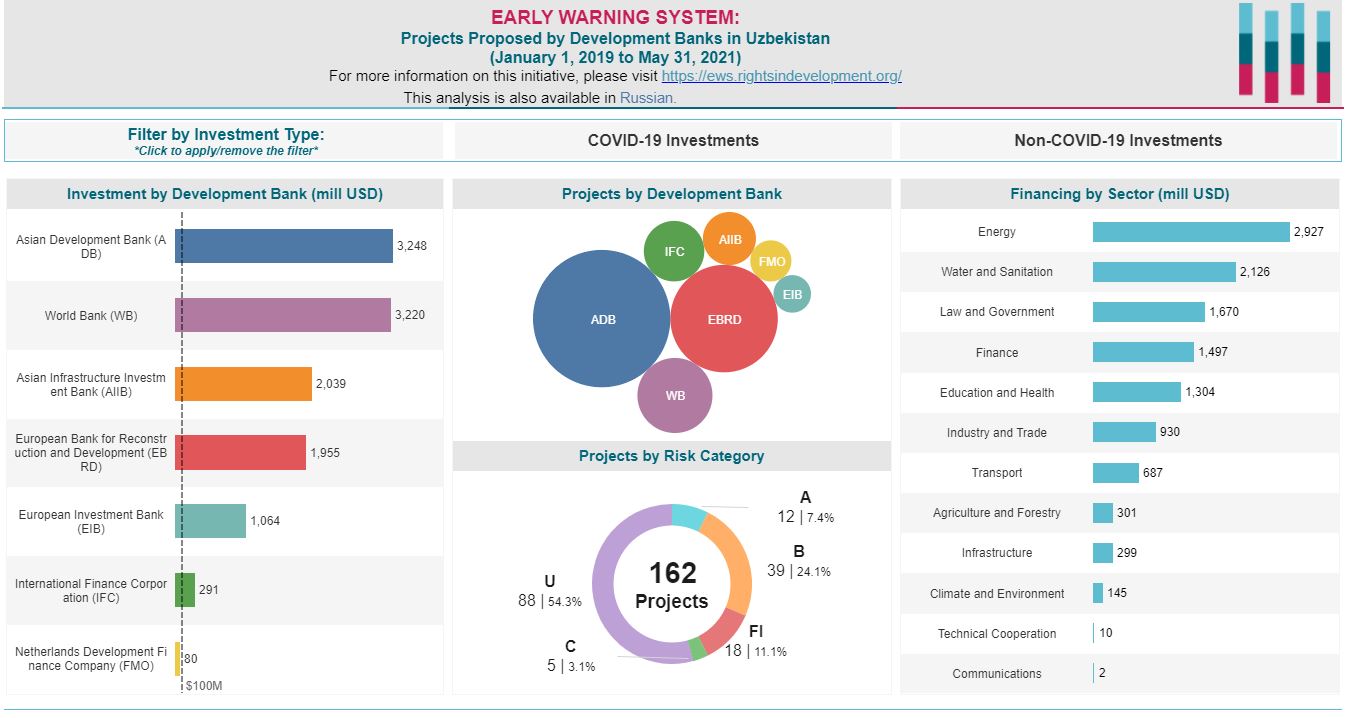
Over the last decade, the Asian Development Bank has invested $3.6 billion in Uzbekistan’s energy sector, mainly for the development of gas infrastructure. This is not compatible with the ADB’s vision of a greener planet, or Uzbekistan’s pledge to become carbon neutral by 2050.

An ADB evaluation of its lending between 2009 and 2019 found that Uzbekistan was its second-largest borrower in the energy sector. This week, from May 3-5, the ADB’s Board of Governors will meet to discuss ways to ensure a resilient and green recovery from the pandemic. If they are sincere, they must help Uzbekistan ditch fossil fuels and tap into its tremendous renewable potential.

Fossil fuels remain the primary source of energy production in Uzbekistan, with natural gas accounting for 85 percent of the total. The national targets for renewable energy development, set in the government’s green transition strategy document, remain relatively modest at just 25 percent of electricity generation by 2030.

But if Uzbekistan is to have any chance of reaching its commitment under the 2015 Paris Agreement to be carbon neutral by 2050, then no more fossil-fuel infrastructure can be built. Recent estimates suggest that gas combustion saves only 30 percent of the greenhouse emissions compared to burning coal, the dirtiest of fossil fuels. So the idea that fossil gas is somehow compatible with the legally binding international treaty is false. Given the significant economic lifespan of gas infrastructure – 30 to 50 years – such projects are clearly incompatible with Paris.


Moreover, Uzbekistan expects to be particularly affected by climate breakdown. In the government’s proposal outlining how it will reach its Paris commitments, Tashkent warns of average air temperature increases in Uzbekistan two times higher than current rates of global warming.

Without additional resource-savings measures by every country, Uzbekistan may face a lack of water, more desertification and land degradation, and increasingly frequent droughts leading to the instability of agricultural production, thus threatening the country’s food security.

The way forward is clear: Development banks must support Uzbekistan’s drive towards carbon neutrality. This year the European Bank for Reconstruction and Development, another multilateral lender active in the country, concluded that if Uzbekistan is to reach carbon neutrality by 2050, it must halt the construction of new fossil gas plants and intensively develop renewable sources of energy.

Yet ADB investments in renewables, particularly solar power, remain low. Renewables account for just 12 percent of the bank’s total energy portfolio in Uzbekistan, at $400 million, despite the overall potential for renewables at an astonishing 4,000 gigawatts. Instead, according to our estimates, the bank has spent over $1.4 billion on new generation facilities in the past decade: five combined-cycle gas turbines with a total capacity of 2,210 megawatts.

The ADB is currently revising its energy policy and has declared its intention to align with the goals set in Paris. Such an approach is welcome. In Uzbekistan, this would mean halting investments in fossil gas and instead prioritizing sustainable decarbonization and energy savings.

Such an approach is the only realistic way for Uzbekistan to achieve carbon neutrality and for the world to chart a path toward Paris.

Read the full briefing “ADB energy investments in Uzbekistan: where to go?”.

The article was updated due to discovered miscalculations.

« Previous Page
Next Page »

Footer

CEE Bankwatch Network gratefully acknowledges EU funding support.

The content of this website is the sole responsibility of CEE Bankwatch Network and can under no circumstances be regarded as reflecting the position of the European Union.

Unless otherwise noted, the content on this website is licensed under a Creative Commons BY-SA 4.0 License

Your personal data collected on the website is governed by the present Privacy Policy.

Get in touch with us

  • Bluesky
  • Email
  • Facebook
  • Instagram
  • LinkedIn
  • RSS
  • YouTube